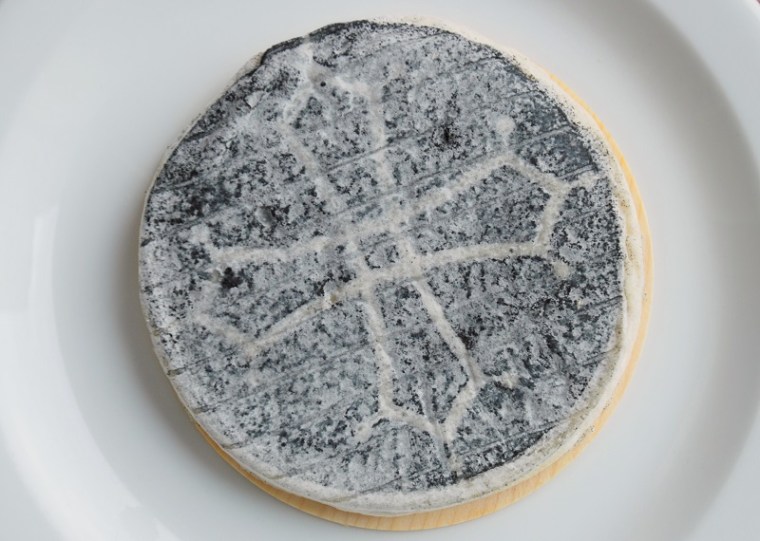
I am cheating again for this week, because this goat cheese is one that I had a while ago after my visit to La Cloche à Fromage in Strasbourg. I think it is a perfect choice for cheating a bit because this is one very fine goat cheese. It comes from southern France, and the cross on the cheese makes that clear: it is the Occitan Cross used by local rulers in Provence and Languedoc back in the days when France wasn’t as large as it is today, and the people in the south spoke Occitan (the langue d’Oc), a language still alive in a large part of the country and south of the border in Catalonia. The cross is white on a background of ash, which is used on many goat cheeses in France. The alkaline ash lowers the surface acidity of the cheese, and that in turn allows the molds that form a rind to develop better.
White Goodness
Inside, the Croix Catal is a beautiful white, and mine was ripe enough for the paste to ooze a bit, with flavor fully developed. As goat cheeses go, this was one of the best I have ever had. It had everything that makes a goat cheese a goat cheese, but is was unusually creamy, very fresh and clean – just délicieux. It is made on a farm with a little over 200 goats in Rudelle, a tiny little town of less than 200 souls with a remarkable fortified church with crenelated walls. Rudelle is in the French département Lot, named after the river that flows through it.
Ha! A cheese I had never heard of and bam! it makes my top five of the year. Yes, it was really that good. What a joy to behold, what a surprise to bite into! The Tomme de Jura is a semi-hard cheese that is produced and mostly eaten locally. It has a grey-white mottled rind, a perfect yellow color and small, irregular holes. It’s a bit sticky, tastes fresh but with a lot of character for a relatively young cheese (ripened 2-4 months), and it’s almost sweet as milk. It is apparently largely a local cheese – most of it is eaten here. I guess just like some of the white Jura wines they do not produce a whole lot, and the local yokels are happy to keep most of it to themselves.
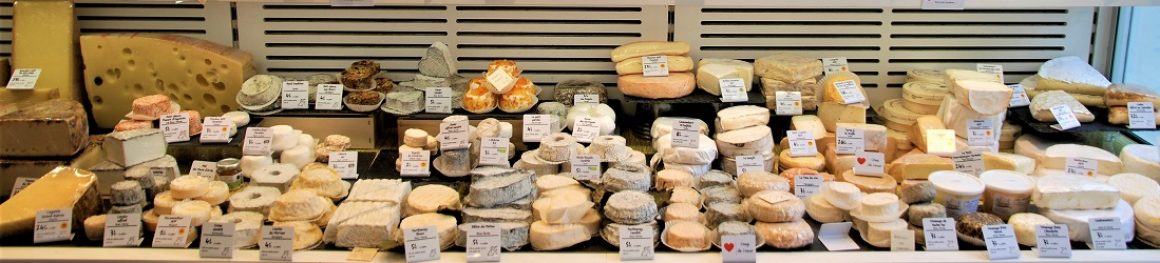
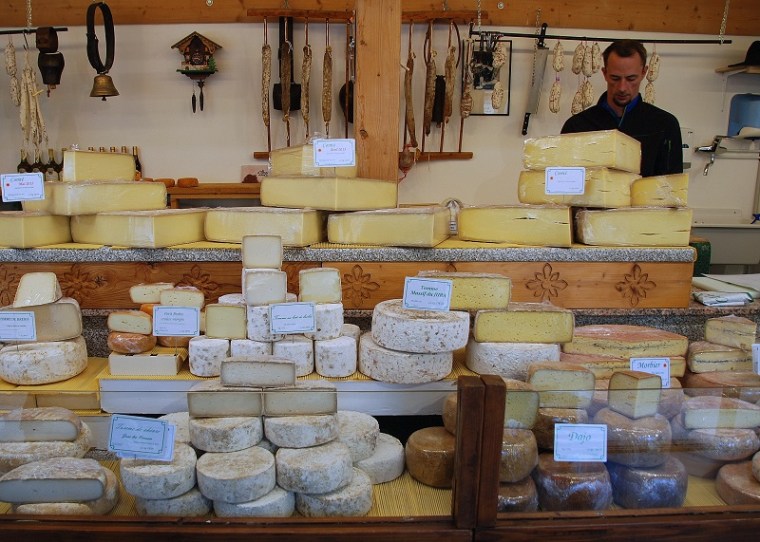
Best-looking cheese shop ever: Jose les Rousses
The Tomme de Jura came from the excellent little cheese shop in Les Rousses where I purchased cheese for weeks to come – there will be more praise for the place in the weeks to come. And strangely, here too it is not so easy to find much information about the cheese or the purveyor. José les Rousses, père et fils, have been in the business of cheese mongering since 1976, and in Les Rousses, they compete with the gargantuan Fortress that has been transformed in one of the world’s largest cheese ripening facilities and a fromagerie that caters largely to tourists attracted to the town because of the fort, and they do so quietly. There is nothing flashy about the fromagerie of José les Rousses. I stood in line waiting for my turn with locals, who all seemed to know exactly what they wanted. There was a cheese I have never heard of before (and that doesn’t exist on the World Wide Web) named Dajo, and a host of other local cheeses, one better looking than the other. And cow bells, of course, and assorted sausages.
Yup, that’s what it says: Jesus sausage…
I brought a local smoked sausage with the startling name Jésus de Morteau that was a big hit a week after our visit to the mountains along with the mountain of cheese: every single one of them deserved to come down the mountain with us, but after a good 2 kilos I came to my senses and realized that not everyone in the family was going to applaud the idea of having cheese for breakfast, lunch and dinner for the next few weeks. There was no information about the actual farms the cheeses that were sold came from. Elsewhere, that may not have been a good sign, but in the way the cheeses were labeled, packaged and displayed, it was clear that père et fils did not mess around. When he handed me my shopping bag o’ cheese, I looked in the eyes of a man who knows life is too short for crappy cheese.
Ready for its close-up: Tomme de Jura’s many holes
So the people at Bleating heart have good distribution in the Southland. I found a piece of their Foursquare at the Wheelhouse in Culver City; a chunk of Buffalo Blue in Claremont at the Cheese Cave and at a Whole Foods in Sherman Oaks they sold this Fat Bottom Girl. It is a sheep’s milk cheese with a dark ivory paste and a very nice textured rind, that is created by hand-rubbing with salt water during the aging process. Apparently the cheese accidentally ended up with a rotund shape which inspired the link to the Queen song Fat Bottomed Girls from their 1978 Jazz album. There were some cheeses taken out of their forms and then left unattended, which caused them to sag a bit under their own weight, creating the shape that linked it to the female anatomy. After some careful testing the cheese maker was able to develop just the right process to recreate the initial accidental fat bottom in the cheeses with standardized precision.The piece I got, alas, was too small to allow me to recognize it as such. Shame on Whole Foods for depriving its customers of the experience by chopping up the cheese in small little bits! The sleeve liner of that infamous Queen album had a picture of dozens of naked women on bicycles, among them one with her bottom (which wasn’t fat at all) turned towards the camera. I was at an age where boys have no sense of humor about naked women on bicycles yet – it took that image very seriously and it occupied a prime spot in my feverish imagination for quite a while.
The cheese on the other hand is pleasant and, as the Bleating Heart people put it, approachable. It lacks the edge a lot of sheep cheeses have. In fact, if you’re a die-hard sheep cheese kind of a person, you may find the Fat Bottom Girl wanting a bit. But chances are, you’ll still find enough to your liking in this one, the flagship cheese of the Bleating Heart enterprise. It is available on a limited basis, because sheep produce milk for only 6-7 months or so, and the cheese ripens for 3 to 4. So the cheese making season runs from March to September and if the cheese sells well, none may be had between December and about late May or so. You can listen to Queen twelve months of the year, if that is any consolation – but I would not recommend that.
So here is my report on two cheeses I got just across the border, in the German town of Lörrach. They have the German version of Whole Foods there, only better. Better especially in the cheese department, because their counter makes any cheese lover’s eyes water with emotion – it is about twice the size of most cheese shops in LA – the quality is on a par and the variety is vastly superior, in particular of course because the Germans are not afraid of the bacteria in a nice bloomy rind Camembert. After we hastily tucked into a Camembert the other week that wasn’t quite ripe yet, we got one at our new favorite store, practiced patience and were amply rewarded with a cheese that we finished in a few quick sessions. Good Camembert is to be cut up in big old chucks, not dainty little slices.
But back to the store. It is called Hieber and it is a small chain in the extreme southwest of Germany, an area of small cities, diverse industry, vineyards and excellent infrastructure – basically an area with long traditions and a very high quality of living. Levi Strauss, the man that gave us the blue jeans, came from here.
In the German Corner: 6-month-old Besler
I asked for a raw milk cheese from Austria and one from Germany, as I noticed that both countries were well-represented in the store’s selection. The Rubachtaler is from the Far West of Austria, and the Besler Bergkäse from the Far South of Bavaria. And lo and behold, they come from creameries (a creamery is a Sennerei in local parlance) that are less than an hour apart. The Bessler family runs a creamery along with a guest house where they serve an awful lot of their own cheese.
Squaring off: Besler (0n the left) vs. Rubachtaler Alt (12-15 months)
The Rubachtaler from Austria is a vexing cheese when you try to find out more about the peeps who create it. I have stumbled across the folks of the Dorfsennerei Sibratsgfäll, who make the Rubachtaler – it stands to reason that they also do the Rubachtaler Alt – ‘alt’ means nothing more than old. However, on their website, they do not say anything about the Rubachtaler. Perhaps it is a brand they do not market themselves – the info that they are making the cheese comes from an Austrian website about cheese producers, and me thinks they ought to know. Either way, let’s just leave this for what it is. Even Philip Marlowe would not have solved every case. The more important part of the whole affair – a dead giveaway at this point, really – is that to me, this match-up between Austria and Germany was won by the former. The Besler is a little like an Emmentaler, not quite as pronounced, and certainly a cheese I would buy again. But I am more of a salty type of a guy – I like the older cheeses, and the Rubachtaler is a bit like a Gruyere. Both have a beautiful straw-yellow color (both are made of milk from cows that eat either grass from alpine meadows or hay from those very same meadows, little or no silage), and both are made of raw milk. But only the Rubachtaler has the crunch of protein crystals and that thick buttery creaminess of a ripened mountain cheese. You may cry foul and insist that I cannot compare a 12-15 month old with a 6 month old, but the last time Austria bested Germany in soccer was back in 1986 – so even if this match was a little rigged with the Austrian cheese being the more mature one – cut those Austrians some slack, OK? They do not have it easy.
Next week: after our trip to the French-Swiss borderlands, we have been eating copious amounts of cheese from Franche-Comté. And most of those derserve their own post – besides, I bought so much of it, we’ll still be munching Comté in three weeks from now.
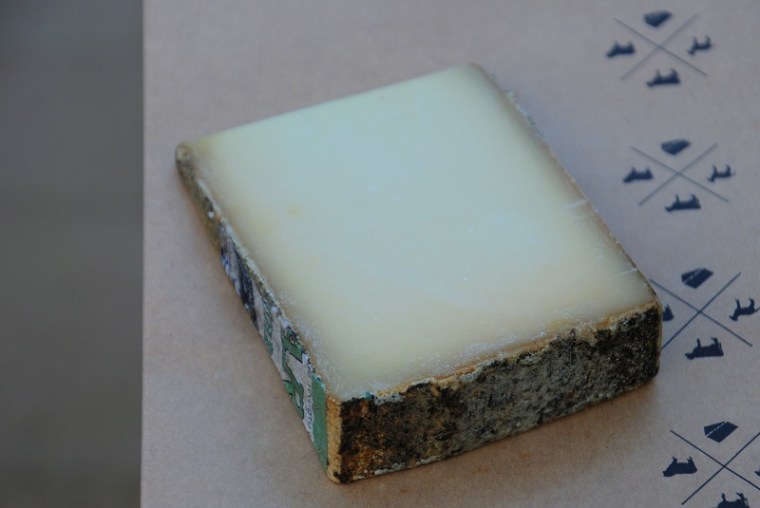
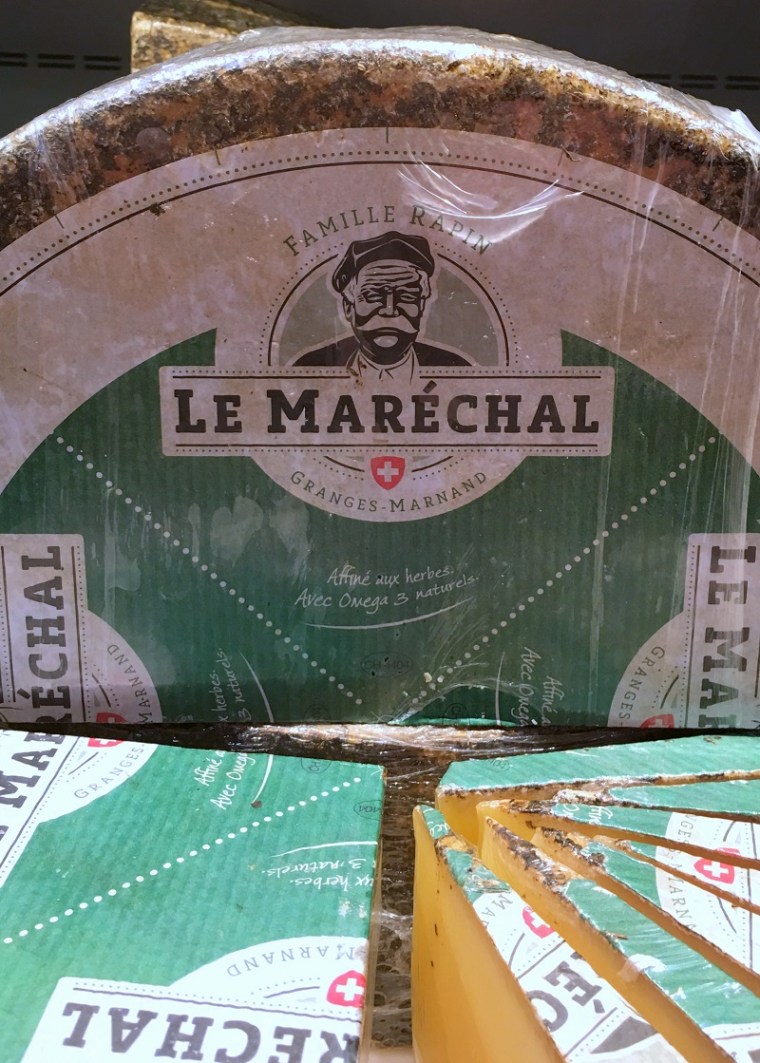
In the US, this cheese is sold only at Whole Foods as Emmi le Maréchal as the result of a marketing agreement between Swiss cheese giant Emmi, Whole Foods and Jean-Michel Rapin, the actual cheese maker, who named the Maréchal after his grandpa, a blacksmith. In French, a blacksmith is called a maréchal-ferrant, so there you have it. Grandpa’s picture is on the cheeses, although it is hard to tell at Whole foods, as they pre-cut their cheese in relatively narrow pieces. Imported cheeses are expensive, and a piece the size of grandpa’s picture may set you back a month’s rent. We had to take Jean-Michel’s word for it, initially. Rapin describes his cheese as reflective of his grandfather’s character: original and robust. I would agree. At first it looks and feels like any old Swiss mountain cheese, except for the dark rind, which comes from the herb coating, and that herb coating of course imparts that little extra during the 5+ months of aging that makes the Maréchal a standout. It is saltier, more herbal than similar cheeses, and it misses the sweetness of, say, a Gruyère. I read a review that speculates on the effect of flax seeds in the cows’ diet, giving the cheese that bit of an edge (it’s a little stinkier than a Gruyère, too).
Better in Switzerland? I think so….
I recently had some Maréchal Vielle Cuvée here in Allschwil (a town on the edge of Basel, Switzerland) and lo and behold (or rather lo and taste): the Maréchal in Switzerland is the better cheese. Not sure why (it may be that the VC version has ripened a bit longer – it is supposed to have at least 5 months under its belt), but it has a fuller, richer flavor and none of the saltiness that I think creates the edge in the US export version. It may have been because I was going through a Gruyère-phase when I had the Maréchal in the US, and preferred the sweetness of that cheese. But maybe, those sneaky Swisses just keep the best cheese for themselves. Oh, and this being the land of plenty, at least when it comes to cheese, they have big half-wheels sitting in the cheese counter, so there he was the other day: Grandpa.
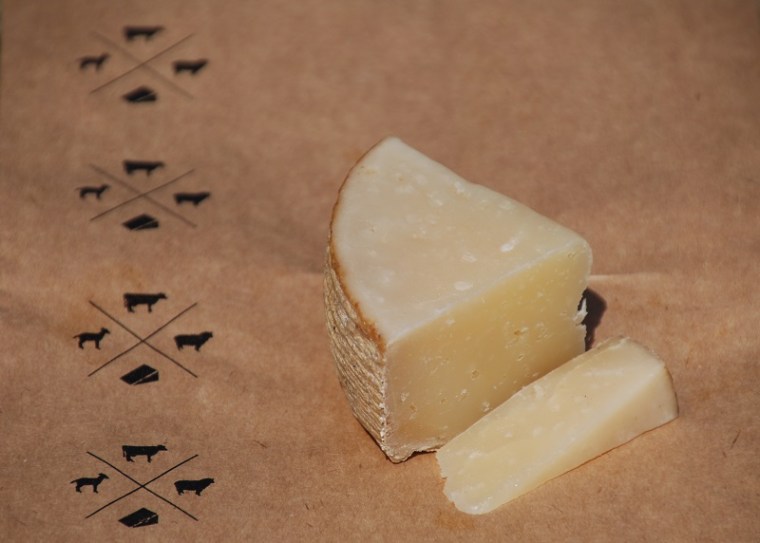
Ok, I am cheating here, because the Buffalo Blue is a cheese I bought in Claremont, about a month ago. But some weeks, there are just leftover pieces of cheese in my house, and at other times – it’s a party. I have written about the folks at Bleating Heart in this blog before so I will not repeat that here. You can find something on their Four Square cheese that I tried in week 9 of this year. That was a pretty unique cheese, because it is made with the milk of goats, sheep, cows and water buffalo, those of Mozzarella di Bufala Campana fame. Seana Doughty, the cheesemaker and founder of Bleating Heart, decided not to try to recreate her own Mozzarella and created a blue cheese instead. Given that buffalo milk has about double the amount of milkfat of normal cow’s milk, this makes for a very creamy blue.
There is a bit if sweetness in Buffalo Blue that balances the bite of the Penicillium, which makes it a very accessible cheese. That is absolutely not to say that this is not an interesting chees, au contraire: it is an adventure in blue, and one can only hope that the good folk at Bleating Heart will continue to defy convention and, as they say “making seriously good cheeses without taking ourselves too seriously”.
So let’s get to the second part of the title first. Terroir is a word sometimes used by the pretentious and the pretenders to talk about whatever expensive red or white they are swirling in their glass. Since it is foreign, it is supposed to help lend instant credibility to whatever comes before or after the use of the t-word. To the people who invented it (oui, les Français) it actually means something, and it is not only used for wine, although that is the field of food & drink appreciation where it is heard the most. Terroir, in a nutshell, ties a product to the land, to the climate, and to the traditions that impart a product its particular qualities. In cheese-speak, a Frenchman tastes the lush green pastures of Normandy, the houses that seems to grow out of the ground on which they stand, the lazy cows that chew and chew and the thick pillowy clouds full of rain when he tucks into a chunk of Pont l’évêque cheese. It is the concept that a food belongs somewhere, has a pedigree and a history that is not interchangeable. The cherished French AOCs (Appellation d’origine contrôlée), which have been replaced by the EU’s AOPs are related to the idea that you can’t uproot a product, transplant it to somewhere else and expect it to be the same. And what does all of this have to do with this week’s cheese?
Sable de Wissant is not a particularly old cheese with a long history going back to Charlemagne or Louis XIV. It goes back to Antoine Bernard and the 1990s, when this man, who raised goats for a living, decided to get into the cheese business. That did not seem an obvious choice because Antoine’s creamery is in the far northwest of France, an area many people in parts of the country more blessed with natural beauty and culture lovingly refer to as the sticks. Antoine first traveled around, learned on farms and monasteries and then set about creating cheese with a solid sense of terroir: the raw cow’s milk for the cheese comes from local farms and the beer used to wash the cheese and give it its unique yeasty flavor is brewed in Wissant, another small town in those very same sticks. And so here is a relatively newcomer to that fabled plethora of 246 French cheeses Charles de Gaulle talked about (“how can one govern a country that has 246 different cheeses), and it is all about local flavor, local products, and local labor of love – terroir, in essence. The cheese is semi-soft, smells like a nice white beer and has a creamy, soft but not runny texture and a full, rich flavor which combines yeast, barnyard and butter in just the right proportions. Well, done, les frères Bernard! And well done by the Cloche à Fromage in Strasbourg, on the opposite end of the country, for offering this delicious creaminess to the folks in Alsace.
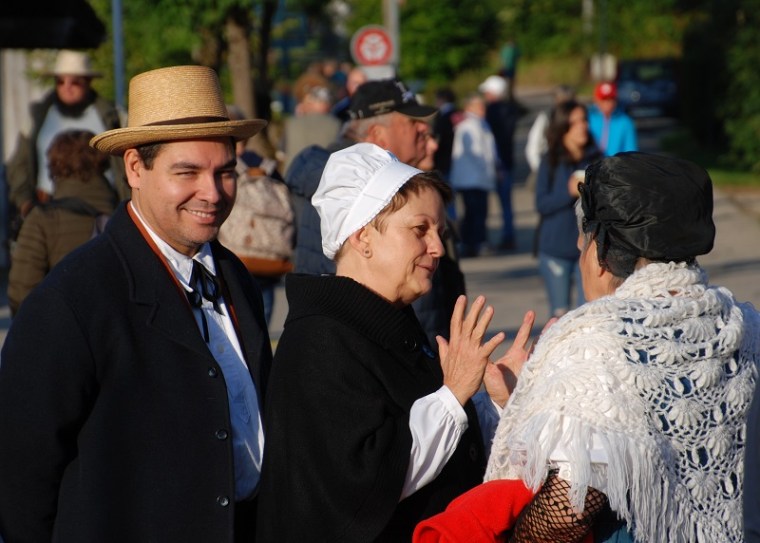
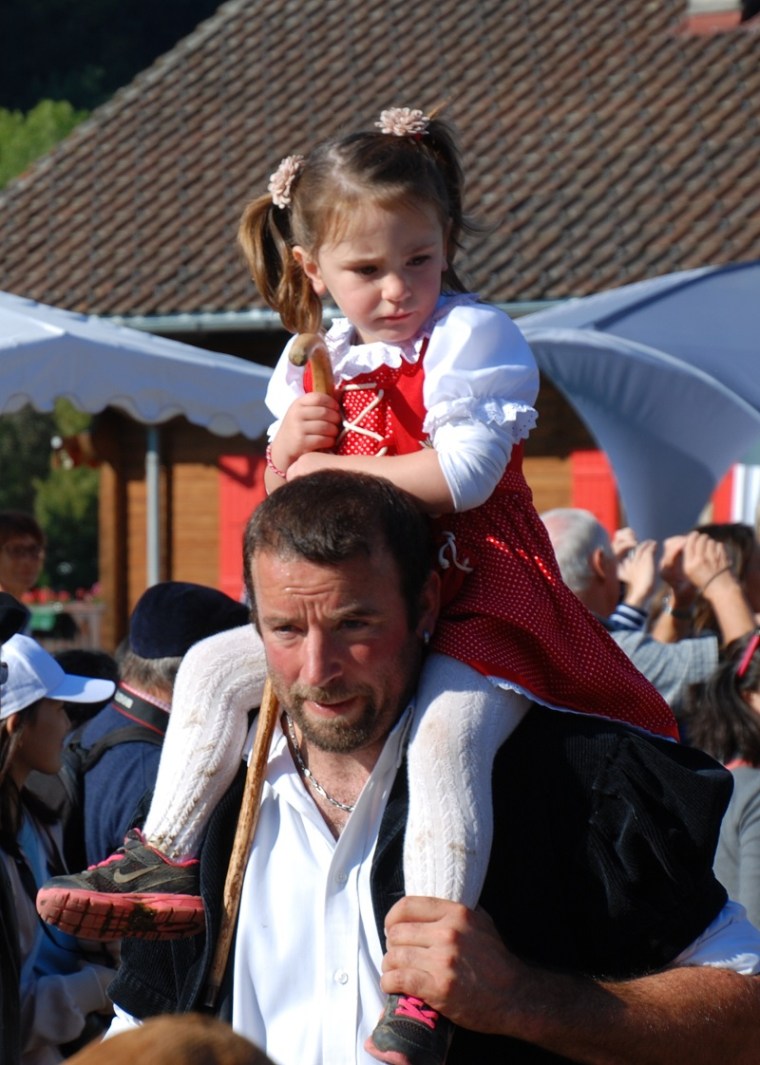
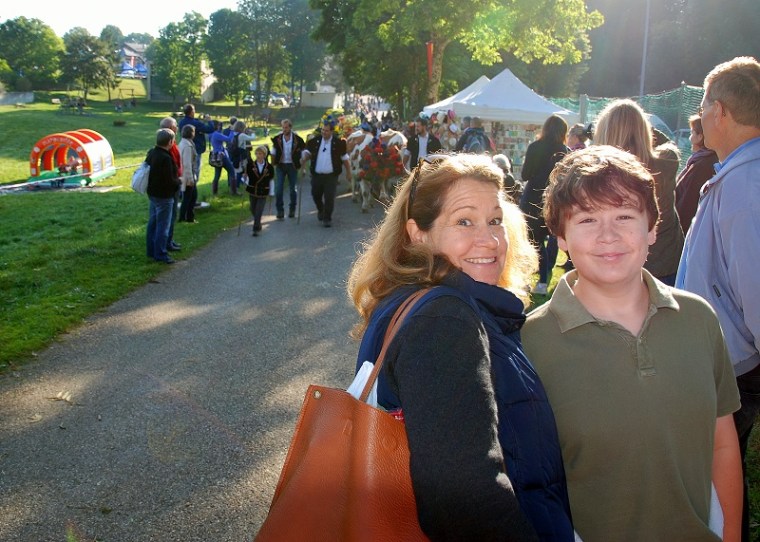
13 years after we first visited Saint-Cergue, there were now three of us. And all three of us gazed in awe at the magnificent beasts, the colorful traditions and – of course – the cheese….
a few more images –
Cheeky CowWaiting for the CowsVacherin Mont d’Or is in season again!Likes to toot his own hornHow now, brown Cow?
“What on earth” you could hear those Swiss mountain farmers think “are we going to do with all that friggin’ milk?” That’s when some smarty-pants came up with the idea of making cheese. A lot of milk goes into a single cheese, you can roll the wheels down the mountain (ok, they really don’t do that, but they could, if you ask me), and you can keep the cheese for months. Fast forward a lot more cows and of course, the question becomes “what on earth” – exactly: “are we going to do with all that friggin’ cheese?”
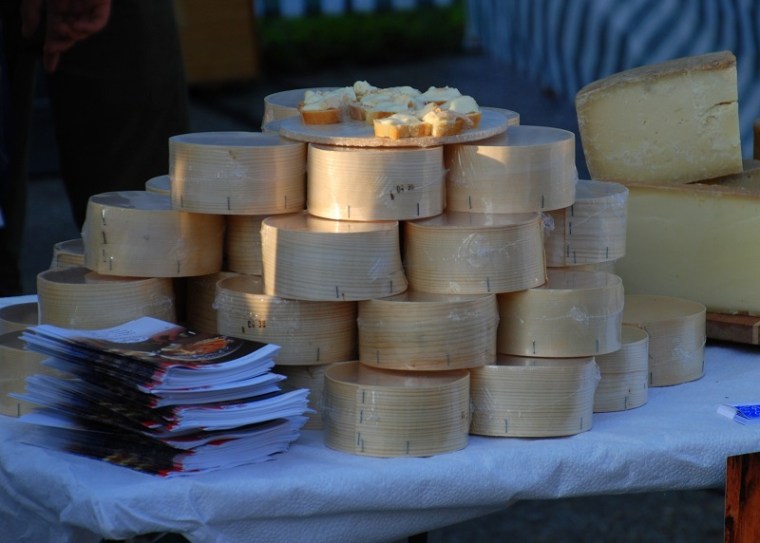
Cheese shop in Les Rousses, France
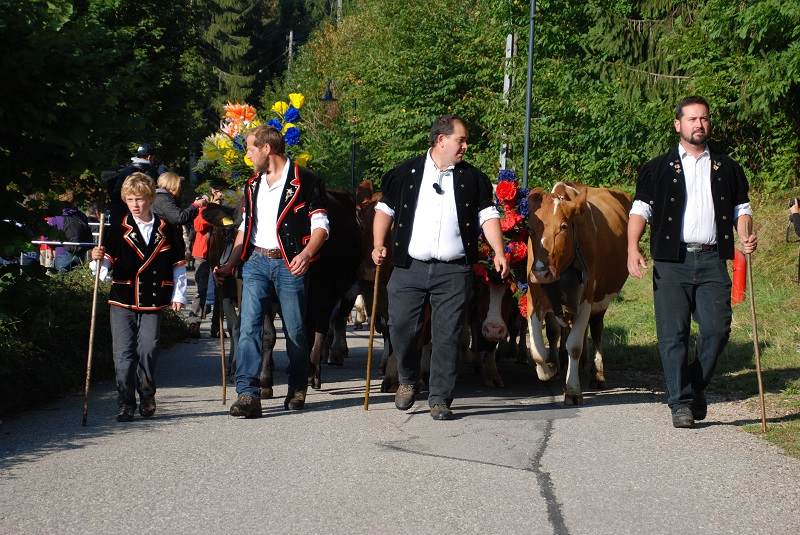
You eat it. your neighbors eat it, the people one town over eat it. And visitors eat it. A lot. and then you send it all over the world so everyone eats it. Problem solved and worldwide reputation established. We found ourselves in the epicenter of cheesiness this weekend, as we witnessed a spectacle where the-cows-that-make-the-milk-the-farmers-turn-into-the-cheese-that-gets-sold-around-the-globe are brought down from their summer pastures, where the mountain herbs on which the cows feast give the milk that je-ne-sais-quoi that makes the mountain cheese so yummy, to the winter pastures and stables where they wait until spring.
Flower PowerMore cows, more bellsDogs, too
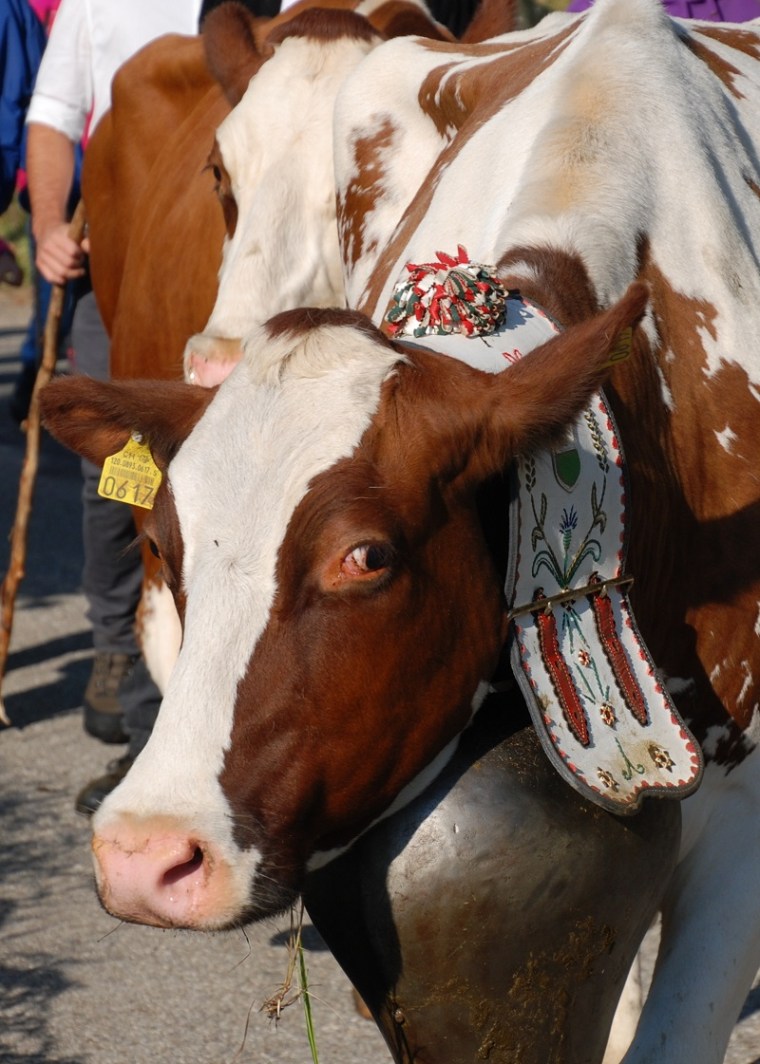
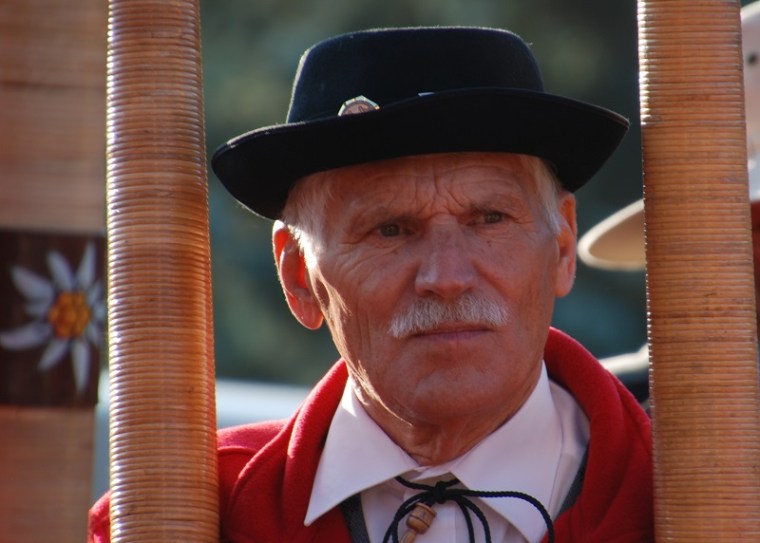
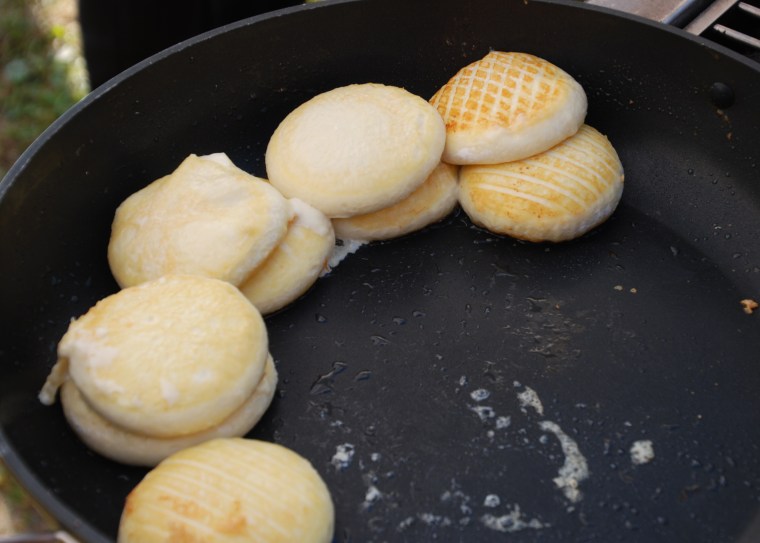
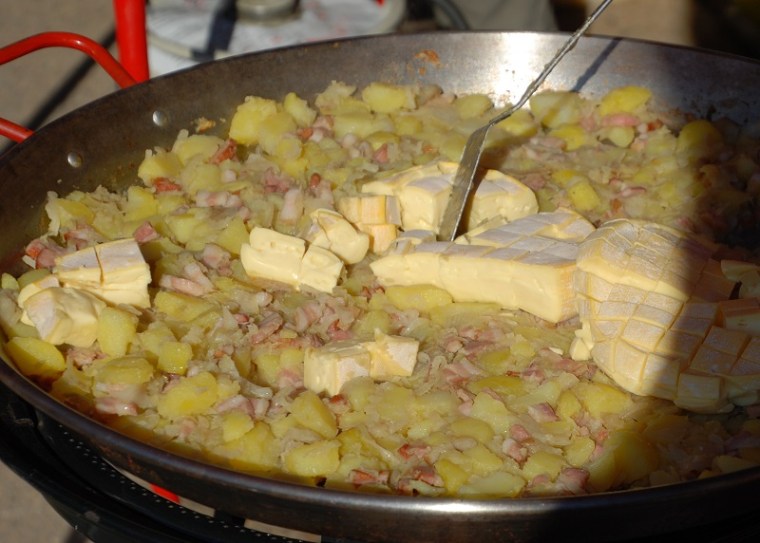
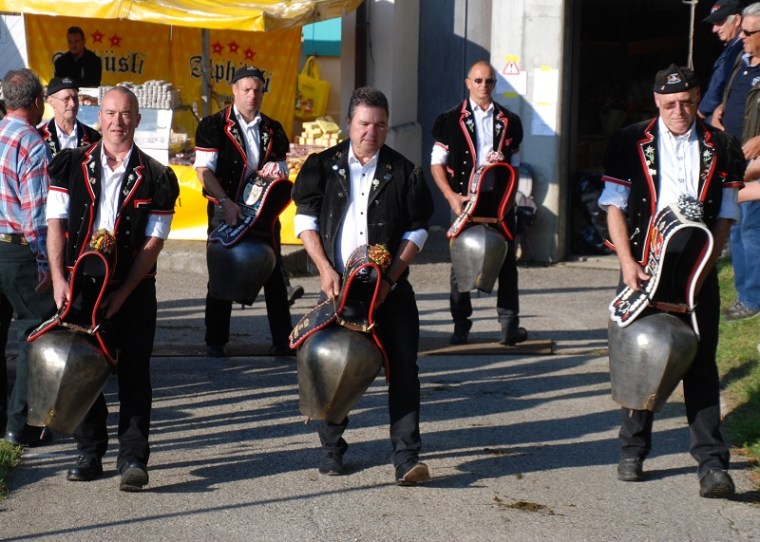
The town of Saint-Cergue has turned this chore into something people from the US, Sweden, Belgium, France, and Japan travel for thousands of miles to witness: cows with big old bells (Bruce Dickinson!) around their necks, some with flowery headdresses are poked and prodded down the mountains, do a few tours around the town, spray the pavement with poop and disappear, all this to the delight of the visitors, who feast on Tomme Vaudoise grillée and on Tartiflette, a stew of onions, bacon, potatoes and Reblochon, and thus help to take care of some cheese for which the locals now no longer need worry about transportation costs.
Tomme Vaudoise – grilled, which adds heavenly scentsTartiflette is almost ready, another 10 minutes or so
Why, you say, is this area an epi-cheese-center? Because it is frontier country. We overnighted in a hotel that straddles the border between Switzerland and France. And both countries face the above-mentioned ‘what to do with’ dilemma. So they are fiercely competitive. On the Swiss side, the Tomme Vaudoise is the innocent-looking vanguard of the Gruyere and Emmentaler forces a little further inland. The Vacherin Mont d’Or has been claimed as a Swiss cheese, but the French will never recognize it as such. On the French side, there are the formidable stacks of Comté wheels, fittingly being aged in a old fortress in Les Rousses, the Morbier, and the Bleus – those of Gex and of the Haut Jura. for the cheese lovers, this pitched battle makes the border region a Cheese Wonderland. Ah, I had to restrain myself – 0vercome with emotion while looking at the cows, I could have kissed any of those dewy-eyed pretty ladies. Instead, I whispered a quiet “Thank you” in each ear.
Waiting for the cows to come homeSwiss MissCowbell, anyone?JodelnThirteen years later…
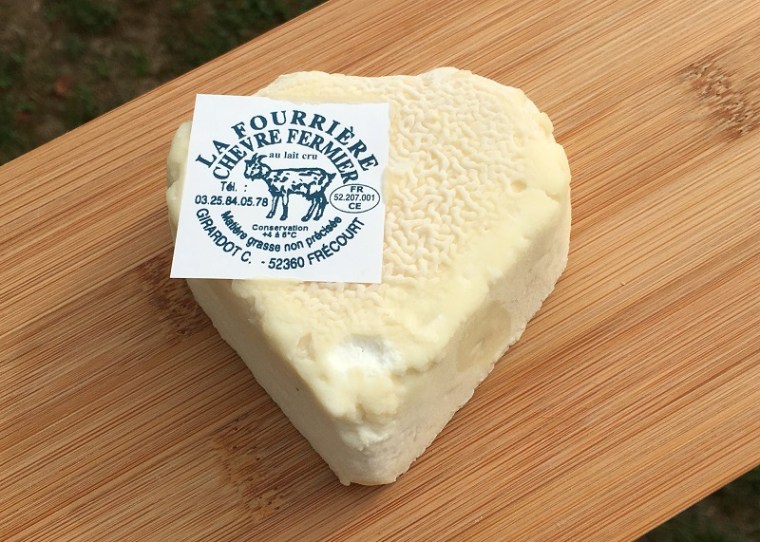
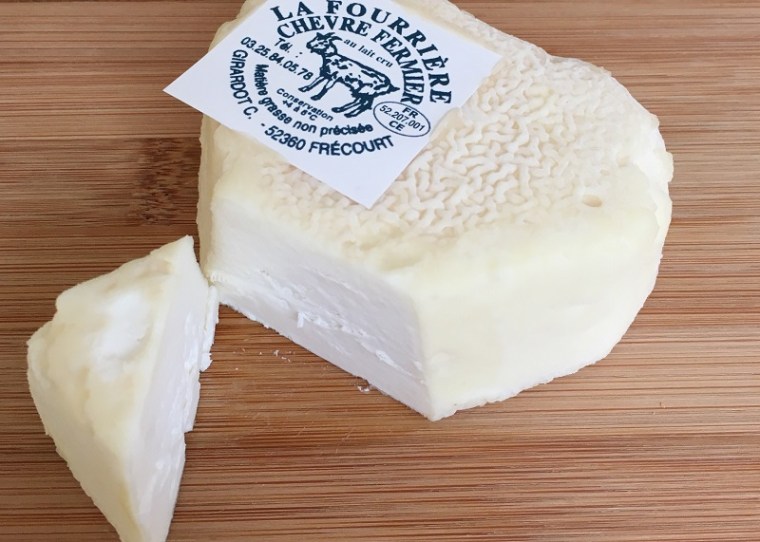
I know I promised to have an Austrian-German cheese cage match, but that will have to wait until next week. In the meantime, I did find a delightful little goat cheese from La Fourrière – I assume the word means something like ‘pen’, as in an enclosure for animals, because the word translates as pound – as in dog pound or impound lot. I am sure Mme. Girardot doesn’t have anything to do with impounding cars. Her goats produce a nice little cheese that isn’t particularly goaty; it does have that typical flavor, but it is not very pronounced and since it is sold after a bit of ageing, the cheese has a bit of saltiness I really like. All in all a very pleasant cheese, so I hope Mme. Girardot will find a successor – I can’t tell how recent the posts on her page is, but she is trying to sell the farm, a bit east of the town of Langres, itself known for an eponymous cheese. She wants to retire, and it would be sad if those heart shaped cheeses would just disappear after 21 years. Anyone out there stuck in a dead-end job?







 Cheese: Buffalo Blue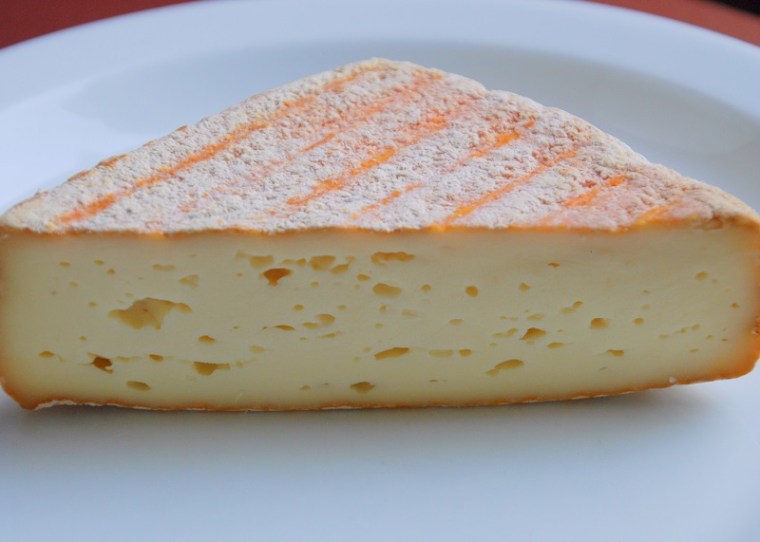







 52 Cheeses