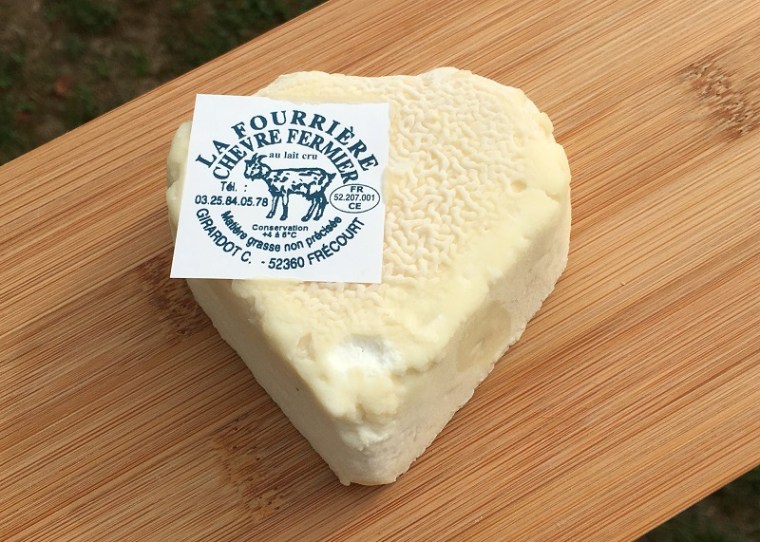
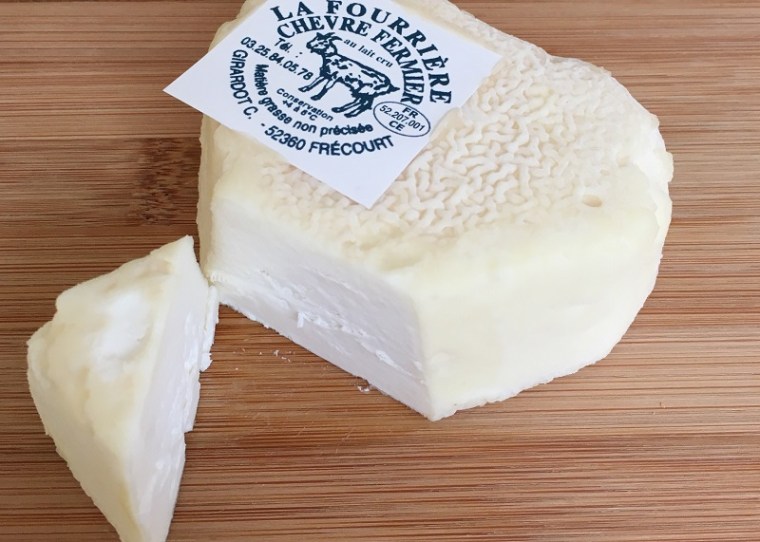
I know I promised to have an Austrian-German cheese cage match, but that will have to wait until next week. In the meantime, I did find a delightful little goat cheese from La Fourrière – I assume the word means something like ‘pen’, as in an enclosure for animals, because the word translates as pound – as in dog pound or impound lot. I am sure Mme. Girardot doesn’t have anything to do with impounding cars. Her goats produce a nice little cheese that isn’t particularly goaty; it does have that typical flavor, but it is not very pronounced and since it is sold after a bit of ageing, the cheese has a bit of saltiness I really like. All in all a very pleasant cheese, so I hope Mme. Girardot will find a successor – I can’t tell how recent the posts on her page is, but she is trying to sell the farm, a bit east of the town of Langres, itself known for an eponymous cheese. She wants to retire, and it would be sad if those heart shaped cheeses would just disappear after 21 years. Anyone out there stuck in a dead-end job?
Brothers Simon and Tim Jones of Lincolnshire Poacher Cheese are certifiable cheese nuts whose web pages are brimming with enthusiasm and idealism. They run their place on wind and solar, heat their milk with straw pellets and even pump heat out of the ground. And we’re not even talking about the cows yet. Their 230 Holstein Frisians munch on food that is largely grown on the farm, a family operation since 1917 (they also have a few Ayrshire cows – that’s a Scottish breed, but they blend right in because they look like red Holsteins, pretty much). As the Joneses do not use pesti- and other cides, the cows live among happy healthy bugs and critters of all kinds. Their farm sits 7 miles or so away from the North Sea near the town of Alford, which has a windmill with five sails as its claim to fame. A very disturbing sight for a Dutchman. Anyone who knows something about windmills understands that more than four sails is just wrong, and in England apparently that are some mills that even have six sails. One needn’t wonder why the Empire couldn’t last.
The piece of Lincolnshire Poacher I had was relatively young, had a fresh clean taste and a beautiful yellow color. I liked it a lot, but I will be looking out for their more mature cheese, because I believe that there is more flavor and goodness to be had with age. Some of it is aged over 3 years. You can listen to Simon Jones explain this and more on a beautiful little video; their website is also a treasure trove of information, photos of happy cows and of the assistant cheesemaker who apparently likes to play the trombone when he is not up to his elbows in curds.
The Lincolnshire Poacher is originally a traditional song that has been adopted as an anthem of sorts of Lincolnshire county. It is used as the official march of several military units. Benjamin Britten even arranged a version, but that one is for the dogs. Chris Sarjeant plays the tune in this video. It has crappy sound quality, but the crowd sings along and he picks a mean guitar.
When I was bound apprentice in famous Lincolnshire, Full well I serv’d my master, for more than seven year, Till I took up to poaching, as you shall quickly hear. Oh, ’tis my delight on a shining night, in the season of the year.
Phew! After moving to Switzerland, traveling back to the US to get my travel documents sorted, picking up the final dog to complete our household and a host of other things, I am finally caught up. This is why there will be a small avalanche of posts: weeks 33 through 37 will pour like lava from an erupting volcano (or like fondue from a toppled pan) onto these blog pages today and the only thing left to do for the week is to talk about my new cheese of the week which will come from Austria or Germany. That’s right, I am doing another one of those cheese cage matches, where two cheeses fight to the death for that prized title of Cheese of the Week.
In the meantime, I still have a lot of catch-up posts that will be released on a regular basis, one after another, until all of the Cheeses of the Week have been accounted for. The above picture is one I would like to dedicate to my family. While the biggest burden of the 52 cheeses project falls on my shoulder, they too pitch in where they can to lighten my load as I eat my way to the finish line, only 14 more cheeses away.
Look forward in this place and on Our Swiss Life for dueling accounts of this weekend’s adventure: the Désalpe in St. Cergue, Vaud, Switzerland, an all-cow extravaganza that features more cowbell than even Bruce Dickinson would care for, alpenmacaroni in ridiculously large pans and all manner of other things we look forward to, based on our first cow encounter of the third kind, a lifetime ago.
In Salamanca I bought a well-ripened Torta del Casar, a sheep’s milk cheese named after the town of Casar de Cáceres where this cheese originated, in the Extremadura, a region in Western Spain. There are a lot of producers in the area, mine was from the creamery of the brothers Pajuelo (Santiago is the brother who is still alive, Ignacio has passed away). They brand their torta Manjar Extremeño. Which probably translates as ‘delicacy from the Extremadura’ or something like that. Cáceres has UNESCO World Heritage status and the cheese befits its origin, because it is monumental. Like some other cheeses on the Iberian Peninsula, cardoon thistle pistils are used in curdling the milk, and this process leaves a faint bitterness in the cheese, that only adds to the complex flavors in this bad boy. It has a distinct smell and an equally distinct taste.
Ready, set, spoon!
It is a big fat mouthful, especially when eaten as intended: put the torta on the table, slice of its top (the rind is quite hard as does not get eaten) and start spooning. The milk for the torta comes from Merino and Entrefina sheep and because both are not prodigious producers, it takes the milk of a small herd of sheep to make a single cheese. In turn, that makes Torta del Casar one of the most expensive cheeses in Spain. Cured for a minimum of two months, it is worth getting a cheese that is a little older to get the full benefit of the full-flavored runniness that makes this such an excellent experience. In 1999 the Torta received its DPO protection. There are at least another 3 tortas in Spain (Torta de Barros, Torta del Canarejal, and Torta la Serena) that are eaten in a similar fashion and have similar flavors. Collect them all! This one was eaten with colleagues as the sun was setting over the Douro Valley in Portugal, together with some other splendid cheeses from Salamanca, a dinner where cheese was the main course.
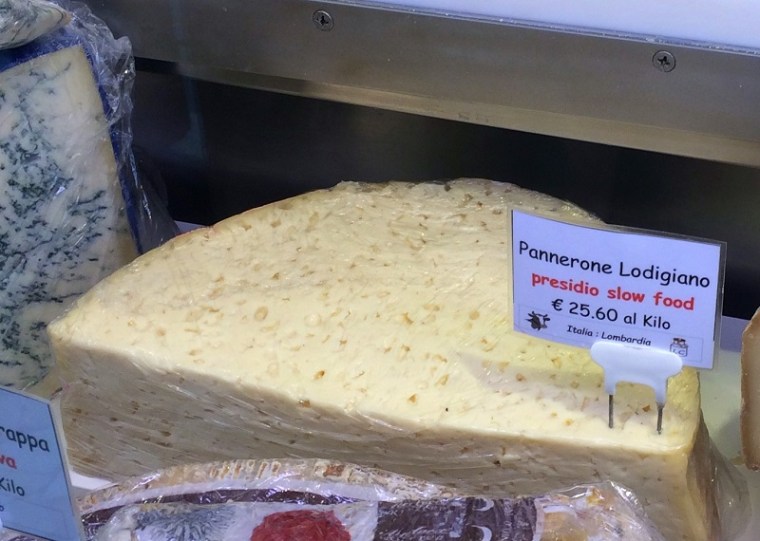
Just about 20 miles from Milan is a small town called Caselle Lurani and in that town is an easy to miss creamery that turns out this cheese, among others, that is actually on an endangered species list of sorts. Pannerone, a cheese made from afternoon cow’s milk (2% more milkfat, apparently, than the morning take) has a few things that make it unique, and give it an acquired taste which may be why it is not nearly as widespread as it once was. In fact, the creamery run by the Carena family is the only producer left. Pannerone’s (comes from panéra, which means cream) unique qualities come from an unusual production process; the whey is allowed to run off naturally, there is no pressing involved at all and that makes for a soft cheese. Then, it sits for four or five days at 28-32 degrees until all the whey has drained. No salt is added to the cheese, so the bacteria that are at work here are solely responsible for the flavor. The cheeses look impressive in the cheese counter, which is how I happened upon it: a cylinder is about 8 inches high and a foot in diameter. It has lots of little holes and a nice pale ivory color.
My next challenge was to get a piece, after I identified what I wanted. That went through the point-and-use-exaggerated-facial-expressions method, because even if Venice is inundated with visitors from abroad, a lot of merchants do not speak anything but Italian, and my Italian is non-existent. It was clear what the message directly aimed at me was to convey: ‘no, this is not what you want.’
‘But it most certainly is!’ said my English words and my facial expressions and my body language. The gentleman I spoke to decided to bring in the big guns, the owner of the shop, who reiterated: ‘bee-ter!’. I was certainly not going to like it. After this final attempt to dissuade me, I just had to have it, and the experience of finally sinking my teeth into it was rewarding: not that it would make it to the top of my list, but my buying the cheese over some local objection and then reading up on it made the tasting feel like the end of a journey.
A cheese of many holes
It is creamy and a bit sweetish at first, but it does develop an unusual, mildly bitter flavor in the mouth soon afterwards. It could do with some fruit, to counterbalance the bitter taste, and that is a popular combination in many recommendations. Pannerone has a D.O.P designation and the Slow Food organization recognize it’s uniqueness as well – they are in fact the people talking about it as if it is an endangered species worthy of preservation. Things look good though, at the Carena Creamery: the descendants of Angelo Carena who passed on to that great dairy in the sky two years ago seem to have fun doing what they are doing, judging by the images on their website, adn a determination to carry on the good work, all the way down to the youngest members of the family. Great-grandpa would be proud!
Yes, indeed, there is a connection between the cheese and the von Trapp’s of Sound of Music fame. The great-grandfather of the two cheesemakers, brothers Sebastian and Dan von Trapp was that famous von Trapp, played by Christopher Plummer in the wildly successful movie that took enough liberties with the actual family’s story to leave several von Trapps somewhat irritated with it. At any rate, the cheese makers, above claiming cheap and easy fame instead present themselves as the third generation of dairy farmers from Vermont. Grandfather Werner bought the farm with wife Erika in 1959, and here is where the name of this cheese comes in. ‘Oma’ is the informal address for one’s grandmother in German – in English the cheese would have to be named Grandma. The milk for Oma comes from a herd that is largely made up of Jersey cows, with some other races mixed in. the Farm’s website features some of these happy girls
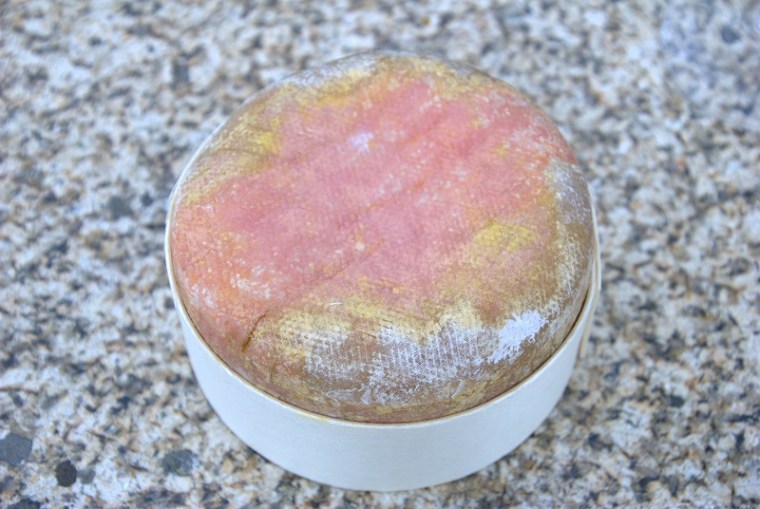
The semi-soft cheese comes as a small wheel, about 6 inches in diameter. It is aged and washed in brine at the Cellars at Jasper Hill, the affineur that also ripens the Landaff cheese of Week 7 fame. After 60-90 days, the cheese has developed a pale orange rind, a decent smell and a very balanced flavor. As washed-rind cheeses go, Oma is relatively mild and creamy, while full-flavored – perfect if you want a little adventure without completely stinking up your refrigerator. And: it’s made of raw milk, which means the flavor is brought to you in cooperation with the natural bacteria in the milk, not just those added in the cheese making process. Therefore: more flavor, more goodness.
Cheese Counter at DTLA Cheese
I found my piece of Oma at the DTLA Cheese shop in Downtown L.A.’s Grand Central Market, where they do more than just sell cheese. They also serve a mean mac and cheese and their grilled cheese sandwiches are guaranteed to leave you with strands of melted cheese dangling from your chin. They are so good, you will not care. DTLA is the second venture of cheese sisters Lydia and Marnie Clarke, their first being the Cheese Cave in Claremont.
This week I got a gift. A gift of cheese. A colleague who knew about my 52 Cheeses quest brought me something that came with a story. There are few things that connect people to their heritage the way food does, and all of us are familiar with the melancholy sighs bemoaning the absence of some real fill-in-the-blank. In the 1980, when I worked a lot with German tourists in the US, it never took more than about 8 or 9 days before my guests began to lament the quality of American bread, compared to what they like to call black bread. This was well before Whole Foods and in most of the country, burger buns, dinner and breakfast rolls and wonderbread were holding down the bread-fort.
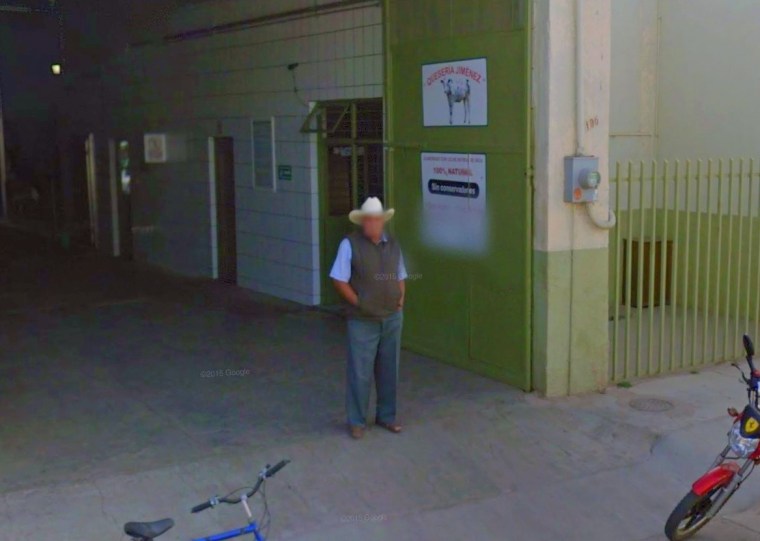
My friend’s family members rejoice and think of a place far away in the old country every time they bite into the pleasant graininess of a soft white Mexican cheese they just call Queso Fresco. She brought me a piece, neatly packaged in a plastic bag to keep the whey from dripping all over my desk. The cheese, she announced, comes from Quesería Jiménez, an unassuming facility that could pass for any other industrial building safe for the cow picture on the door. I was unable to find anything but the streetview google image.
Queseria Jimenez
The quesería is in La Capilla de Guadalupe, and apparently, this modest town is home to the best looking women of Mexico. I am not googling that because lord knows what will come up in such a search. Capilla’s cheese is certainly worth the trouble and the risk – I am pretty sure that bringing it in to U.S. is frowned upon by the FDA. It is creamy, fresh, and not too salty. It melts to create splendid quesadillas which, I am told, is really what this cheese is made for. I enjoyed it just by the slice also, and I realize that I now have the old Playboy excuse if I were to ever travel to Capilla to see if what they say about the women is true: “I am only here for the cheese”, I will be able to claim.









 52 Cheeses