This week I got a gift. A gift of cheese. A colleague who knew about my 52 Cheeses quest brought me something that came with a story. There are few things that connect people to their heritage the way food does, and all of us are familiar with the melancholy sighs bemoaning the absence of some real fill-in-the-blank. In the 1980, when I worked a lot with German tourists in the US, it never took more than about 8 or 9 days before my guests began to lament the quality of American bread, compared to what they like to call black bread. This was well before Whole Foods and in most of the country, burger buns, dinner and breakfast rolls and wonderbread were holding down the bread-fort.
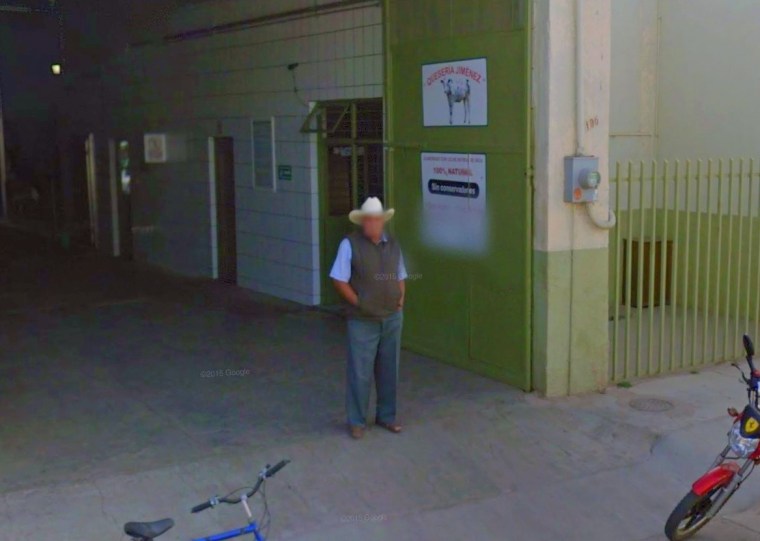
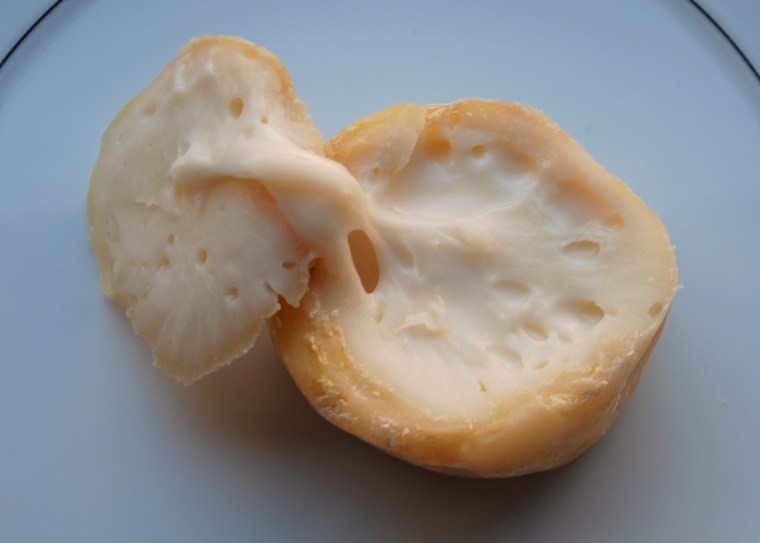
My friend’s family members rejoice and think of a place far away in the old country every time they bite into the pleasant graininess of a soft white Mexican cheese they just call Queso Fresco. She brought me a piece, neatly packaged in a plastic bag to keep the whey from dripping all over my desk. The cheese, she announced, comes from Quesería Jiménez, an unassuming facility that could pass for any other industrial building safe for the cow picture on the door. I was unable to find anything but the streetview google image.
Queseria Jimenez
The quesería is in La Capilla de Guadalupe, and apparently, this modest town is home to the best looking women of Mexico. I am not googling that because lord knows what will come up in such a search. Capilla’s cheese is certainly worth the trouble and the risk – I am pretty sure that bringing it in to U.S. is frowned upon by the FDA. It is creamy, fresh, and not too salty. It melts to create splendid quesadillas which, I am told, is really what this cheese is made for. I enjoyed it just by the slice also, and I realize that I now have the old Playboy excuse if I were to ever travel to Capilla to see if what they say about the women is true: “I am only here for the cheese”, I will be able to claim.
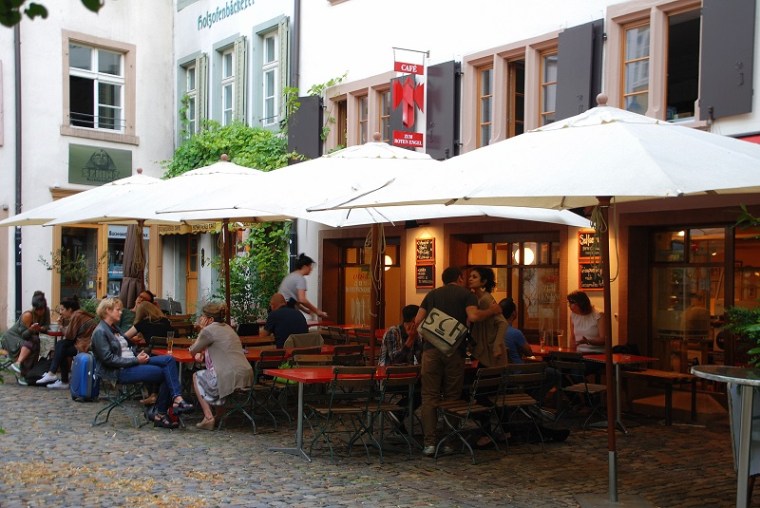
I travel to Basel on a fairly regular basis, and while most people in Europe associate that city with the pharmaceutical industries on the edge of the old city and most North Americans don’t associate it with anything in particular, there are enough nooks and crannies that make it a pleasant place to visit. There is, for instance, the Andreasplatz, a small square with lots of ivy covering the ancient walls, a few small shops and Café zum Roten Engel (In the Red Angel). It’s tiny, it has a tiny terrace and a tiny counter, but the Wähe comes in generous slices, as does the coffee or tea to go with it. Wähe is the Swiss version of a fruit tart; there are savory kinds as well and I’d be compelled to say they’re the Swiss version of a quiche. Whatever is in season is slapped into them – good ones are not too sweet and there is more fruit than the cream & eggs filling, so the whole thing is relatively flat.
The Rheinsprung is another delightful place, or rather, a road. From near the Middle Bridge it goes up rather steeply towards the square next to the Münster (the city’s cathedral) and about 100 yards in on the left side, there is the so-called blue house, a baroque mansion that was built for a silk merchant in the second half of the 18th century. It has a ridiculously ornate wrought-iron fence and local guides tell the story of how this house and its neighbor played an important role in the history of Basel’s pharmaceutical industry.
Das blaue Haus
Both mansions were owned by silk traders (brothers, in fact) and in order to dye silk, an industry developed first in France, and then in the surrounding countries. Basel was favored because of the permissive legal climate when it came to the chemical processes involved in creating artificial dyes (it was easy to steal other people’s secrets without repercussions), and its location on the Rhine river, whose waters provided transportation. The river was also a cheap and easy way to wash away the chemical leftovers. At the end of the Rheinsprung is the Münsterberg, the promontory with the best river view in Basel, and the cathedral itself, which has a beautiful Romanesque north gate, the Galluspforte.
Basler Munster
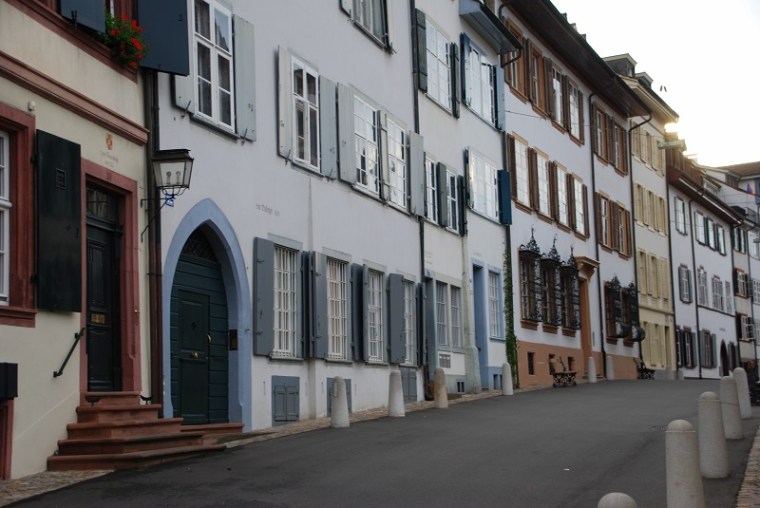
A little bit more up and down from the cathedral will have you going up the steps of the Lohnhofgässlein lined with thick-walled age-old houses in pastel colors.
Lohnhofgasslein
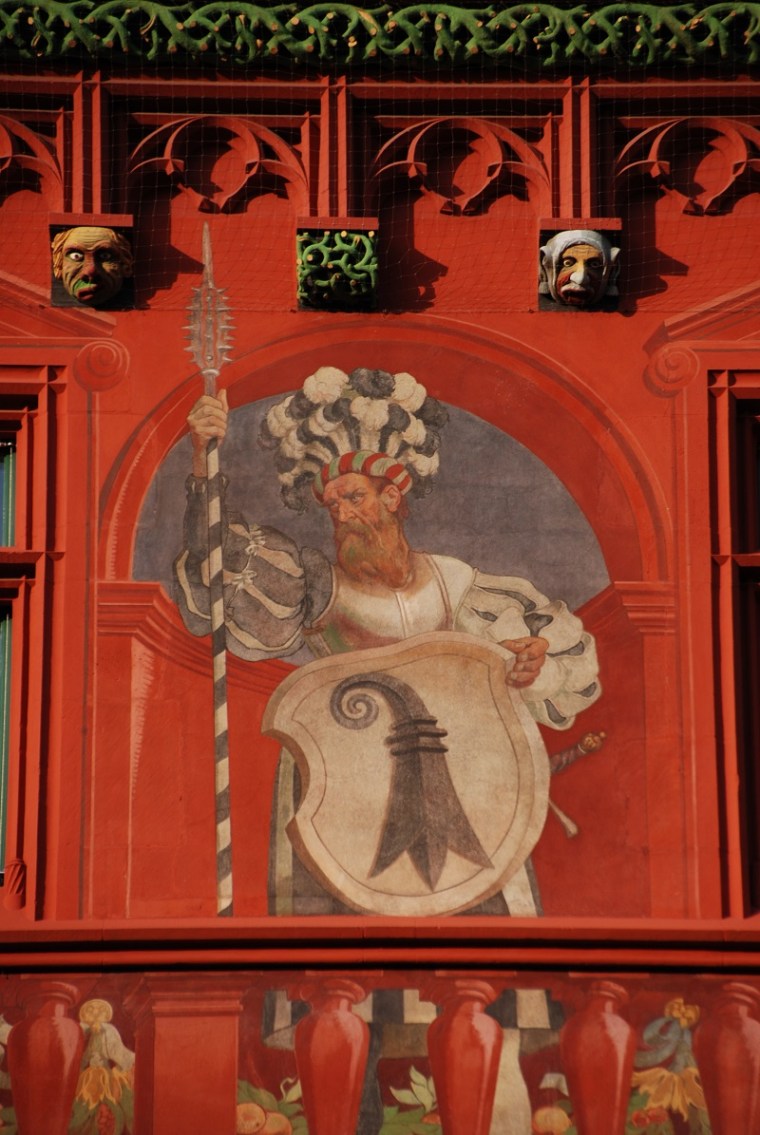
Eventually, all roads in the old city will converge on the lower-lying areas, the Barfüsserplatz (Bare-footer Square, named after the Franciscan monks who had a monastery here) or the market square in front of city hall, are rather garish red-colored house that has medieval roots but received its current skin in the late 19th century. This little bit of Basel can be bitten off in about an hour and a half. The Red Angel is not far from the market square and if it is too hot for coffee and Wähe, there is Moevenpick ice cream on the square at the eponymous restaurant.
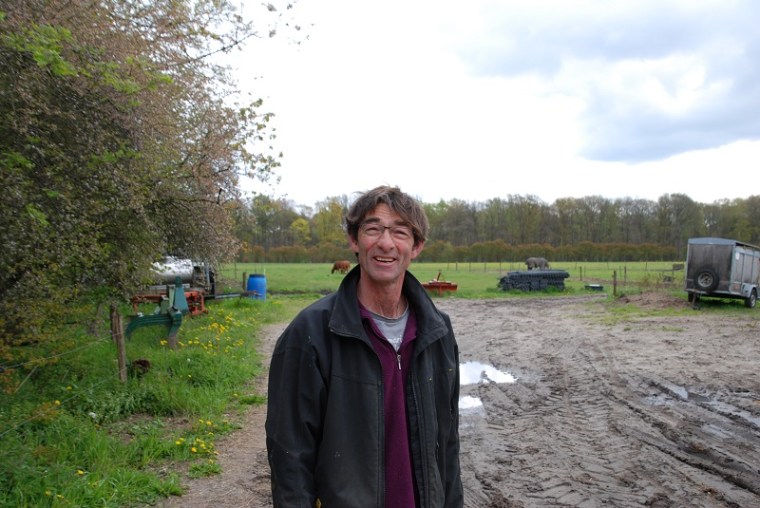
Michiel Cassuto has a beautiful farm, beautiful cows and beautiful looking cheese. Oh, and it tastes great too. Brandrood, if you will, is the Dutch version of a Gruyère: it comes in great wheels, has a natural rind (which makes for beautiful colors and patterns) and has the consistency and flavor of those cheeses from farther south. Like the other cheeses from the Gelderse Vallei, they are a far cry from the yellow stuff you can buy in pre-wrapped chunks at Schiphol airport; think of filet mignon vs. hot dog – it may both be meat (sort of) but it not quite the same. Brandrood has a bold flavor that lasts, some nuttiness and a bit of a sharper edge, but all very well balanced.
Brandrood cheese with a beautifully mottled rind
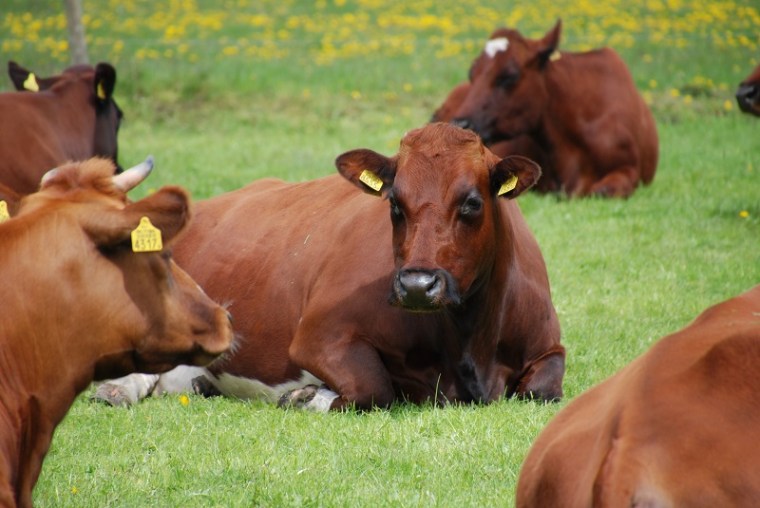
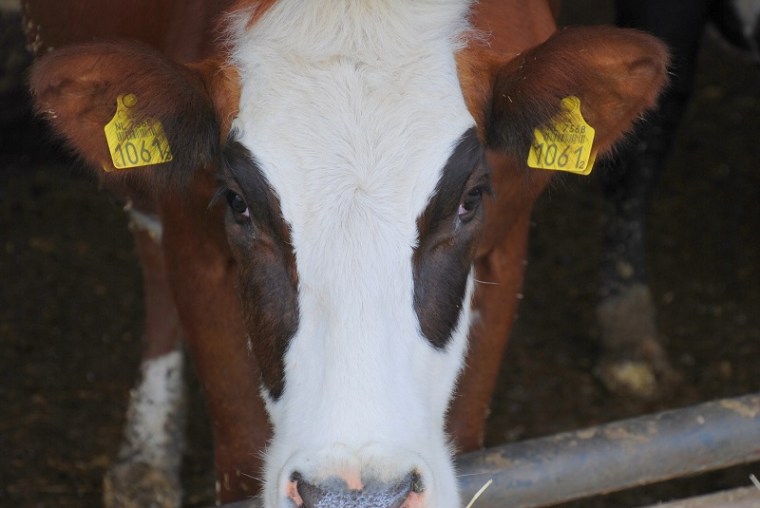
The farmer, who does everything himself, writes on his website that he grew up wanting to milk cows. And boy, does he live his dream. The Brandrood is a cow breed (“fire-red”) that has been around for centuries, but almost died out. They are beautiful beasts, and when I asked Mr. Cassuto (the name is Italian only because long-time-ago ancestors came from Italy, Michiel is as Dutch as vanillevla) if I could get a little closer to the cows to take a picture he casually suggested I should just climb over the fence, mind the cow pies and get as close as I wanted.
Brandrood cows
Cassuto has about two dozen of them, there aren’t many more than about a thousand still around. They do not yield an awful lot of milk so for many years they have not been bred a great deal and that has threatened their survival, hence their inclusion on the list of the Slow Food Foundation of Biodiversity. Leaving the farm, itself hundreds of years old, I felt good about the Brandrood’s chances of long-term survival – if you have friends like Michiel Cassuto who’s clearly in it as much for the love of it as for the money, things are looking up.
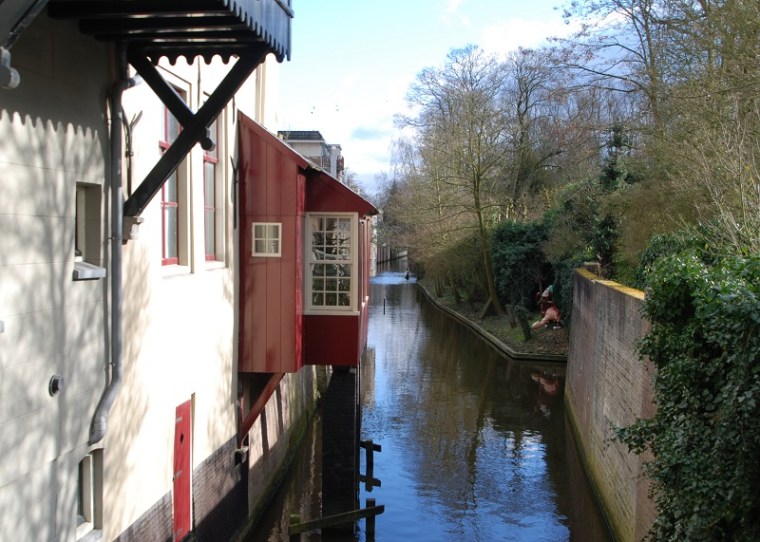
The Dieze River, running through and under the city of ‘s Hertogenbosch
The reason I was in the Netherlands for a quick visit in week 12 of this year was an exhibit in the city of ‘s Hertogenbosch. That’s a mouthful of Dutch, but all it really means is “Duke’s Forest”. In the late Middle Ages, the city was one of the largest in the Duchy of Brabant, along with Louvain, Brussels and Antwerp. The Belgian fight for independence, which officially ended with the treaty of Maastricht in 1843, cut the duchy in half, and north of the border, Noord-Brabant became a Dutch province and Den Bosch (for short) its rather quiet capital. Today, the city is overshadowed in the province by Eindhoven of Philips fame, but from its heyday date both a very large (for the Netherlands) Gothic cathedral as well as its other big claim to forever-after fame. Around the middle of the 15th century, a certain Joen or Jeroen van Aken was born here, and he was to become the most famous Dutch painter of his time as Jheronimus Bosch (usually spelled Hieronymus in English). As was the case with other painters of his time, many of his works eventually ended up far away from Den Bosch, because the Netherlands were variously owned and operated by Burgundy, France, Austria or Spain, and their kings, dukes and princes took away a lot of art, sometimes paying for it, too.
Giraffe from the Garden of Earthly Delights
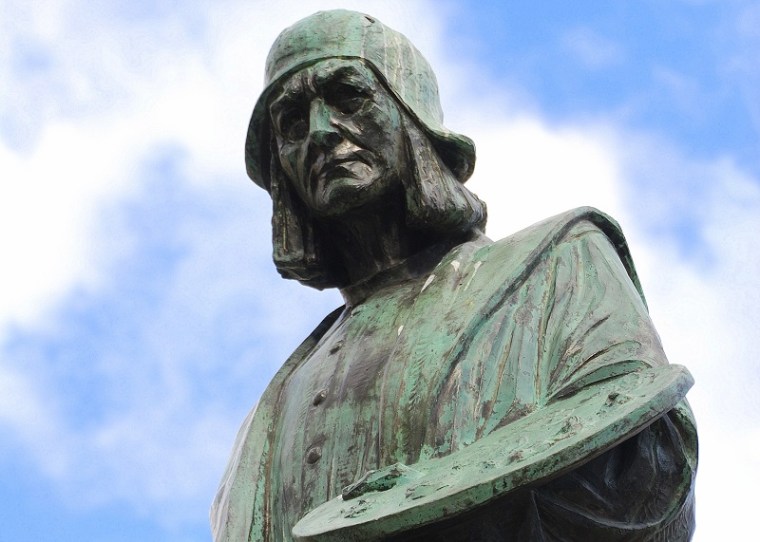
Sadly, the city couldn’t show a single painting of its famous son in its museum, and something had to be done for the celebration of the 500th anniversary of Bosch’ death in 1516. Enter a team of art experts assembled to conduct the most comprehensive study of Bosch work ever, with an intriguing proposal to any museum or gallery willing to participate in a trade: we provide research and restoration services for free, and in return, we get to have your Bosch paintings or drawings for our exhibit. The idea worked like a charm, and this spring, the spectacular exhibit brought close to half a million visitors to Den Bosch. In city parks, unsettling three-dimensional monstrous sculptures, lifted out of Bosch’ paintings created a strange cityscape, many local merchants got into the act and for a few months, den Bosch was all about its famous son, who is honored with a statue in the main market.
Jheronimus Bosch, statue on the main market square
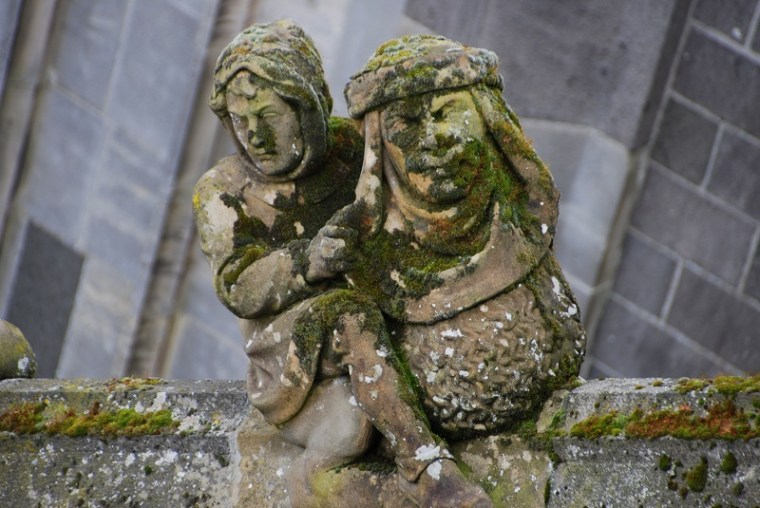
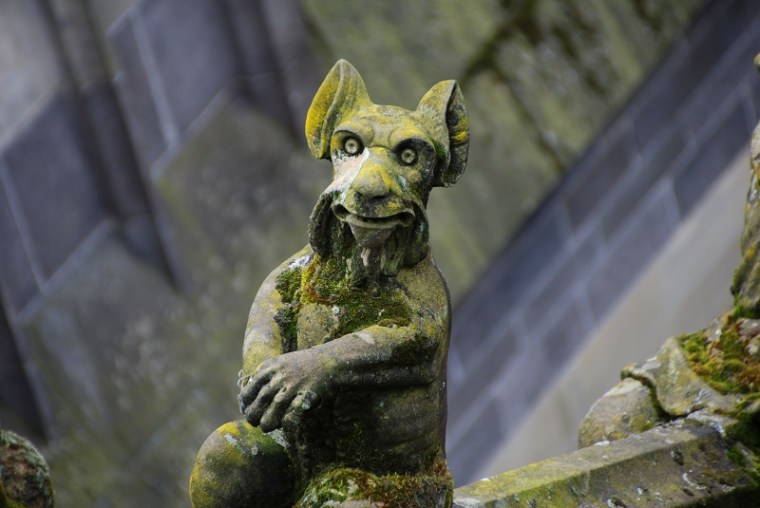
I stayed in the Duke hotel, a modern, friendly place that has top-floor rooms with views all over the city. Many little details, such as a fun collection of snacks, an XXL shower and the integration of bits and pieces of the old building in the decidedly modern aesthetic made my room a lot of fun to be in. Aside from the exhibit, visitor had a chance to climb to the roof of the cathedral, to see the sculptures on the flying buttresses that support the walls up close. 82 feet over the city is a wondrous world of medieval craftsmen, strange gargoyles and human-animal hybrids straight out of a Bosch painting.
Rider on a man-beast, sculpture on a flying buttress of the cathedral
The church’s interior is certainly worth a visit, but it pales in comparison to the thrilling roof exploration. All sculptures have been replaced in the late 19th century and some have been replicated more faithfully than others, but overall, the sense of being in a world Hieronymus Bosch would have felt right at home with added tremendously to my visit.
Monster, more than 80 feet over the city
In the meantime, the Bosch circus has moved on to Madrid. The royal Spanish thieves of yore ensured that the Prado today has the largest single museum’s collection of Bosch’ works, and it was easy to get other museums to pitch in: the Prado has plenty of bargaining power: “I’ll give you a fistful of Goya for your El Bosco triptych”. Den Bosch is recovering from the visitors (the museum was open around the clock in the last days of the exhibit) and things are returning to normal. If you happen to be in the neighborhood, the inside of the church is certainly worth a peek, the cafes are very inviting, Bosch statue is still there, and a little boat tour on the Dieze, the little stream that runs under and through the old city is a great way to get a perspective that is a little different.
Marc Mulders, the Last Judgement, stained-glass window in the cathedral
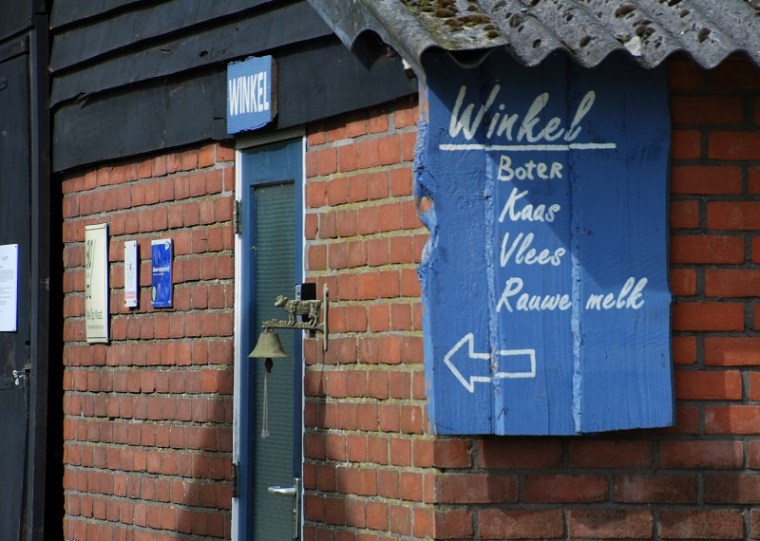
Not far from where my dear old mother lives in the Netherlands is an area known as the Gelderse Vallei. A valley in the Netherlands is a rare thing, given that much of the country is as flat as a pancake – for there to be valleys you’d need mountains or at least hills, and those are few and far between in Holland. But here, between two glacial moraines left after the last ice age, it’s there: the Valley of Gelderland. The southern part of this area is known as het Binnenveld, an area with a diverse mix of farms. Many of the farmers here are trying new things (or go back to really old things for that matter) and their eagerness to experiment is supported by the proximity of Wageningen University & Research Centre, the 21st-century guise of the venerable national agricultural university and the initiative Food Valley, a cooperation between 8 local communities that promotes knowledge and information about healthy food and sustainable agriculture. The latter claim sounds a bit pompous and vague but driving around the area it quickly becomes apparent what it means: small, crooked country roads provide access to beautiful farms where an agricultural cornucopia is being produced, from fruit juices to pork and from fresh advocaat (a drink made with eggs, sugar and brandy) to honey. A local bakery makes rusks out of locally grown Spelt while a bit further down the road a farm store sells eggs, advokaat, fruit juice, jams and a host of other things, all locally produced. And, of course, there’s cheese. I have posted something about Remeker already, but there are other farmers in the area that also produce cheeses from a particular breed of animal, usually valuing quality more than quantity, when it comes to the milk the cows give.
Blaarkop cow at the De Hooilanden Farm
There is Michiel Cassuto and his Brandrood herd; the de Hooilanden Farm with its Blaarkop cows; Welgelegen, a farm with Montbéliard cows and the van Dijk family farm with 1,200 Saanen goats. The latter three have their raw milk cheeses aged and marketed by the Meester-Affineurs (“master agers”), a company that takes its mission to produce a natural product very seriously. As an example, they have successfully fought off mandates to disinfect the boards on which the cheeses ripen. They did so with the assistance of a local company that did the tests to show the boards were fine without getting sprayed. Given that they work with raw milk cheese, they do have very strict hygiene rules: for example, in winter the tails and the udders of the cows need to remain cleanly shaven… close proximity to the other animals and the conditions inside a barn require more stringent rules, clearly. The Master Agers have a clean, crisp website, and they ship. So I was able to order a decent chunk of each of their three cheese and try them a week after my visit in the Food Valley.
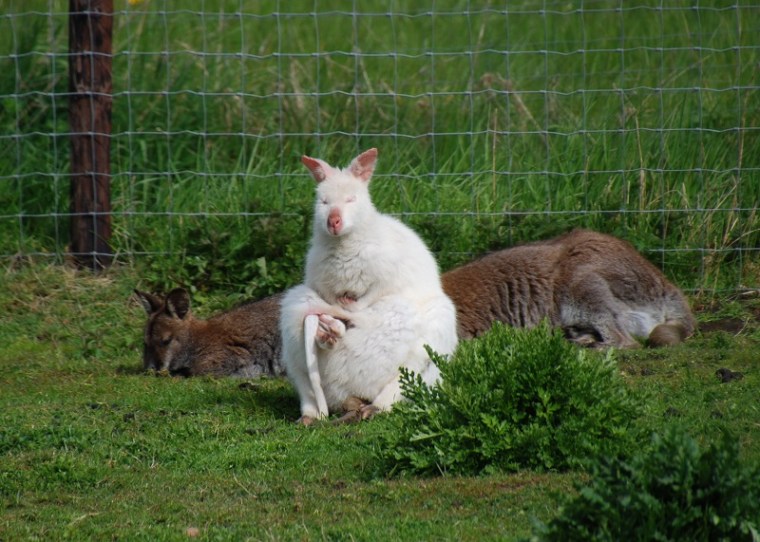
Wallabies at the van Steenbergen farm. No, they are not kept for their meat
I had visited the van Steenbergen farm, which has a delightful farm store that sells beautiful things from all over the region, along with their own eggs. They have chickens, cows and wallabies. Wallabies ?! “Yah, we had some leftover land and my husband had read an article about wallabies so we thought: why not?” the woman who runs the store said. Believe it or not, she said it with such conviction that it sounded like the absolute best thing to do. Wallabies in the Food Valley. Of course.
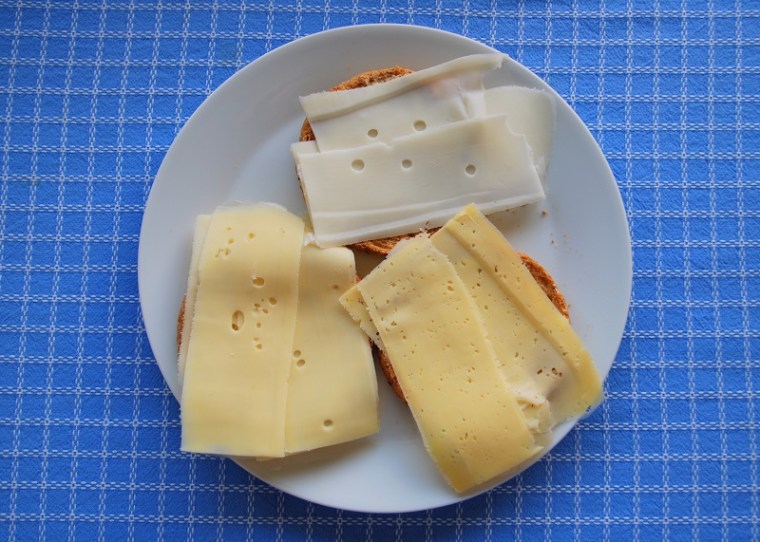
Clockwise from top: Saanen, Montbeliard, Blaarkop
The Saanen is basically a Gouda cheese with a goat twist, or a chèvre with a Gouda twist – a semi-hard cheese with a pale ivory paste, very creamy, initially without an outspoken goatiness. Kind of sweet, delicious. You need to keep it in your mouth a while for the goat flavor to really unfold, but then it packs a nice punch. The Montbéliard has a lot of small holes in it – nutty, with a pleasant chewiness, a bit of barnyard and salty. The Blaarkop was similar, perhaps a little sharper than and not as creamy as the Montbéliard. The picture shows the trio the way the Dutch eat their cheese: in slices, on a rusk or a slice of bread.
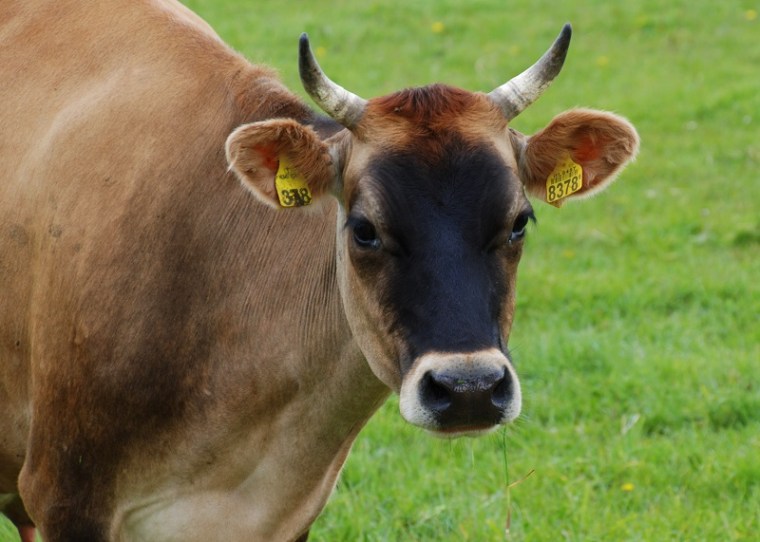
Jersey Cow at the De Grote Voort farm, where Remeker cheese is made
Lodewijk and Fleur Pool are the farmers at the Hooilanden (the Hay Lands), a farm that sits at the end of a long, somewhat twisted country road in the Gelderse Vallei. I visited their farm, saw the cows and bought a piece of cheese, all the while not meeting anyone. There were signs that told me where to go and what to do, and that, the Pools must have decided, should suffice. I picked up a piece of Hooilander Graskaas. Grass-cheese is made using milk from cows who feed on fresh grass rather than hay, it is creamy and quite mild, and the piece I got was still quite young; it had not ripened more than 8 weeks. Often young cheeses (the Dutch tend to select their cheese, most of which is the same ‘Gouda-style’ kind of cheese, based on its age and use 5 or 6 age labels to differentiate) in the Netherlands do not have a lot of flavor yet, but this one does, surprisingly so. It is a creamy, flavor-packed delight, not too salty but not as bland as many young cheeses taste. It has a very clean finish, the flavors do not linger all that much: a perfect cheese to cut up in cubes and eat as a snack with a glass of cold beer.
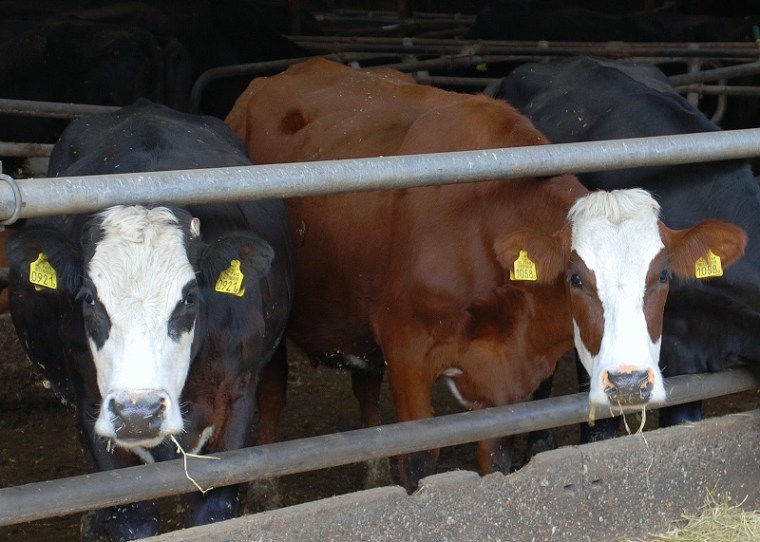
Blaarkop cows at De Hooilanden
An added bonus was certainly to meet the friendly cows that provide the milk and to have such a sense of place associated with what’s on the plate. In my next post, there is more about the area and about the other cheese Lodewijk and Fleur make: Blaarkop (“Blisterhead”), named after the cow breed they keep here. The blaarkop has been around in the Netherlands since the late Middle Ages and they are easily recognized by the oval colored spots (the blisters around their eyes. They have always been dual-purpose, and this is how it is at Hooilanden: you can buy cheese and steak here…
Boyle Heights is a working class neighborhood just east of downtown LA. Until the 1950s it was a diverse place called home by Jews, Latinos, immigrants from Eastern European and Portugal and people from Japanese descent. But a practice called redlining (in essence, financial institutions drawing a red line around an area on a map and deciding not to provide loans, insurance etc. to the people living within that red line) eventually forced all but the poorest people out and today Boyle Heights is almost completely Latino. If it is a working class neighborhood, it is also a neighborhood of people who know how to live: while it is quite shabby in some places, you don’t ever get the sense of desolation that you encounter in some of the urban wasteland in the poorer parts of LA. Boyle Heights is alive with people who go grocery shopping, take the family out for breakfast, sip a cup of coffee in a café, wave at a neighbor walking by. And that is the way the people like it here: the city is resisting attempts by developers to gentrify the neighborhood, and right now, it looks like they are winning: good for them, because Boyle Heights doesn’t need any ‘improvement’ beyond the normal maintenance people themselves can do.
Mole, mole, mole
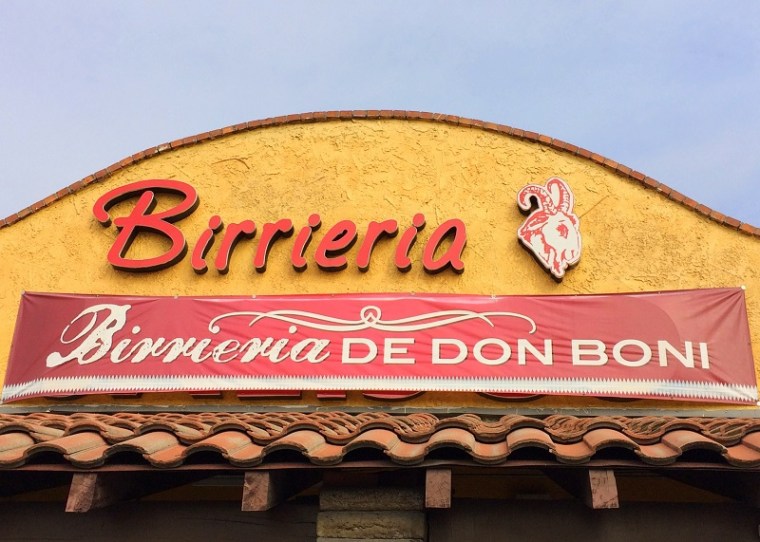
The three of us were there on a Melting Pot food tour, but some of the highlights of our visit had little to do with food. There was plenty of that too: a marketplace with a bewildering variety of foods, colors and flavors, a place where a gringo like myself would get completely lost without a little bit of help, which we had in the guise of our guide, Andrew. I tried spicy cucumber ice cream (interesting, but next time I am getting a different flavor), Christine got all kinds of mole and I found a place that sold cheese. We also visited a tortilla factory and we sampled the goat stew at Birrieria de Don Boni. Yup, I said goat stew. That’s why their call the restaurant a birrieria – a goatery, if you will. It is pretty much all they serve there, and many people bring their entire families here for a simple but tasty meal on the weekend. And that means everyone, not just mom, dad and a kid or two: a family order in this otherwise inexpensive restaurant sets you back $195 – they know you’re bringing the lot of them.
They got your goat
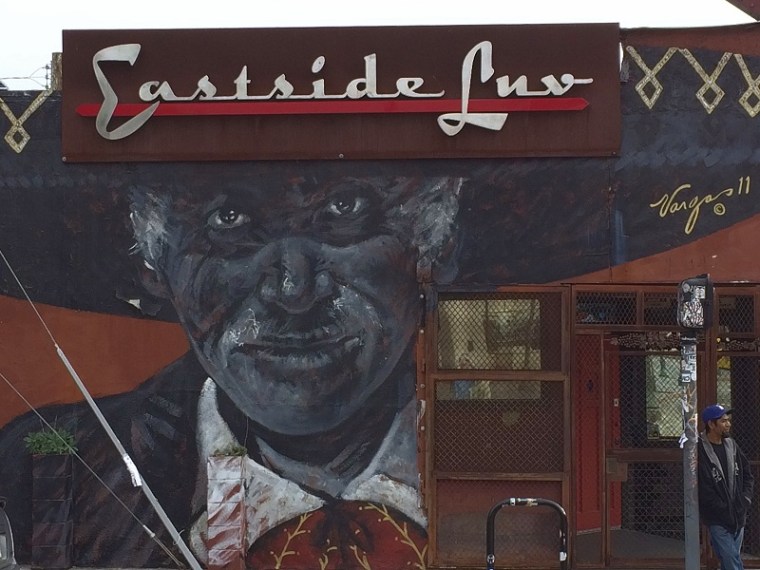
As for the non-food highlights: certainly the heart of Boyle Heights, Mariachi Plaza, would be one of those. The west side of the triangle is occupied by a beautiful Queen Anne building, the former Cummings Block and Hotel (named after the man who paid for it back in 1889), now the Boyle Hotel or the Hotel Mariachi. It is a residential hotel, and several dozens of musicians live here. And then, throughout the day, it is a coming and going in the plaza of colorfully dressed Mariachis, all looking for gigs. There is something very ‘artisanal’ about these men in their charro suits, getting ready to go to work like any other working man – except their work is the business of making music. On the Plaza there are two stores, one for charro suits and all manners of accessories, and the other for instruments. On the eastern edge of the square is a beautiful mural of a musician and there is even a music school in the neighborhood, the Mariachi Conservatory, where children learn how to play this music of frustration, heartbreak and longing, the Mexican Blues. Historically musicians have mostly been male, but the school also has girls, and I recently found an all-woman band called Mariachi Flor de Toloache on NPR.
Robert Vargas mural
Not far from Mariachi Plaza is Primera Taza, a coffee shop in a small, narrow building, and this is where I met the Blue Girl. She was in a painting by local artist Ray Vargas who also made a very large piece that sits in the back of a makeshift patio behind the café. We bought the Blue Girl home, where she represents a gritty urban LA in our decidedly suburban home. At the café, I also picked up a postcard from a local realtor. It showed a house that was maybe 15 feet wide at most but looked cheerful and well kept. It told the story of an entrepreneur who knew her area and her potential customers, who was there to provide a service (and make a living in the process) rather than transform the neighborhood. I took the postcard with me, as a reminder that a place like Boyle Heights can do quite well for itself and thrive without masterplans, mixed-use projects and development corridors, thank you very much. I plan to come back occasionally to see how the neighborhood changes – hoping that I will be pleasantly disappointed when it comes to any large-scale gentrification developments.
Ray Vargas’ Blue Girl at Primera Taza
Shameless Plug #1: This was the third time we did something like this with the Melting Pot; if you are out here (or if you live here, of course) and you are looking for something fun to do, try one of their tours. Christine, Charlie and I thoroughly enjoy them.
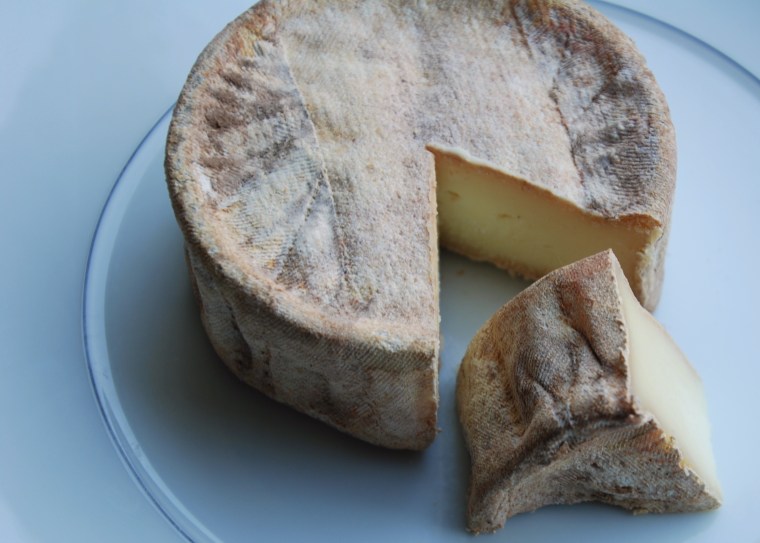
At the Mercado da Ribeira, I found my cheeses at the Manteigaria Silva, where a very friendly Portuguese man took the time to carefully explain exactly what he was giving me. While I got four different pieces of cheese, my pick for the week was clearly the Azeitão. This creamy sheep’s milk cheese comes from a town with the same name, less than 20 miles south of Lisbon. Some of the neighboring towns are also allowed to produce it (the cheese has a Denominação de Origem Protegida (DOP) designation, so there are rules); mine came from the creamery of Victor Fernandes, and the British Guild of Fine Food agrees with me that this is one fine cheese.
Azeitao
Just like the Spanish Torta del Casar, the way to eat this puppy is to slice off the top, take a spoon to it and go to town. Sure, you can take a piece of bread and slather the delicious goop all over it; add a sip of wine if you want. But if no one is looking, why bother? I ate mine straight up, and I must confess it did not take long. Yes, it is that good.
Ready to scoop
The official leader of the pack of Portuguese cheeses is the Serra da Estrela, named for the mountain range where the sheep live that provide the milk. There are two different breeds, the Bordaleira Serra da Estrela and Churra Mondequeira, both of which do well in the rather unfriendly climate with long harsh winters and hot summers. Old Lucius Columella, a roman expert on agriculture already wrote about these sheep and the cheese made with their milk. They packed me a chunk of Estrela Velho, ripened for 18 months. It’s no longer runny, of course, but semi-hard. To me, the mix of tang, sweetness and saltiness was not that different from the Azeitão, even if the Estrela was sharper and obviously has a completely different texture: both are wonderfully complex (but not complicated) cheeses, they somehow seem a bit related.
Serra da Estrela
A third cheese I tried that was interesting was also from the Estrela Mountains: Queijo da Cabra da Serra da Estrela – a goat cheese with a straw-colored rind and a semi-soft pale white paste. If found that the eating the rind made this cheese a bit too salty, but cut it away and you’re left with a nice, robust goat cheese that packs a bit of a punch. Quite a nice cheese, but not really a match for the other two.
Queijo da Cabra da Serra da Estrela; quite a mouthful, literally
“No”, said the people that were kind enough to make reservations for me at the end of my week traveling in the Douro area. “You need to change your schedule and not go back to Porto until Monday. On Sunday, we celebrate the feast of St. Anthony in Lisbon, and you don’t want to miss that.” So I did as I was told and ended up in Lisbon, more than thirty years after my first visit, on the day the Lisboetas celebrate their saint. You see, St. Anthony of Padua, as it turns out, wasn’t from Padua at all: he started his life in Lisbon as Fernando Martins de Bulhões, and after a stint as an Augustinian, he became a Franciscan when he heard about the martyrdom of five Franciscans in Morocco, an event depicted in all its gruesome detail in the church of St. Francis in Porto. He did eventually make his way to Italy and he did die in the city he has become associated with.
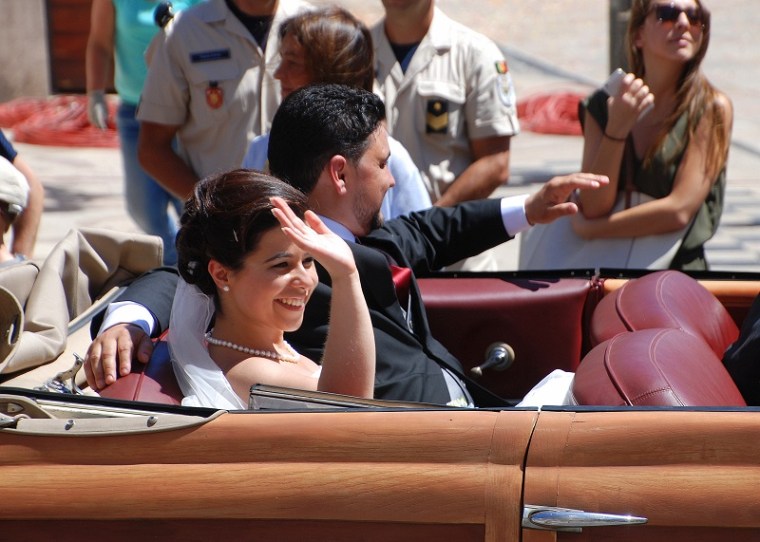
Getting hitched on St. Anthony’s Day
Saint Anthony is a big deal in Lisbon. The saint of lost articles is believed to help Portuguese men and women find their mate, and Sílvia Monteiro, the woman who took me around pointed to a motorcade of oldtimers, each with a bride in them, on the way to the church of St. Anthony. That’s where the couples get a blessing, before they walk to the cathedral of Lisbon, right next door, to get hitched. Apparently, the city pays for the dresses of the stars of this parade – they tend to be picked based on their wealth, or rather lack thereof.
Pao de Santo Antonio
In the narthex of the Church of Santo Antônio, people were selling bread. You are to take a piece of bread, wrap a little note with a prayer with it and stick it in the frame of a picture of the saint. It goes back to the legend of a woman whose son was brought back from the dead by our intrepid saint: in gratitude, she donated her son’s weight in wheat to feed the poor.
Makeshift throne for Santo Antonio
If you do not yet have a girl to take to the altar, help can be had by buying a terra cotta pot with a green globe of basil (manjerico), often with a (paper) carnation pinned to it: add a little poem for your loved one and hand it to her with a flourish: guaranteed to work (I think).
This clever lady sold Santo Antonio in a sardine can
Of course the best of all the Saint Anthony stories is where he’s walking along the beach in Rimini, thoroughly disgusted with his inability to reach people. As he is muttering to himself the fishes from the sea begin listening to him, lining up to hear him preach: success! And that’s all you need, in Lisbon, to start grilling sardines on pretty much every street corner of Alfama, the old quarter under the cathedral, on the Feast of St. Anthony. Sardines, Sangria, a salad with grilled green peppers: eat it and you will feel that melancholy in your soul that says: if only for a little while, I am now Portuguese.
In the Fabrica de Pasteis de Belem
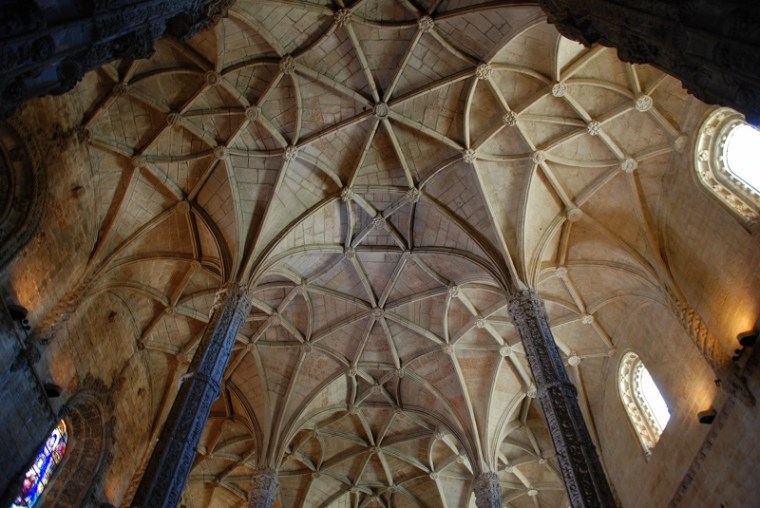
But wait, there is more in the way of food and religion here: there are the Pastéis de Bélem, the small egg-yolk custard pastries originally created by the monks of the Jerónimos Monastery in Bélem, a suburb of Lisbon and today sold all over the country. The egg whites were used to starch the monks habits, hence the yolk surplus. There is the venerable institution of the Fábrica de Pastéis de Belém, not far from the actual monastery itself, which is a stunning example of the typical Portuguese version of Gothic architecture, the Manueline style. They serve them warm there, and they are spectacular, even if the size of the place and the number of patrons inside do give you the sense of being in a fábrica, a factory. Sure, these things probably make your cholesterol go through the roof, but honestly, they are worth taking a few months off your life.
San Jeronimos, vaulting in the nave of the churchSan Jeronimos, in the cloisterSan Jeronimos South Portal, early 16th century
And finally, a food with a dark religious side: in 1497, King Manuel I of Portugal, the same ruler after whom the architectural style was named, followed his neighbors, Spanish King and Queen Ferdinand and Isabella, as he expelled all Jews from the country. Those remaining had to convert and give up their sinful ways, and one way to demonstrate that they were now part of the team was by eating sausage – pork, that is. So along came the Alheira, a sausage made with a lot of garlic, chicken or game, and bread – a pork-imposter as it were. (Paella, laced with shellfish and sausage, is said to have the same mean-spirited roots.)
The Alheira is the yellowish sausage; behind it is Morcela (black pudding)
With Sílvia, I walked the streets, sipped coffee at Café A Brasileira, bought a drawing showing famous Portuguese author Fernando Pessoa on a donkey at the Livraria Sá da Costa Editora, and a felt St. Anthony from a friendly lady who had set up under a leafy tree on the edge of Alfama. She dropped me after several educational and entertaining hours at the Mercado da Ribeira, a hip, modern market with a plethora of eateries, a cheese and meats shop where I got my Portuguese cheese and giant screens to follow the European Championship soccer games. I enjoyed some delicious cod (I believe it is actually illegal to spend more than 3 days in Portugal without eating the national fish) and a glass of wine before I walked on, in the relentless heat, and made my way to Alfama where, as the afternoon slid into the early evening, I used a few Spanish words, my hands and some creative facial expressions to order my sardines. As the square where I sat, sharing a table with a friendly Portuguese woman and her mom (“your Portuguese is very good – not really”) was getting increasingly crowded, my soul began to feel heavy with each bite of a sardine. The vague sadness that stems from the loss of empire, the notion that centuries past may have been the best of times and the certainty that even with Cristiano Ronaldo on the team, the European Championship was a very, very long shot. For a fleeting moment, on the Calçadinha de São Miguel, I too, was Portuguese.
Sardine hanging from the sky in AlfamaSardines
As I strolled back to my hotel in the early evening, with shadows lengthening but the sun still sizzling, Fado music from speakers tumbling out of sidewalk cafes, I realized it had all been a dream. I was not Portuguese at all, I had to pack for a long drive to Porto the next morning, and the saint of lost articles was a fraud: somewhere in the city of St. Anthony, I had not found, but lost my sunglasses. Maldição! As if I needed a reason to return to Lisbon.
In Avignon, no one really dances on the bridge, and as a matter of fact, no one ever did, in all probability.
Sur le pont d’Avignon
on y danse, on y danse
sur le Pont d’Avignon
on y danse tour en rond.
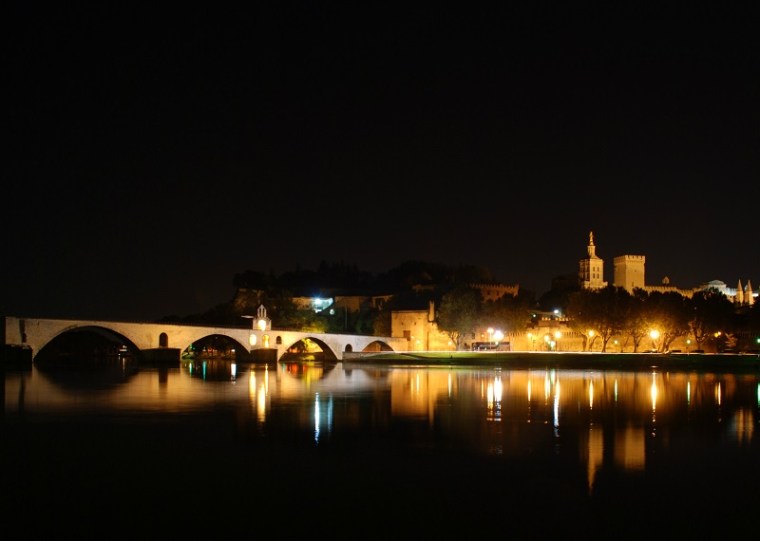
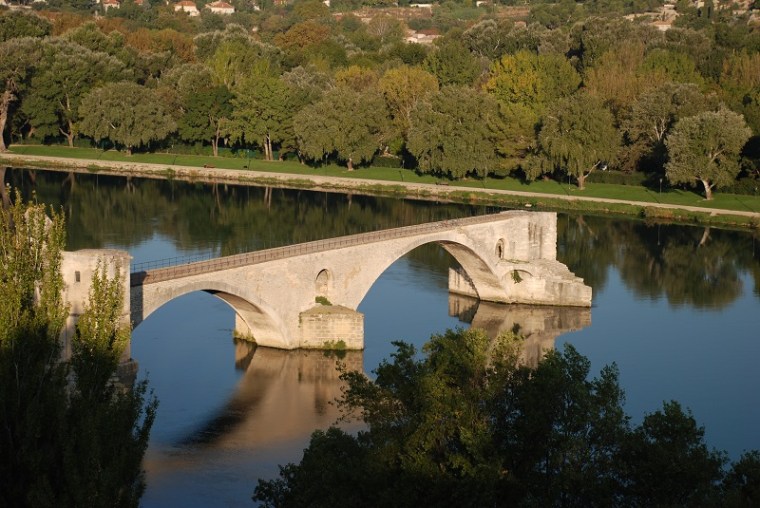
A French ditty that is simple enough for foreign students of la plus belle langue to learn, and therefore has made it in the heads of thousands, nay hundreds of thousands of middle schoolers all over Europe. Of course there are all kinds of things wrong with this song. First off, the original more accurately places the dancers under the bridge: sous le pont. The bridge itself is rather narrow, and traffic would have been seriously impeded by bunches of people who had nothing better to do than to disrupt commerce with their frivolous pastime. Today, it’s a moot point because the Pont Saint-Bénézet has only four arches of its original 22 left. Forty years after it was first completed in 1185 Louis VIII destroyed it, and when it was rebuilt, the Rhône River so often took out a few arches during high water that the people of Avignon grew tired of having to rebuild it. Today it is probably the most famous bridge to nowhere in all of Europe.
All of this is not to say that a visit to Avignon is disappointing, au contraire. But much of the city’s charm is found beyond those sites to which it owes its fame. Under the relentless Provencal sun, Avignon gets very hot, but the winding streets are narrow enough to find a little shade in them – you simply have to cross the street here and there. And as soon as the sun is up, there is nothing to stop you from getting a head start. The city’s biggest attraction by far is the palace of the Avignon popes, but before it opens, you can walk around it, always keeping it on your left, until you reach the Rue des Escaliers Sainte-Anne, the steps of St. Anne, which lead to the top of the Rocher des Doms, the promontory where the very first inhabitants of the area sought to defend themselves from intruders into their land. From here you have gorgeous views over Villeneuve-lès-Avignon and the Tour Philippe-le-Bel across the Rhône. That tower is how far the bridge once reached. The short stump that is left can also be admired from this viewpoint.
Pont Saint-Benezet from the Rocher des Doms
From here it is all downhill to the Cathedral Notre Dame des Doms d’Avignon and beyond it the 14th century Popes’ Palace. It’s a bit of misnomer, because despite some beautifully decorated rooms, it may be more appropriate to call it the Popes’ Fortress; there is nothing particularly inviting about its façade and the looming hulk of the building casts massive shadows on the surrounding area.
Palais des Papes; the belltower on the left belongs to Notre Dames des Doms
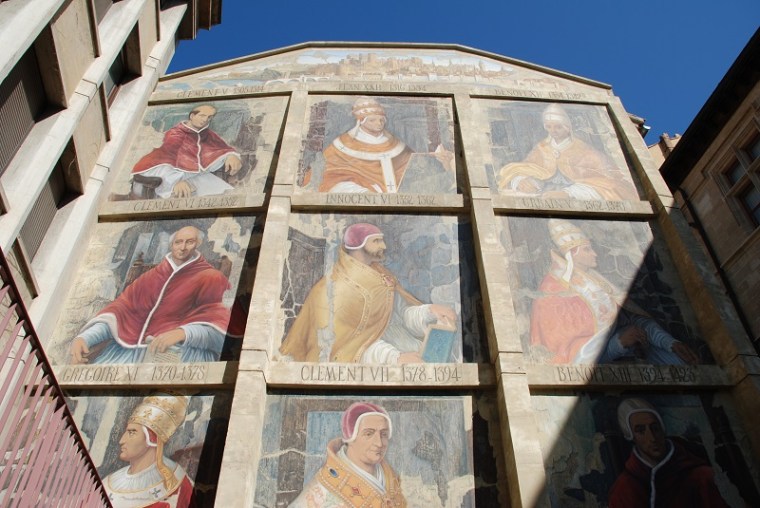
Having the popes live in Avignon from 1309 to 1375 initially completely overwhelmed the town’s infrastructure: cardinals brought hundreds of people in their entourage and an extraordinary building boom ensued. Pope Benedict XII built what is now known as the Old Palace. He must have been a humorless, dour fellow, because this part of the complex looks solid, boring and unfriendly, both inside and out. Benedict pinched pennies, only to have his successor splurge on the New Palace. Clement VI was responsible for anything colorful, intricate or luxurious that is left in the building today.
All nine Avignon Popes. In the middle on the left is Clement VI, the big spender
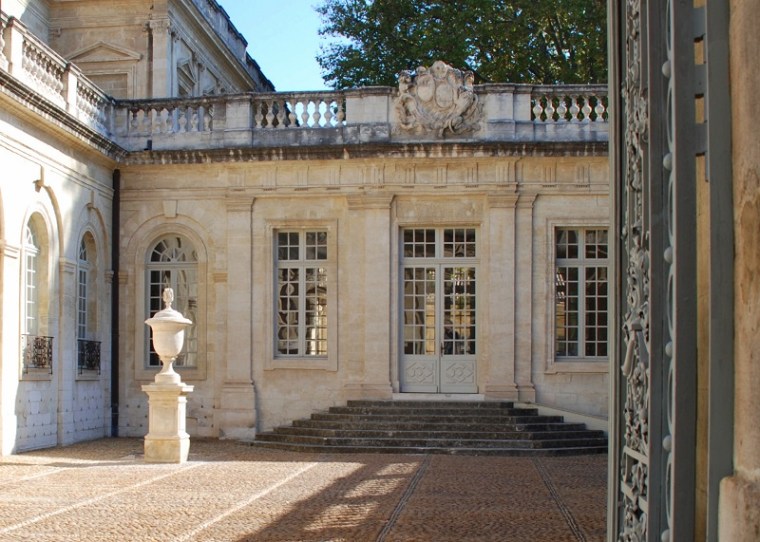
The best way to visit is with the self-guiding devices – pick a time early or late in the day, when tour groups have largely left or haven’t quite gotten there yet. From the palace it is not far to the Place d’ Horloge with its carrousel and its many cafés. A bit tucked away in the southwestern corner of the square is a short alley that leads to the Palais du Roure, a building with an inner courtyard that displays a collection of bells and houses a small museum of sorts about Provençal culture. There are a handful of these small museums where visitors can enjoy history, natural history and art in bit size chunks: the Musée Lapidaire in a former Jesuit church has ancient sculptures, among them one depicting the fearsome Tarasque, the local water monster. The Musée Calvet houses an eclectic art collection with some works by Manet, Corot and Sisley.
Courtyard of the Musee Calvet
The Musée Anglodon has a van Gogh, and works by Cézanne, Modigliani, Picasso and others in a beautifully furnished 18th century house; of course, there is also the Musée du Petit Palais, next to the Palace of the Popes, which showcases Italian and Provençal art from the 13th to the 16th century, among other things.
Two other places of note: the Place Crillion, a little away from the center just inside the city walls, with the beautiful 18th century building of the Comédie, now a very chic store, has some quiet and I daresay romantic outdoor terraces. The place is beautifully lit at night. And of course there are the Halles, the covered market with the spectacular vertical garden by Patrick Blanc (the André le Nôtre of our days) on its façade.
Les Halles, the covered market with Andre Blanc’s vertical garden
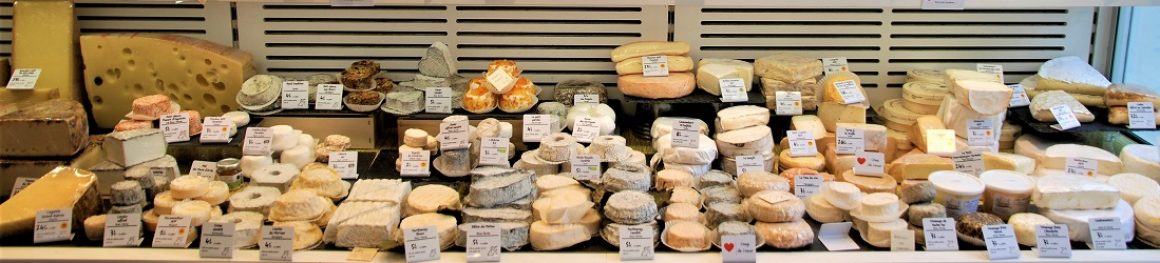
In there is the splendid Maison du Fromage, the cheese temple where I got my Banon and the other cheeses for week 5. You see, even if you forget about the whole bit about dancing on the bridge, Avignon has an awful lot to offer.























 52 Cheeses