At the Wheel House, I picked up a piece of Four Square along with a chunk of Hooligan (I went back for more of that weeks later, so see Week 21) and two other cheeses that were somewhat less remarkable.
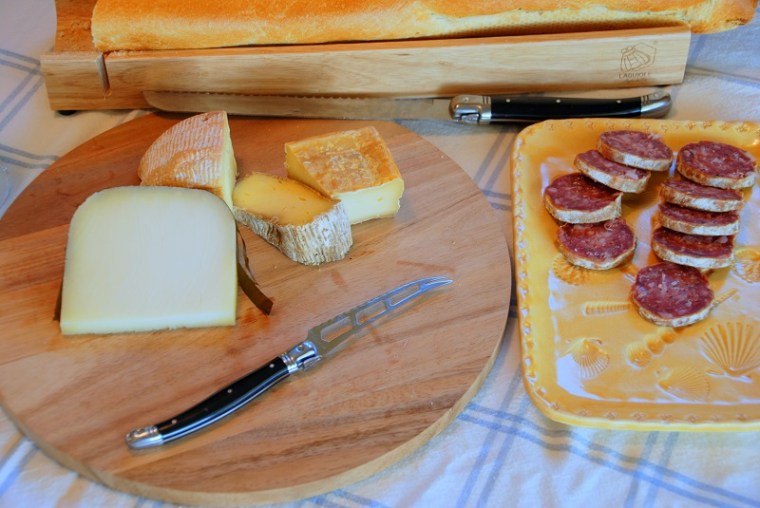
Clockwise from bottom left: Seascape from Central Coast Creamery, Hooligan, Humble from Parish Hill Creamery and Four Square
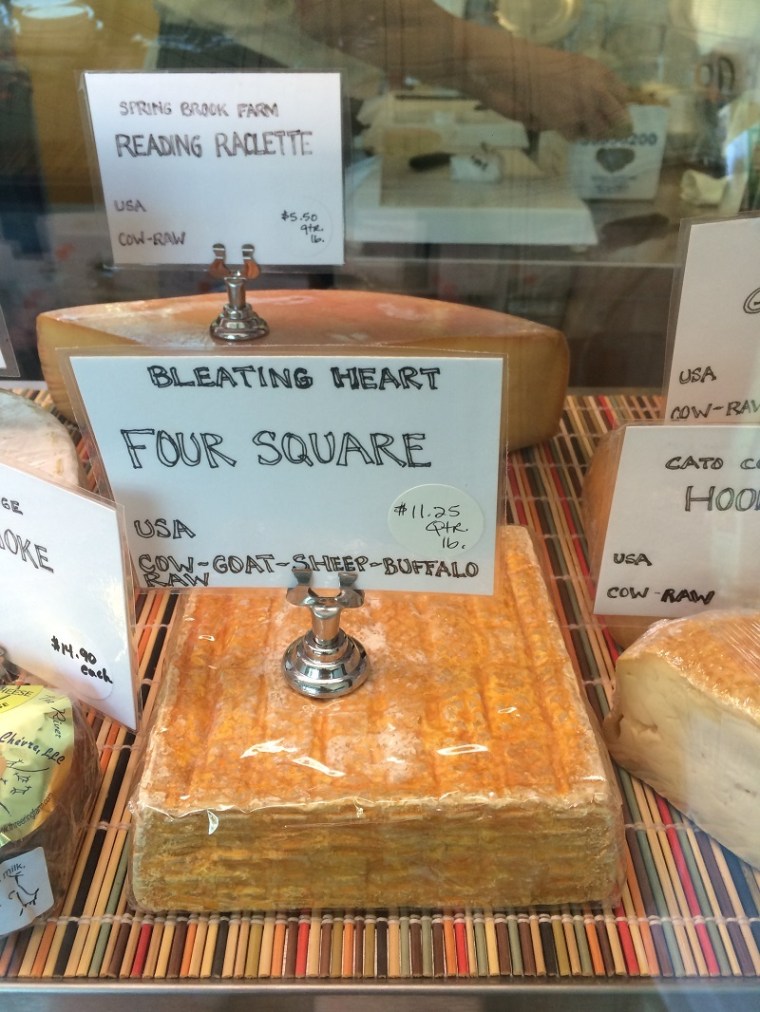
The Four Square was irresistible, because who would not want to try a four milk cheese? Seana Doughty is the driving force behind Bleating Heart Cheese, the company that creates this cheese (it will be available again this summer, but I got one of the very last pieces of it, it is a limited offering). She and her husband Dave Dalton appear to have a lot of passion for the art of cheese making, a healthy disregard for tradition if it suits them (I am sure purists have nothing good to say about a four-milk cheese) and a sense of humor about the whole thing. The best part about their website is the ‘stories’ section where they present the milk producers. The place that has the water buffalo is Double 8 Dairy and they have their own fun video that shows the daily work on the farm. That one definitely is worth a view.
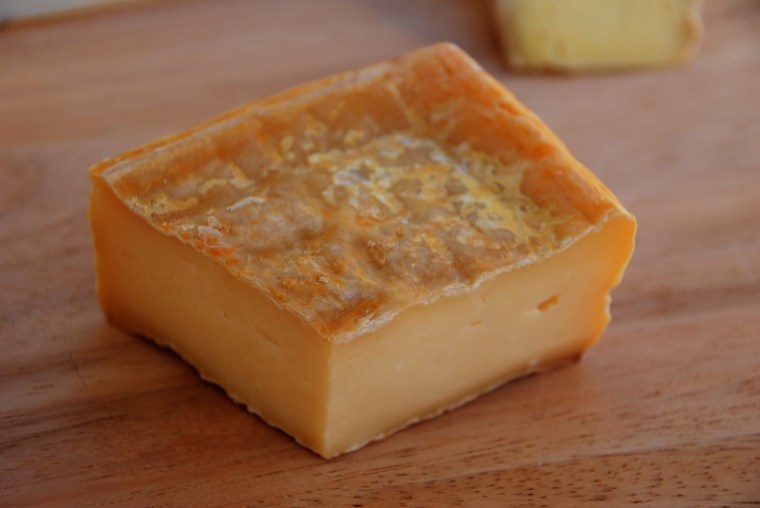
Four Square is made with equal parts cow, sheep, buffalo and goat milk, ripened on redwood planks, washed with a brine every few days for 2-3 months. The squares have developed a very nice orange hue by that time. The cheese is fragrant in the best possible cheesy way and the semi-soft, pale ivory paste has a smooth, creamy texture and an easy, slightly salty taste. It is not overly complex but very pleasant – I may have been a tad disappointed with that, having expected something multi-layered that would take advanced placement classes in cheese appreciation to truly decipher. Instead it was just a very nicely balanced, full-flavored piece of cheese that can be enjoyed without or with rind, the latter for a salty flavor enhancement.
Four Square: Buffalo, Cow, Goat & Sheep all in one!
Think of this cheese as a blue with training wheels. That sounds a little unkind, as if the goal should be to graduate to the more challenging blues, and it’d be far from me to be the Penicillium Roqueforti Nazi. Fourme d’Ambert, as blue cheeses go, is not so sharp, very creamy and still has the musty flavor that comes with the blue mold. For some it could be an ideal gateway drug, others may decide that this is as moldy as they’d like it to get. Unlike its famous cousin Roquefort, this cheese is made with cow’s milk, which is a partial explanation for its smooth flavor; sheep’s milk often lends an edge to the cheese.
Legend has it that Julius Ceasar, on his way to Alesia where he defeated Gaul leader Vercingetorix, munched on some Fourme, which would make it a sort of a Benedict Arnold fromage. More reliable mention of the cheese dates back to the 9th century, where it was used as a currency, if you will: cheese makers, who did their work in stone huts in the summer pastures called Jasseries, paid for the use of the land with their cheese. The Fourme was mostly sold on the market of the town of Ambert, from which eventually it took its name.
The area in which, according to the regulations which bestow the AOP designation on Fourme d’Ambert, is largely in the Auvergne region, and the cows, who need a minimum of 150 outside grazing days, spent their time on land that is between 2,000 and 5,000 feet in altitude. Today the Jasseries are hardly used anymore and the milk is collected by a small number of rather large creameries, which determines the cheese’s designation as a fromage laitier, a factory-made cheese. That sounds worse than it should be because even if the cheese does not come from a single farm (fromage fermier) or is largely produced by hand (fromage artisanal), the entire set of rules still apply: the feed for the animals must come from the designated AOP area, cannot contain any GM products and, importantly, the milk has to be raw, not pasteurized.
The cheese is marketed after ripening at least 28 days, but a longer period is not uncommon. Some 20 liters of milk, a little more than 5 gallons, go into a Fourme (the word comes from the latin ‘forma’, which is the root, in French, for both forme (form), and fromage (cheese), so Fourme probably means cheese). The shape is always the same: a cylinder 19 centimeters (7.5 inches) in height and 13 centimers (5 inches) in diameter. It is sold by the slice or the half slice, and usually wrapped in foil. The rind is not really edible, but it is very thin, so there is no need to lose big parts of the creamy goodness. My Woodland Hills Whole Foods carries the l’Or des Dômes brand from the Société Fromagère du Livradois.
Ha! Johannes Gutenberg from Mainz was probably happy when he was able to finally leave Strasbourg behind after having spent some 14 years there between about 1434 and 1448. No one knows exactly how long he lived in the Alsatian city on the Rhine, but he was there: court documents show he was sued a number of times, most spectacularly by a woman who claimed he had promised to marry her, but then reneged on the promise. Back in Mainz, about 130 miles downstream, he continued work on his invention that would earn him worldwide fame: the printing press with movable type. So as time wore on the city of Strasbourg decided to honor the man who had left behind debts and at least one broken heart with a square and a statue, very close to the gorgeous red sandstone cathedral, one of the most beautiful Gothic Cathedrals in France – make that the world. Just off Place Gutenberg in the Rue des Tonneliers is la Cloche à Fromage. In fact, there is really two of them, one cheese shop, the other a cheese restaurant – same company, different experience. I decided to have my choucroute (sauerkraut with sausage and other assorted meats) at Aux Armes de Strasbourg right next to the statue of my pal Johannes, but I did pick up some cheese before I sat down there.
Choucroute, Sauerkraut with all kinds of meat, Alsatian style
And that’s where the praise starts. La Cloche auf Fromage is not an enormous place: the cheese counter at a decent-sized Whole Foods may be just as big, but that’s where the comparison ends. Here are the five reasons why I just love a French cheese shop:
The French are fearless and know when to ignore food safety warnings: most of the cheese is made with raw milk. My wife in fact had an aunt who used to rail against EU regulations: “one day, they will take away our lait cru, and it’s all going to be over!” It hasn’t happened yet, aunt Collette, wherever you are…
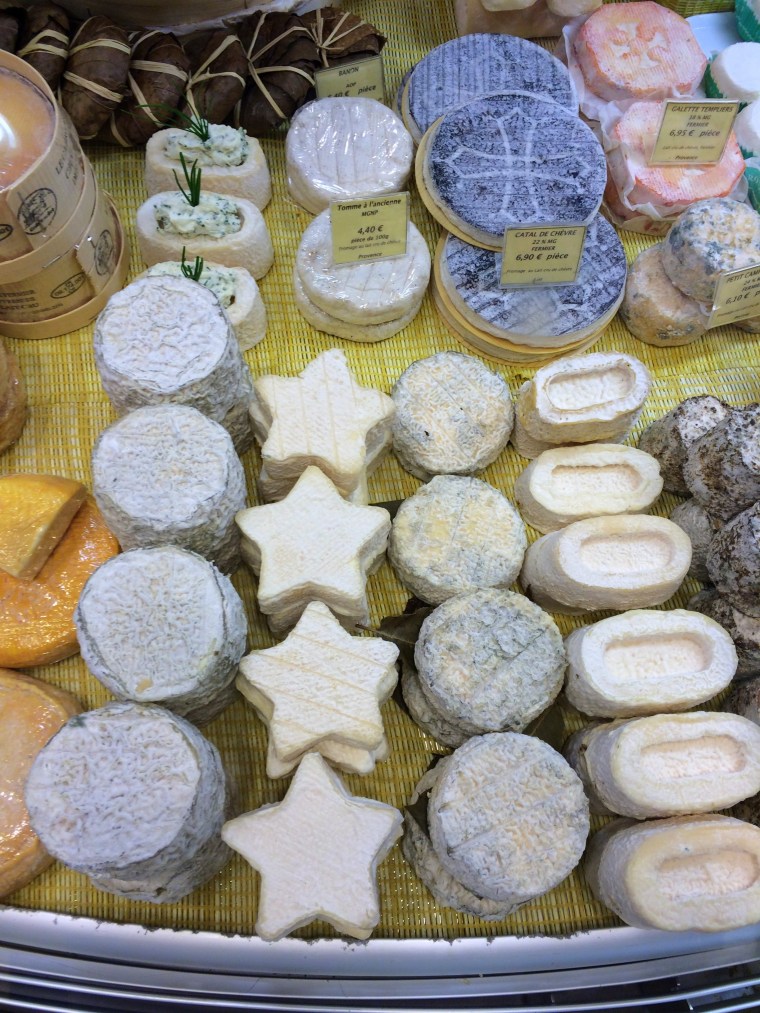
The French value geography. Geography is terroir, and terroir is where the food meets the landscape. Terroir is the combination of soil, water, sun, wind, slope and so on that creates the particular environment which determines the qualities of the particular food. So neat little cards will not only tell you what kind of cheese you’re looking at, but also, where your cheese is from, and soon you can begin to build an image of the life and work of the people who produced the cheese. The better cheese shops in the US have adopted this level of care, but in France, this has always been par for the course.
The French are open when it comes to food. In a land so full of culinary traditions, there is still a lot of room for experimentation and so a cheese shop worth its salt will always carry some interesting new cheeses alongside the national and regional favorites.
The staff in these shops: they know what they are talking about; they respect the cheese and they know how to wrap it properly.
Finally: coming from the US, the prices will ensure that you walk out with a slightly bemused grin on your face: a cheese plate that would set you back the price of 20 lattes in the US can be put together for 15 euros here.
There are of course thousands of them all over the country, and it’d be far from me to even pretend that I could pass as an authority, but here are some of my favorite cheese mongers in France: there is Hisada in Paris, close to the Palais Royal. Of course it is jarring at first to walk into a cheese shop in Paris where the staff is Japanese, but once you see that they approach fromage with the same sensibility, flair and understanding of quality, it all makes perfect sense.
In Les Halles de Dijon
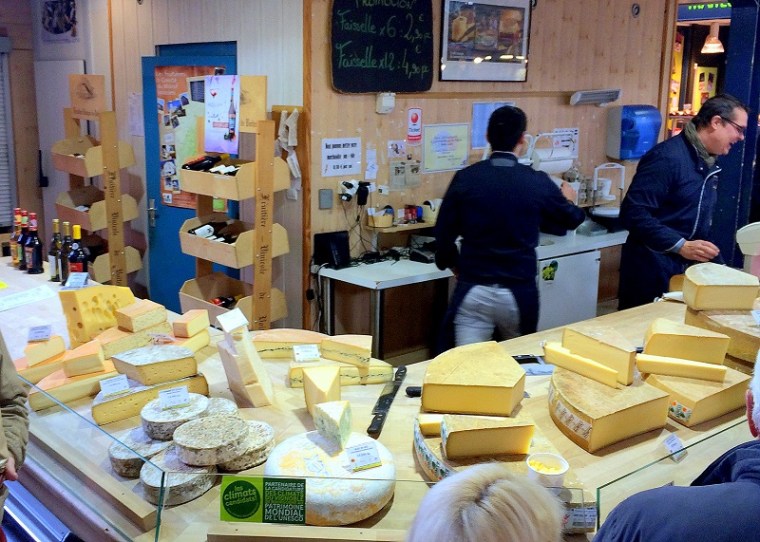
Benoit’s stand at Les Halles de Dijon specializes in the large cheeses from the Jura. They carry cheese from all over France though, and they have an very visible division of labor: the muscular guys are handling the Comtés, the Emmental and the Morbiers, while the daintier sellers wrap the Chèvres and other assorted small cheeses.
Maison du Fromage, Avignon
In Avignon, it’s the Maison du Fromage in Les Halles, and in Lyon the Halles de Lyon – Paul Bocuse are a food temple of sorts, where I would not dare to prefer one exquisite cheese monger over another.
In Les Halles de Bocuse, Lyon
Oh – and of course, if you are in Strasbourg, make sure to check out the magnificent cathedral. One cannot live of cheese alone.
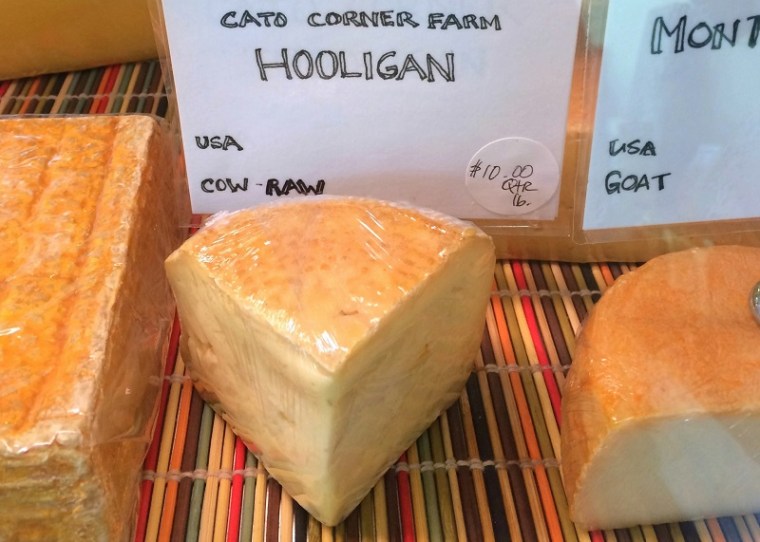
If Cato Corner Farm’s Hooligan could enter a stink-off with a Munster from Alsace, I do not know who would come out on top. Take a piece home with you and forewarn the people in your household, because there is no way you are going to be able to wrap this baby in a way that will prevent the odor to stay inside the paper. Raw milk from Jersey and Brown Swiss cows guarantee that the Hooligan is also very creamy – there is nothing not to like about this cheese. Cut off the rind, which is washed with brine and buttermilk during the ripening process, or leave a little on for a bit of extra intense flavor and crunchiness.
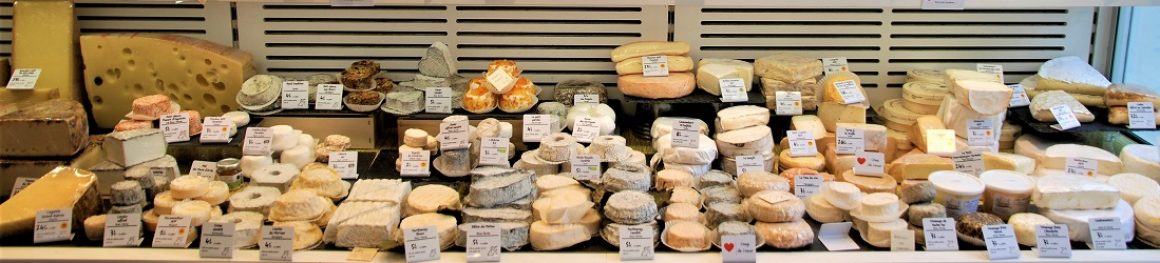
Cheese Counter at the Wheelhouse
You can eat it young, when it tastes like grass and grazing cow, or wait for it to start running and take in every last bit of bold flavor – not for the faint-hearted. If you think brie is quite an assertive cheese, pass on the Hooligan. Mark Gilman, the man in charge of creating the cheeses at Cato Corner consulted with French and Belgian cheese makers, who know a thing or two about stink, to come up with the Hooligan. His mother runs the farm and looks after the herd of less than 50 cows. Cato Corner’s website, which has gorgeous ‘portraits’ of its cheeses, suggests to have a beer with the Hooligan, or sweet white wine. I say suspend with the niceties and just start eating that bad boy. There is more than enough in there to keep your taste buds busy. This is one of my favorite American cheeses.
Berkswell Flying Saucer Goat Cheese
I got the Hooligan and the Wheel House in Culver City, and with it, I picked up a piece of Grayson, a washed rind cheese with small holes, and a nice strong flavor – nothing too funky, but pretty salty. I also got a slice of Berskswell sheep’s milk cheese. It comes from England, from a creamery called Rams Hall, that’s operated by Stephen Fletcher.The town is not far from Coventry, and they drain the whey from the cheese in colanders, which give the cheeses their typical form – round and flat, with a ridge running along the width of the cheese. It has a distinct scent – it pales in comparison to the Hooligan but is is pretty robust. The cheese has a nice, quite complex and rich flavor, and it is not your typical sheep’s cheese. The people at Rams Hall age their cheeses for at least 6 months, which helps to allow all the flavor to unfold, of course. The milk comes from some 350 Frisian sheep. Apparently these animals are prized for their even, friendly temperament. Being half Frisian myself, I think I am qualified to say that what goes for the sheep from Friesland does not go for the people there.
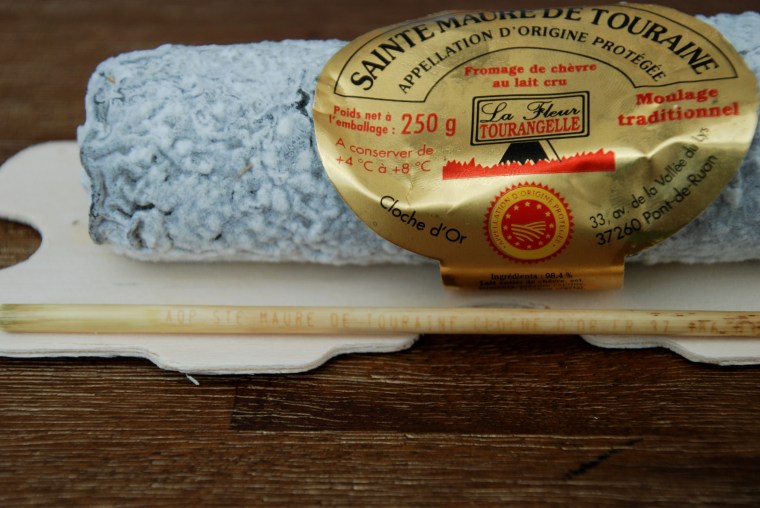
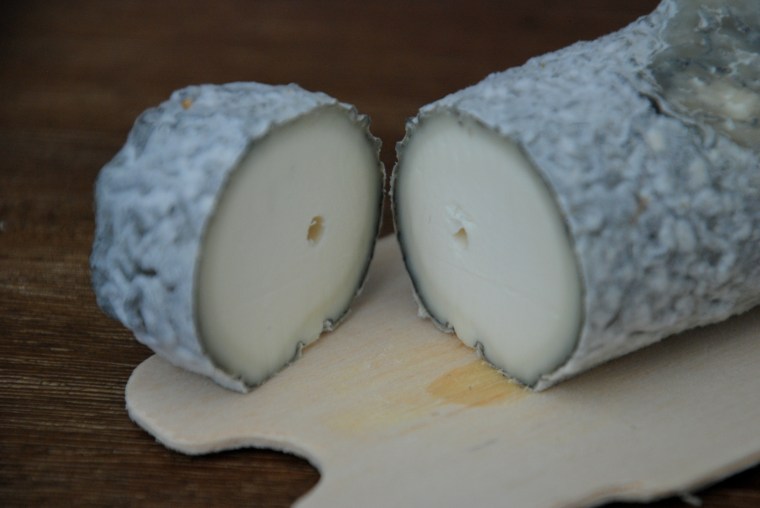
Sainte-Maure de Touraine: start cutting on the right
Cheese: Sainte-Maure de Touraine
Producer: Cloche D’Or
Where: Pont-de-Ruan, Indre-et-Loire, France
Week 32 has an excellent example of why I enjoy the 52 cheeses process. The start this time was inauspicious: we are in the process of moving from one country to another and time is precious: not exactly the best of times to seek out a cheese monger and ponder myriad choices. So, at a local Géant supermarket in Alsace, I found one of the few raw milk cheeses they had (the fact that the vast majority of the cheeses on offer were made of pasteurized milk shows that the country is going to hell in a hand basket) and took it home. And that’s always when it starts to get interesting: there is the tasting, and there is the research. The tasting yields pleasure, the research yields the stories, and these, for the purpose of this blog are probably more important. Let’s face it: most people have very little idea what it means when they read: ‘the cheese is nutty, with caramel overtones and some faint floral notes’. There is certainly room for elaboration at one point and I am not against using those kinds of words – but most folks that bite into a piece of cheese go one of two ways: “I like it!” or “Meh”, (Those that go “Eww, that’s disgusting” should have stayed away from that Munster in the first place.) so I would never take any flowery cheese description’s word for it, and just make up my own mind – and encourage others to disagree with my assessment.
So here is the story on Saint-Maure de Touraine. Let’s begin with the first part. ‘Maure’ of course comes from a word for ‘black’ (think ‘Moorish’) and the saint in question may have been some ancient deity in charge of fermentation – seems very fitting for a cheese to adopt this name. There may be a relation also to the Moors that stayed in France after the Saracens (yes, that’s kind of the same as the Moors) suffered defeat at the hands of Charles Martel in 732. They may have introduced goat cheese making in southern France – more specifically their women, because cheese making was a woman’s job. Skeptics point out that there were goat herds well before the Moors’ defeat, but it makes for a good story. The other excellent story related to this cheese is the notion that you need to cut the log at its widest end first. Get it wrong and the goat from which the milk came will lose its milk-producing mojo (I think I screwed up here). But onto the second part of the name, before I forget.
Rye Straw with the Name of the Producer
Touraine today lives on as a marketing concept: it is a somewhat well-defined tourist region encompassing much of the Loire Valley around Tours. In the olden days, it was first a county and then a duchy centered on the city of Tours, erstwhile capital of the Celtic tribe of the Turones (I am using capital in the most liberal sense of the word). Aside from tourism, Touraine also exists in the world of cheese, because since 1990, the Sainte-Maure de Touraine is protected with an AOP and can only be produced in what used to be the old duchy. And it has a very cool proof of authenticity: a rye straw is to run through the length of the log, and when you pull it out, you’ll find the producer’s name engraved on the straw. No straw, no name, no AOP.
A straw runs through it
My log came from Cloche d’Or. Most Sainte-Maure de Touraine is produced by large companies, and this is no exception. Cloche d’Or collects raw goat’s milk from about 150 farmers and churns out some 64o tonnes of the cheese every year. Not exactly your mom and pop cheesemakers, and interesting that such large enterprises busy themselves with making raw milk cheese. Sainte-Maure is a dense, creamy goat cheese with a typical slightly acidic flavor: while not particularly surprising, it is a very solid and thoroughly tasty contribution to the world of goat cheeses. A cheese that does its job, nothing more, but certainly nothing less. A day after my purchase there was but a sad stump left of the once formidable log.
High time, 32 weeks into my 52 cheeses project, to have a list: the most enjoyable cheeses thus far. Notice how I did not say the best cheeses thus far? I don’t aspire to be a cheese arbiter, I will leave that to people with better developed palates and a more astute choice of words. I simply look at which cheese encounters provided me with the most all-around joy, and here is what I came up with, in no particular order.
The Remeker is a favorite because I just think this is what God intended when he said: ‘there be Dutch cheese’. It is really that simple, and the encounters with the brown cows certainly did add to the fondness I have for this cheese. The Hooligan is just so much fun because it is in the house, really. Put it in the refrigerator and you cannot open the door without thinking ‘wow, something’s not right here’. Aside from that, it is just a very flavorful, smooth experience. Except when you mix in some crunchy rind. Then it is a crunchy experience. Two for the price of one! The Azeitão is small enough to spoon it out in one sitting. There is a lot of freshness, some tang, a bit of bitter, creaminess, and what is there not to like about a cheese with an ã in the name? The Mua was a surprise with its chamomile rind, which gives it such an inimitable flavor, and finally, for sheer fresh, delicious ooziness, the Croix Catal, which also deserves many points for looks, was unbeatable.
So there you have it: 3 cow’s milk cheese, 1 goat, 1 sheep. Five different countries and honestly, that is a coincidence, I had no desire to create some inclusive-diverse-feel-good list that gave each country its due. There are obviously a lot of honorable mentions, my list will change over time and I do not mean no disrespect to any of the cheeses I tried.
And then to the explanation: most blogs, I hear, do not make it past 10 posts. A few months ago it looked like mine would become a statistic as well. I did eat my cheeses, I did hone in on the cheese of that week and I made my notes, but I couldn’t find much time to write. So in two bursts, I am catching up and until early October, thanks to the wonderful technology of WordPress, my blog will continue to spit out posts on a regular basis, every few days, until I am completely caught up. In the meantime, I will be going forward sticking to one cheese and one post a week (two if there is anything interesting from the travel front) and in 2o weeks we’ll see which cheeses walk away with that coveted 52cheeses.com Gold Medal for 2016….
Yes, you guessed it, that’s a Greek cheese I am taking about. I picked it up during a brief stop on a cruise, in the town of Thira on the idyllic Island of Santorini, which more or less lives off tourism and agriculture. I found my cheese in a small, non-descript store that sold local products, and this one looked quite interesting. Little did I know that the island has its very own cheese, Chloro. For various reasons, I had not been able to do any homework on Greek cheese. I did find out later that the particular cheese I picked up comes from an island that was only about 40 miles away from a tiny beach in Yeniköy, in Turkey, where I would dip into the Aegean Sea a few days later. But back for a moment to Santorini.
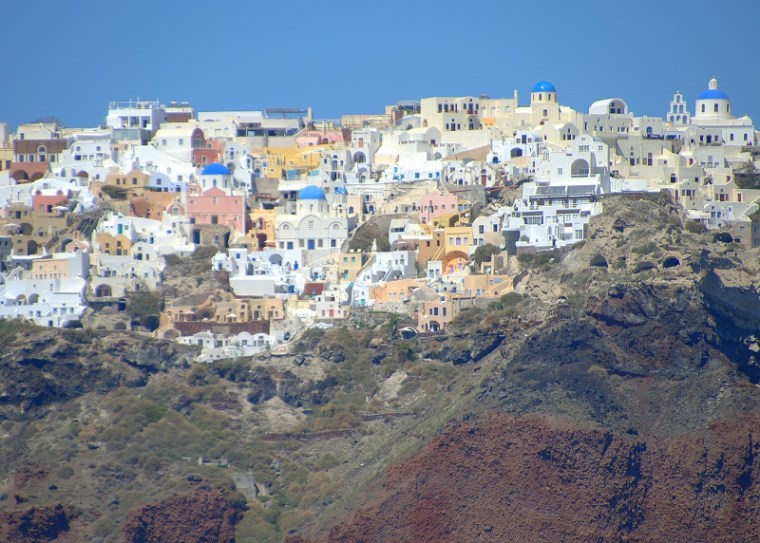
Santorini Island, Village of Oia
3,500 years ago, the people here were none too happy. That was because they got caught up in the Minoan eruption, a spectacular volcanic event that did extensive damage to the old Minoans and their civilization and created the Santorini we know today, a semicircle of sorts surrounding a lagoon with a small island in the middle. Volcanologists see a giant water-filled caldera, where the rest of us just see a string of pretty villages with white walls perched atop some very steep cliffs like icing on a gigantic cake. Thera, where I landed, is the least attractive of the little towns on the island so next time I am there I will have a double mission: see the tiny little towns with the blue-domed churches and get a piece of the Chloro cheese, even if the name does not sound inviting at all.
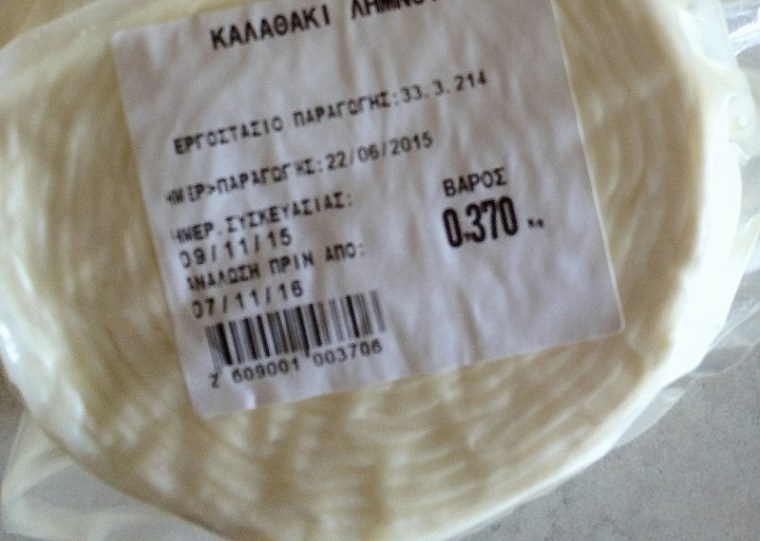
The cheese I did end up with was still interesting and, since I did not have high expectations, a very pleasant surprise. The Kalathaki was fresh and salty (it spends 3 weeks in a brine bath), with a bit of tang and since goat’s milk and sheep’s milk are mixed together to create it, you do get two flavors for the price of one, and they strike a nice balance, I found. I haven’t been a big fan of feta, perhaps because of the omnipresence of the factory produced stuff that is called upon every time olives and greens meet in a salad.
Imprint of the wicker basket that gives the cheese its name
This cheese matures for about 60 days in a small wicker basket and the imprint the basket leaves behind gives the cheese its name: Kalathaki means basket. It is one of more than 20 cheeses in Greece that has a Protected Designation of Origin (PDO, OR DOP, or AOP, depending on which EU language you are using). The sheep and the goats who deliver the milk for this cheese are largely allowed to roam around so what you get in the cheese is the flora and the climate of the island in a relatively straightforward way. Dedicated promotors of the cheese claim that is was around in Homer’s days – but the great poet didn’t really write about it, so it is not that easy to verify.
Santorini, Cathedral of Saint John the Baptist in ThiraSantorini, cruise ships docked in the caldera
Oma, the cheese for week 8, came from DTLA Cheese in Grand Central market in the elusive heart of Los Angeles. In the mid-90s, the effort to revitalize downtown Los Angeles was in full swing. The Public Library had reopened, Pershing Square had been redone, there was a museum of neon art, the new metro stations shone and sparkled with public artworks and Angels Flight had just been brought back from the dead. Twenty years later, those efforts seem to be bearing fruit: there are more restaurants and bars, a great many lofts, some green spaces and there are plans for a do-over of Pershing Square which, in its 90s guise turned out to be somewhat of a bust.
To me, the intersection of Broadway and West 3rd Street is a place where, then as now, revitalization is necessary only in the slightest sense – there is no real need to make huge improvements on what’s there, because it has always been an interesting and colorful corner. There is the beautiful Bradbury Building from 1893 that’s been used in many movies (most famously in Ridley Scott’s Blade Runner) with its cast iron stairwells and elevator shaft and the enormous skylight. As you exit the Bradbury onto West 3rd Street, you are face to face with an enormous mural of Anthony Quinn, who is dancing as Zorba the Greek. The mural is on the side of the Victor Clothing Company, where Quinn supposedly was a loyal customer. The Bradbury’s other rear exit leads to Biddy Mason Park, where a wall created by Sheila Levant de Bretteville recounts the remarkable life of Ms. Mason, who was born a slave, but eventually became one of the founders of L.A.’s First AME church. Additionally, Mason worked as a nurse and ended up owning quite a bit of property in the neighborhood. Across Broadway from the Bradbury is the former Million Dollar Theatre, which opened in 1918. Sid Grauman (yes, the one of Grauman’s Chinese Theater on Hollywood Boulevard) had it built as one of the first of its kind in the country. It marks the northern end of the stretch along Broadway that has a great number of theaters, some of which are barely used anymore, and others that are being rediscovered. The L.A. Conservancy, which busies itself with protecting architectural icons of the past, has a great program every summer called Last Remaining Seats. They stage movies, often with live music or a Wurlitzer Movie Organ, in these old gems. For a few hours, anyone with a (reasonably priced) ticket can relive the glory days of L.A.’s own Broadway. It is worth it showing up on time, as the seats are all sold at the same price and late comers end up in the seats right under the ceiling…
The Million Dollar Theater has been part of the lineup for Last Remaining Seats in years past. The building also was known for years as the home to the Farmacia Y Botanica Million Dollar , but early in 2016, that business closed. It did not just sell basic drugstore items, but focused especially on votive candles, rosaries, saint statuettes, amulets, potions and spells. Anyone with great expectations or concerns in love, money, career, family or all of the above could go here and get the necessary spiritual accouterments needed to ward of the bad and bring in the good. Alas, it is all gone now, just like the plaques in the pavement honoring Latino greats from the movies, such as Pedro Armendáriz and Dolores del Rio.
Chiles Secos !
Next door, though, the Grand Central market is thriving as it is currently trying to navigate the pitfalls of gentrification. The oldest market in Los Angeles, dating back to 1917, still sold day-old conchas, pigs ears and knuckles, fruit with blemishes and Chinese herbs when I first visited in the 90s. Today, the breakfast line for Eggslut is out on the street, there is a McConnell’s Fine Ice Creams outlet, a place where they cure salmon and other fish and a stand which offers German Currywurst. But some of the low-end merchants are still there, the produce is still inexpensive in many places, and Chiles Secos still sells mole – there is hope! Let’s pray that we won’t have to join in the Big Yellow Taxi refrain any time soon for any of these places that derive so much of their authentic charm from being a little worse for wear, a little tattered, a little rough around the edges.
Don’t it always seem to go
That you don’t know what you’ve got
‘Till it’s gone
They paved paradise
And put up a parking lot
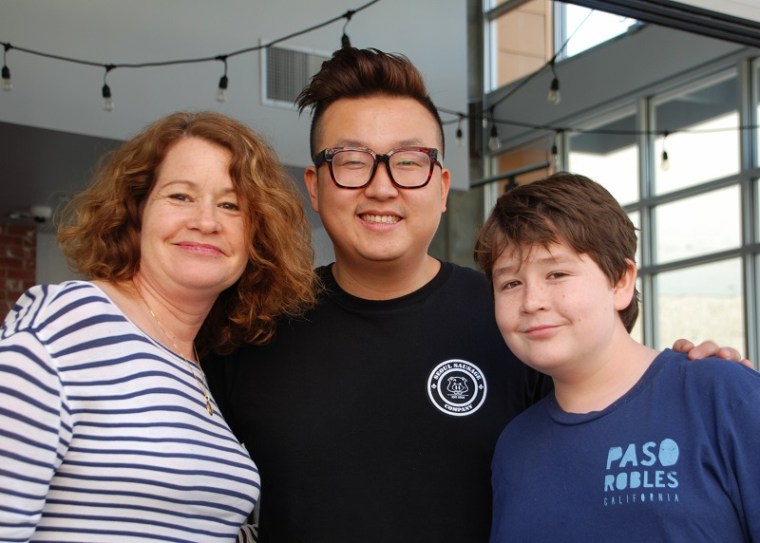
Yong Kim and fans
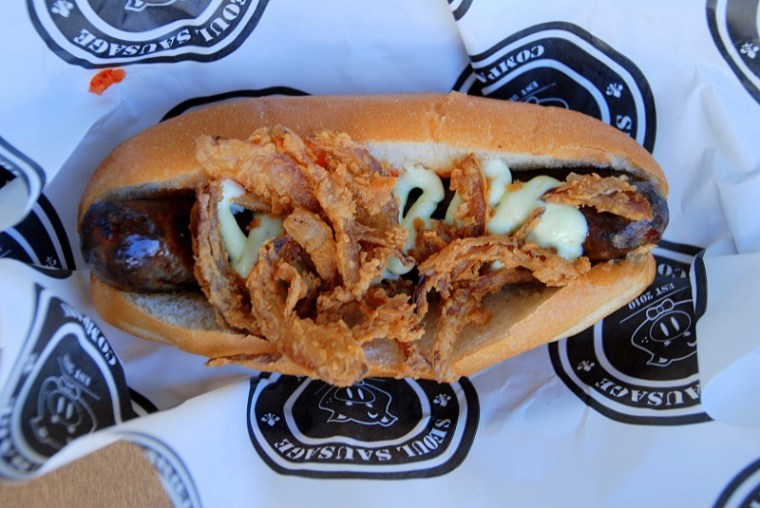
On this week’s visit to downtown, we also fulfilled one of Charlie’s recent dreams when we visited Seoul Sausage, a restaurant he had heard of because he watched the Great Food Truck Race on Netflix. A few years ago, three young Korean guys won that show – they had been Charlie’s favorites throughout all episodes. Yong Kim, one of the three stars of the reality TV-series was there and Charlie had his picture taken – ah, and of course we had the sausages and the famous rice balls. We also picked up a t-shirt with a profound message: “Make sausage, not war”. Peace, everyone.
In my quest for 52 cheeses in 2016, I either try to find some time during travels domestic or international, or I default to my neighborhood Whole Foods. That’s a very flexible concept, because as many Angelenos, my work neighborhood and my home neighborhood are quite a ways apart, and there are a number of stores that fit the bill. I like the Whole Foods in Woodland Hills a lot, because they carry a very wide variety of cheeses, many of them made with raw milk. From what I understand, each store can order from a very big list that WF central decides on, and it seems clear that some stores have a fierce resident cheese monger while others don’t. I am certainly not a fan of the one in the Rolling Hills Plaza – had more than one disappointment there.
Of course between getting my Cheese in Avignon or in Woodland Hills there is a third way: local travel. And a bit of travel it always is, in the City of Angels. We try to combine any weekend quest for cheese with other food destinations in the same area, heck, we even throw in a little local culture on occasion. Here are, in no particular order, the mongers we have visited thus far in the 52 Cheeses Year.
Cheesemongers of Sherman Oaks sits on a strip along Ventura Boulevard that has a lot of upscale, trendy shops and restaurants, and they fit right in. They do cheese, cured meats, they do sandwiches and they sell all the paraphernalia that go with these foods. It is a modern, airy looking place and the owners, Kia Burton (cheese girl) and Chaz Christianson (meat guy) clearly enjoy what they are doing. We met and chatted with Chaz and admired both the selection of spectacular meats and the lovingly laid out cheese counter.
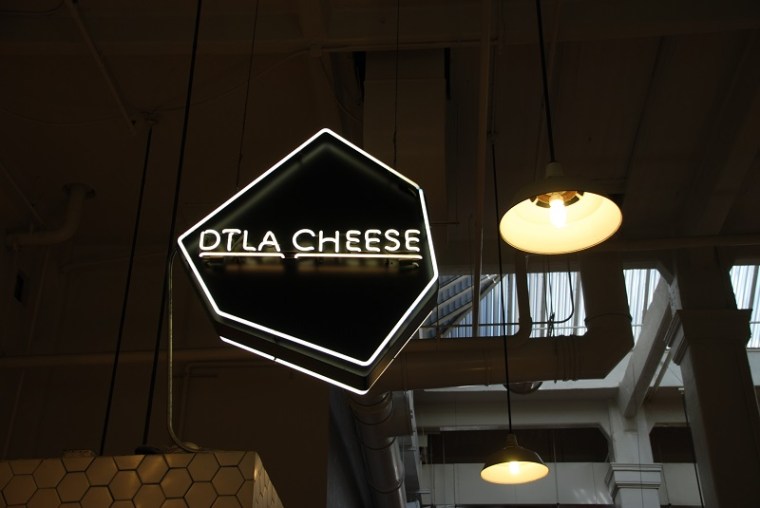
DTLA Cheese in Grand Central Market
DTLA Cheese in the Grand Central Market is a different place entirely. Because the market now is always busy, there is never a boring moment at the cheese counter, and I suspect that much of their income is from their mac and cheese (well-deserved income, I would say) and their sandwiches.
Grilled Cheeeeese Sandwich
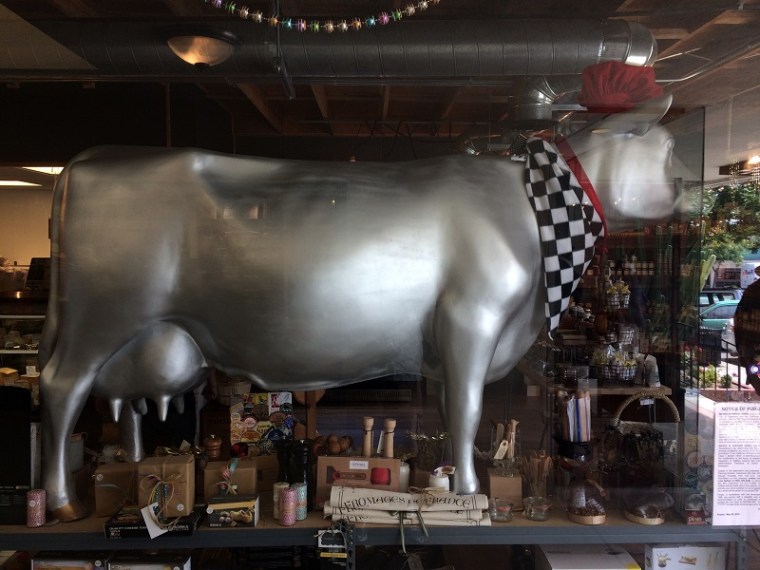
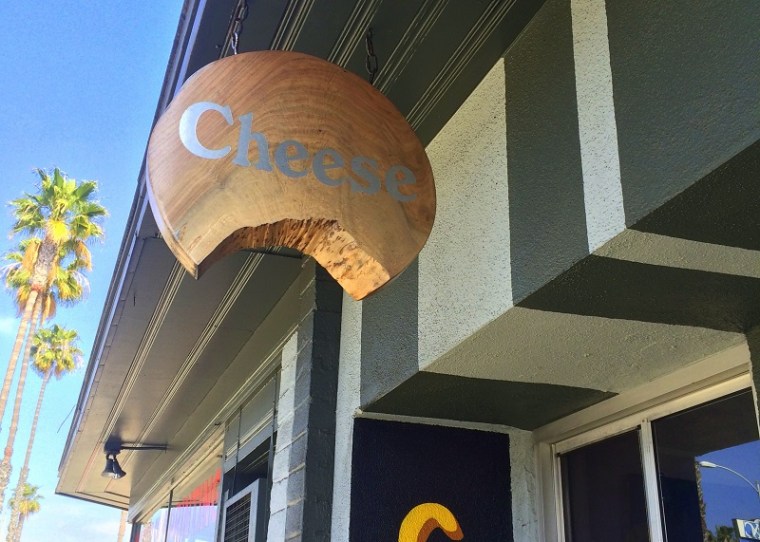
The folks there are friendly, and seem to enjoy working there. The owners are two sisters, Marnie and Lydia Clarke, and their other store is the Cheese Cave, which is possibly the most cluttered among the four places listed here, but I mean cluttered in a good way: who would not want a silver cow in the window, and who would not want to walk out of a place with sixteen items you didn’t know you needed?
Cheese Cave: Window Dressing
In Culver City, in a neighborhood that is, well, soon-to-be-but-not-quite-yet gentrified, is the Wheel House, where they do tastings and classes and make sandwiches, sell $15 jars of jam that’s worth 16 dollars at least and where I have picked up some smelly chunks of Hooligan, one of my favorite cheeses in their assortment. They consider themselves as much of wine shop as a cheese monger.
Wheel House Wine and Cheese in Culver City
All four of these are completely worth the visit and they are so much more than your local Whole Foods or Trader Joe’s. Be prepared to spend a little money; they all sell much more that what you really need (but they’re so attractive that you forget what you really need and go for what you really want), and good cheese is not cheap.
Yes, indeed, there is a connection between the cheese and the von Trapp’s of Sound of Music fame. The great-grandfather of the two cheesemakers, brothers Sebastian and Dan von Trapp was that famous von Trapp, played by Christopher Plummer in the wildly successful movie that took enough liberties with the actual family’s story to leave several von Trapps somewhat irritated with it. At any rate, the cheese makers, above claiming cheap and easy fame instead present themselves as the third generation of dairy farmers from Vermont. Grandfather Werner bought the farm with wife Erika in 1959, and here is where the name of this cheese comes in. ‘Oma’ is the informal address for one’s grandmother in German – in English the cheese would have to be named Grandma. The milk for Oma comes from a herd that is largely made up of Jersey cows, with some other races mixed in. the Farm’s website features some of these happy girls
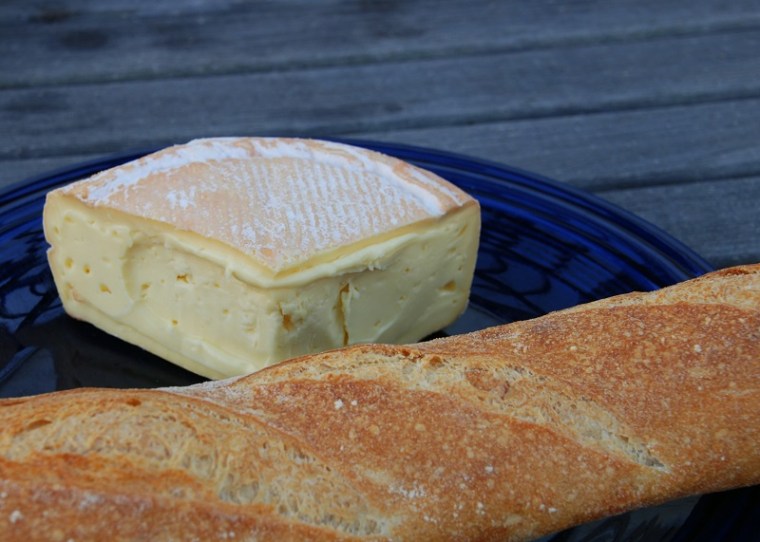
The semi-soft cheese comes as a small wheel, about 6 inches in diameter. It is aged and washed in brine at the Cellars at Jasper Hill, the affineur that also ripens the Landaff cheese of Week 7 fame. After 60-90 days, the cheese has developed a pale orange rind, a decent smell and a very balanced flavor. As washed-rind cheeses go, Oma is relatively mild and creamy, while full-flavored – perfect if you want a little adventure without completely stinking up your refrigerator. And: it’s made of raw milk, which means the flavor is brought to you in cooperation with the natural bacteria in the milk, not just those added in the cheese making process. Therefore: more flavor, more goodness.
Cheese Counter at DTLA Cheese
I found my piece of Oma at the DTLA Cheese shop in Downtown L.A.’s Grand Central Market, where they do more than just sell cheese. They also serve a mean mac and cheese and their grilled cheese sandwiches are guaranteed to leave you with strands of melted cheese dangling from your chin. They are so good, you will not care. DTLA is the second venture of cheese sisters Lydia and Marnie Clarke, their first being the Cheese Cave in Claremont.













 52 Cheeses