Brothers Simon and Tim Jones of Lincolnshire Poacher Cheese are certifiable cheese nuts whose web pages are brimming with enthusiasm and idealism. They run their place on wind and solar, heat their milk with straw pellets and even pump heat out of the ground. And we’re not even talking about the cows yet. Their 230 Holstein Frisians munch on food that is largely grown on the farm, a family operation since 1917 (they also have a few Ayrshire cows – that’s a Scottish breed, but they blend right in because they look like red Holsteins, pretty much). As the Joneses do not use pesti- and other cides, the cows live among happy healthy bugs and critters of all kinds. Their farm sits 7 miles or so away from the North Sea near the town of Alford, which has a windmill with five sails as its claim to fame. A very disturbing sight for a Dutchman. Anyone who knows something about windmills understands that more than four sails is just wrong, and in England apparently that are some mills that even have six sails. One needn’t wonder why the Empire couldn’t last.
The piece of Lincolnshire Poacher I had was relatively young, had a fresh clean taste and a beautiful yellow color. I liked it a lot, but I will be looking out for their more mature cheese, because I believe that there is more flavor and goodness to be had with age. Some of it is aged over 3 years. You can listen to Simon Jones explain this and more on a beautiful little video; their website is also a treasure trove of information, photos of happy cows and of the assistant cheesemaker who apparently likes to play the trombone when he is not up to his elbows in curds.
The Lincolnshire Poacher is originally a traditional song that has been adopted as an anthem of sorts of Lincolnshire county. It is used as the official march of several military units. Benjamin Britten even arranged a version, but that one is for the dogs. Chris Sarjeant plays the tune in this video. It has crappy sound quality, but the crowd sings along and he picks a mean guitar.
When I was bound apprentice in famous Lincolnshire, Full well I serv’d my master, for more than seven year, Till I took up to poaching, as you shall quickly hear. Oh, ’tis my delight on a shining night, in the season of the year.
Ah, our new Swiss Life. After I picked up what I needed from the local web provider, I walked across the street that makes up downtown Reinach to the local butcher and deli, who also sells cheese. I wanted something for dinner, so I got that, some Unser Bier (see Week 33) and this little cheese, wrapped in a white piece of paper with a cheerful blue logo printed on it. And thus, I stepped into the world of Michel Beroud, a cheesemaker in a town that can arguably be considered the cradle of Swiss Alpine cheeses.
Fleurette (CH), Brin d’Amour (F, top left), Muehlestein (CH, middle), Biermutschli (CH) and Holzhofer Extra Rezent (CH, bottom right) – there is more than Gruyere and Emmental here!
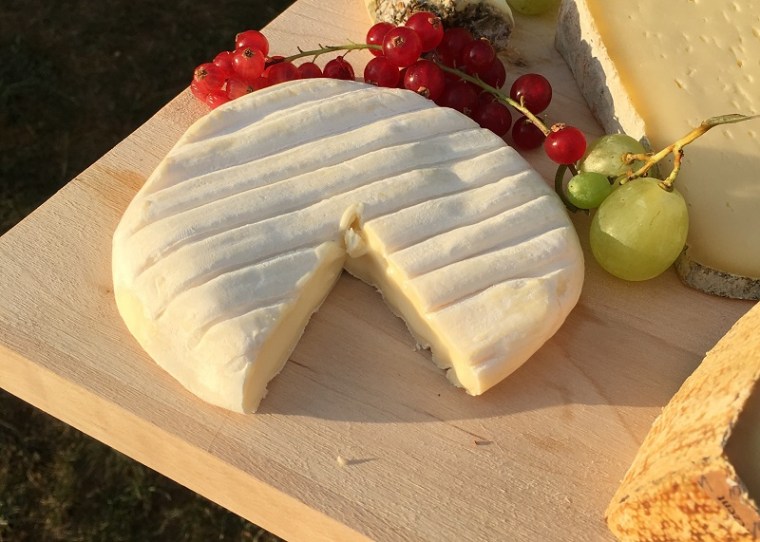
The Fleurette, as the story goes, was the nickname of a woman who came to help pack cheese and showed up every day in an apron with flowers all over. This cheese comes from raw cow’s milk, and the cows that make that milk live their lives chewing on grass that grows on an altitude of about 3,300 ft (or hay of that same grass). Mixed in with the grass is clover, wild cumin and other yummy greens that all find their way in the fine flavor the cheese and a fine flavor and texture it is! Oozing out of its perfect white bloomy rind is a white, creamy fresh-tasting goop that, at 2 weeks ripening, has quite a bit of structure and depth. I know, I know, that sounds convoluted – ok, so it is a bit saltier and has a bit more flavor that you would expect from such a cheese. Beroud makes some other cheeses as well, so I believe I may soon be back at my friendly neighborhood cheese store. But read my post for Week 38 – you’ll find that there is more in this corner of the planet in the way of cheese opportunities.
Just southeast of Syracuse in New York is Cazenovia, and don’t say “well, everybody knows that”. Cazenovia is home to a little over 7,000 souls and at least one ridiculously photogenic farm, Meadowood. Oh, be that way, don’t take my word for it. Look at their website and then agree with me, that’s fine. Meadowood is home to a herd of East Frisian sheep. Apparently these woolly wonders are the best that sheepdom has to offer in versatility: they produce a lot of milk, compared to other sheep, they provide fine wool and if all else fails, they don’t taste so bad either. The perfect package for a relatively small farm. The cheesemaker here is a woman by the name of Veronica Predraza, and
You can listen to a radio interview with her here. I just thought that I could put that in here, because I have not yet had the opportunity to link with a radio program. You can skip the first 2:12 minutes.
Ledyard – competition in the background
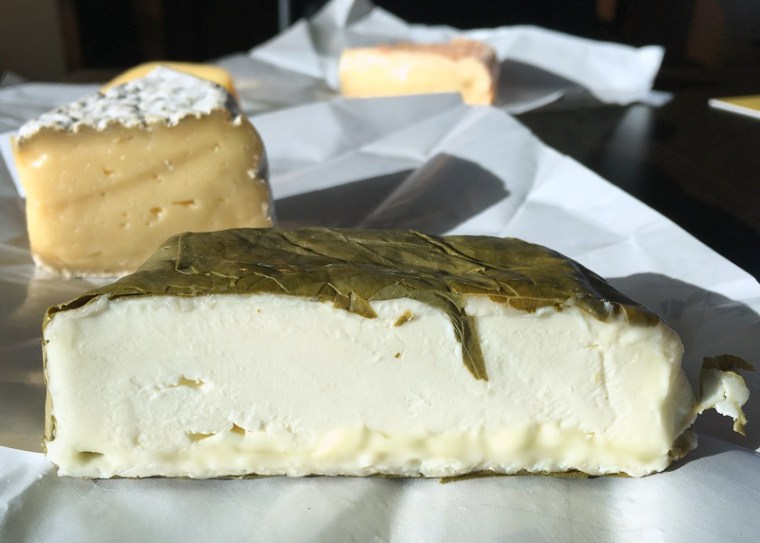
Veronica gave us Ledyard, this week’s cheese. She clearly knows her stuff and ended up borrowing an Italian tradition – that of the leaf-wrapped robiolas – for this particular cheese. so you take your soft ewe’s milk cheese, soak some grape leafs in beer (Deep Purple, a beer made with Concord grapes added for flavor and the purple color), slap ‘em on the cheese to create a neatly wrapped package, let it age for 4-6 weeks and voilà, you got yourself a cheese that is something else altogether. Ledyard is fresh, with some herbal notes, a bit of yeast and a bit of fruit, and yes, this time around I mean all of this high-falutin’ stuff: the cheese packs a lot of different flavors in each bit, and they all seem to be vying for attention, not all together, but one after another, which makes eating the cheese pleasantly confusing (is it a vegetable? No! Is it cream? No! Is it a drink? No!)
Notable: Ledyard became this week’s cheese after a pitched battle with the other cheeses I got from DTLA Cheese, a battle that took the shape of a true cheese orgy: the Smoked Kashar from Parish Hill Creamery in Vermont, the formidable Bandage Wrapped Cheddar from Fiscalini in Modesto in the Golden State, the Adair from Jacobs and Brichford in Indiana’s Whitewater Valley and the take-no-prisoners stinky Dorset cheese from Consider Bardwell Farm of West Pawlet in Vermont. Given the strong field – much better and more competitive than the republic presidential slate. And because of that, let’s show all of the contestants: drrrrrrrummrollllll:
Smoked Kashar from Parish Hill CreameryBandage Wrapped Cheddar from Fiscalini FarmsAdair from Jacobs and Brichford FarmDorset from Consider Bardwell Farm
In today’s popular parlance, this cheese is a boss. In particular the kind that is ripened some 18 months, and that the Swiss call ‘rezent’, which has nothing to do with recent, on the contrary. The word means something like ‘sharp’, and that tasty sharpness is reached after ageing for a good long while.
The valley of the Emme in the Canton of Bern has seen people make cheese for some 800 years, most of the time just for their own use, and to give some of it in exchange for their lease of the pastures to their feudal lords. Only in the early 19th century did it become more widespread and then it took off. Emmentaler is one of the most copied cheeses in the world – heck, even Kraft slices come in something that vaguely resembles the Swiss King of Cheese. I am frankly surprised the Swiss have not ever considered severing ties with the US for that abomination. Emmentaler as protected by the AOP designation is now made in a fairly sizeable part of Switzerland, not just in the Emme Valley, but the stipulations about its production are still quite stringent: raw milk, no silage for the cows, a certain percentage of the diet of the cows has to come from fresh grass etc.
Wirth’s stall on the Basel Market
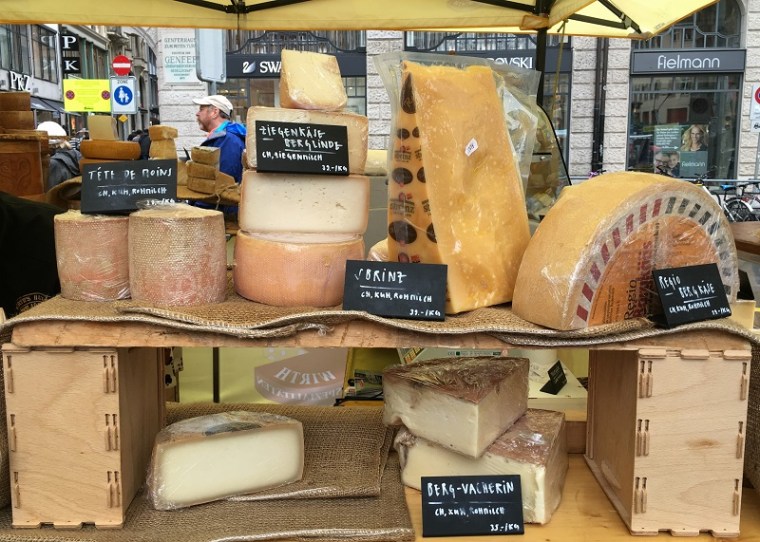
My ‘rezenter Emmentaler’ came from the Wirth cheese stand on Basel’s main market, and like in many other places, the cheese is not presented as from a particular producer – so it is anyone’s guess if the cheese is actually from that fabled valley, or from a place in the neigborhood that fits the bill laid out in the rules of the AOP. So yes, I am lying up there where it says ‘where’… all I know for sure is the cheese is from Switzerland (if it isn’t, someone else is lying)
Holy holes!
Of course all of this is fine and good, but really, the only thing everyone always wanted to know about Emmentaler is: where do the holes come from? Meet Propionibacterium freudenreichii. Freudi, as I like to call him, is a bacteria that inhabits, well, us – there are quadrillions of them in our skin. Freudi is also useful in the production of certain cheeses, and when he is done with his useful reductive work, he leaves flavor and a lot of gas, CO₂ to be exact. The gas finds tiny little bits of haydust in the cheese, enters the minute little capillaries in the hay and voom! it expands and creates a hole.
Emmentaler Crater
If that sounds farfetched, don’t take my word for it. Buy a copy of the study by some Emmentaler-obsessed Swiss scientists in Bern (it will set you back $40, so you may just want to trust me on this one). Raw milk contains more bacteria than pasteurized milk (among them also lactobacillus helveticus, a colleague of Freudi who does a lot of groundwork for him, before he gets started with the whole gasmaking operation) and winter milk has more haydust in it than summer milk, so you know what to do when you want big holes in your cheese. The holes ought to be round, poorly shaped holes may very well point to poor performance on the part of the bacteria and hence poor quality cheese. And the salt crystals and the occasional ‘tear’ of salt water in the bigger holes of the more ripened cheese: it’s all part of the fun. I am sure that you are familiar with the sweet, sour taste of Swiss cheese. Add to that the multi-layered depth owed to raw milk and a natural production process and then, bam! compound that with the body and complexity that comes from 18 months of careful ageing – and there’s a cheese to bow in front of, and chant: ‘we’re not worthy, not worthy, not worthy’, before taking a big fat bite.
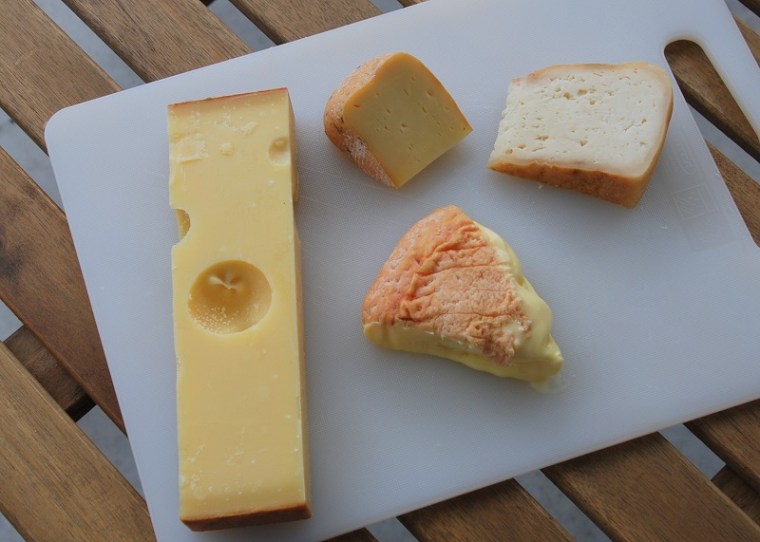
Cheese selection from Wirth’s in Basel: the Boss on the left, Biermutschli (top) and raw milk Epoisses in the middle and the ‘cheese of the week’ (dang it! forgot what it was) on the right.
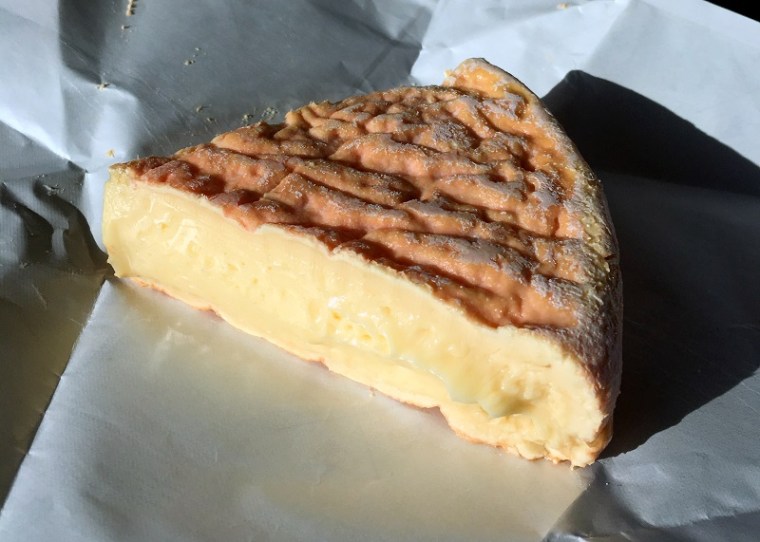
In a French supermarket on the very edge of the Hexagon (the French call their country L’Hexagone sometimes, because of its shape), I experienced one of the blessings of living in the heart of Europe. It is 500 miles to Livarot, but I was able to get my fresh, raw milk Camembert from that very town in Normandy. Because in the US, the FDA watches over you and makes sure you don’t do anything that could be bad for you, you are not able to have a raw milk Camembert unless you leave the country. In our case, we also left the country but we did so in a car and we were back home again for dinner. We brought home a Camembert from E. Graindorge, a rather large producer, with a history going back to 1910, to grandpa Eugène. They have a slick, well done website, and the cheese can be ordered online. They produce some 11 different cheeses, all from the milk of those Normand cows that is transformed into some of the best cheese in the world. Among these cheeses, they feature the blockbusters, Livarot, Pont-l’évêque, Neufchâtel and Camembert de Normandie. All four of them carry the AOP designation, and the other three one day each deserve their own post. The Camembert, a soft cow’s milk cheese with a white bloomy rind really needs no introduction – it is produced all over the world, which explains the long official name of the cheese we brought home: any old cheesemaker can produce a cheese that looks the part and call it Camembert, but Camembert de Normandie is autre chose: something entirely different.
Curds are hand-ladled into the mold – the seal guarantees it!
The cheese with the AOP seal is made from milk from Normandie cows, the curds are scooped into the mold by hand (very carefully, to guarantee just the right texture, and the milk is always raw. Marie Harel, an intrepid farm woman from Vimoutiers helped a man of the cloth, a certain abbot Bonvoust, as he was hiding from the French revolutionaries and he taught her a method of cheese making from his native Brie, which she adapted to create Camembert as we know it today. All of this happened in the waning years of the 18th century, and most, if not all of it, is entirely made up. Marie Harel did exist, but the cheese bit is unlikely, even if the story is a good one, and there is even a statue celebrating her ‘invention’ in Vimoutiers, paid for by an American who claimed to have had tremendous health benefits from eating copious amounts of Camembert. Whatever the origins of the cheese are or aren’t, Marie Harel’s descendants for many years just rudely claimed to own the exclusive rights to this cheese and tried hard to box other farmers out of the lucrative business of supplying Paris with the very popular cheese. Eventually other farmers got in on the action as well, and it wasn’t before long that Camembert was discovered elsewhere. So the early marketing and subsequent success of the cheese set the stage for widespread imitation and eventually necessitated the current clarification to the name. And yes, there is a difference, and it is huge.
Sadly, we were too greedy: should’ve poked it gently before cutting it. a ripe cheese gives a bit more than one that isn’t quite done. The lighter, drier part in the middle isn’t quite there yet. Camembert is OK, but not divine at this stage.
A ripe Camembert de Normandie tastes like the Almighty intended cheese to taste. It has a bold aroma, a creamy consistency, and it adds a bit of a kick to a mouthful of barnyardy, mushroomy flavor. But never mind the adjectives, because there are certain things in life you just recognize when you experience them, even for the first time. Every bite from a real Camembert that has ripened to that ‘just right’ stage is, well, just right – but on a cosmic scale.
The Swiss buy Swiss. Of course they buy German cars and Korean cell phones. But when you go to any grocery store, it is very easy to find out where your food is coming from, and the information doesn’t just reassure buyers that they’re getting ‘made in Switzerland’. Often, the canton is identified as well, and I have seen cheeses with perky little signs that tell you the family farm whence the Käse came from, and this not just in high end cheese shops. Of course, it makes many things quite expensive, because anyone in Switzerland engaged in producing your foodstuffs is paid a decent wage, generous benefits and excellent but expensive healthcare. The Biermustschli is a case in point.
A Mutschli is basically a small round semi-hard cheese somewhere between one and 10 lbs (so much smaller that many of those huge wheels the Swiss roll down the mountains). And this particular cheese comes from the town of Mümliswil, about an hour from Basel. It is made of raw milk and the cows are fed grass or hay exclusively. In ripening of the Biermutschli involves washing the rind with beer and hops; they also smoke the cheese a bit. And the beer used is Unser Bier, literally ‘our beer’, which comes with a tagline that epitomizes the fondness the Swiss have for locally produced things: Bier von hier statt von dort – beer from here instead of from there. Unser Bier got started with a guy who brewed 18 liters of beer in a pasta pan – the rest is history. They create some unusual brews – their summer beer has elderflowers in it, and for the fall they do pumpkin beer.
Mutschli and Summer Beer with elderflower
The guy with the crown sticking out his tongue in the logo of Unser Bier is Basel’s famous Lällekönig, the name for a mechanical device in the shape of a human face with moving eyes and a tongue that moved in and out. Originally, this could be seen on the Rhinetower, and it was connected to the clock on that tower, which stood on the city-side of the old bridge across the river. Eventually, the Tongueking (the character wore a crown) became quite famous and today, with the tower and the original Lällekönig long gone, there is a replacement on the facade of the restaurant at the city end of the bridge. The people on the Grossbasel side of the river like to think the King is sticking out his tongue in the direction of Kleinbasel (little Basel, formerly an independent suburb – across the water, think of Oakland), but there is no historical evidence that the person who made the machine wanted to do anything else that createan entertaining contraption – and he succeeded. And of course, today the red tongue is on the Mutschli, a delightful cheese that just has the perfect balance of smokey, yeasty, a faint touch of bitter and a lot of creamy body – we went back to the market square, to the Wirth cheese stand, a week after we hand a conservative slice to try it to buy our own whole Mutschli. Soon e Kääs!
Phew! After moving to Switzerland, traveling back to the US to get my travel documents sorted, picking up the final dog to complete our household and a host of other things, I am finally caught up. This is why there will be a small avalanche of posts: weeks 33 through 37 will pour like lava from an erupting volcano (or like fondue from a toppled pan) onto these blog pages today and the only thing left to do for the week is to talk about my new cheese of the week which will come from Austria or Germany. That’s right, I am doing another one of those cheese cage matches, where two cheeses fight to the death for that prized title of Cheese of the Week.
In the meantime, I still have a lot of catch-up posts that will be released on a regular basis, one after another, until all of the Cheeses of the Week have been accounted for. The above picture is one I would like to dedicate to my family. While the biggest burden of the 52 cheeses project falls on my shoulder, they too pitch in where they can to lighten my load as I eat my way to the finish line, only 14 more cheeses away.
Look forward in this place and on Our Swiss Life for dueling accounts of this weekend’s adventure: the Désalpe in St. Cergue, Vaud, Switzerland, an all-cow extravaganza that features more cowbell than even Bruce Dickinson would care for, alpenmacaroni in ridiculously large pans and all manner of other things we look forward to, based on our first cow encounter of the third kind, a lifetime ago.
In Salamanca I bought a well-ripened Torta del Casar, a sheep’s milk cheese named after the town of Casar de Cáceres where this cheese originated, in the Extremadura, a region in Western Spain. There are a lot of producers in the area, mine was from the creamery of the brothers Pajuelo (Santiago is the brother who is still alive, Ignacio has passed away). They brand their torta Manjar Extremeño. Which probably translates as ‘delicacy from the Extremadura’ or something like that. Cáceres has UNESCO World Heritage status and the cheese befits its origin, because it is monumental. Like some other cheeses on the Iberian Peninsula, cardoon thistle pistils are used in curdling the milk, and this process leaves a faint bitterness in the cheese, that only adds to the complex flavors in this bad boy. It has a distinct smell and an equally distinct taste.
Ready, set, spoon!
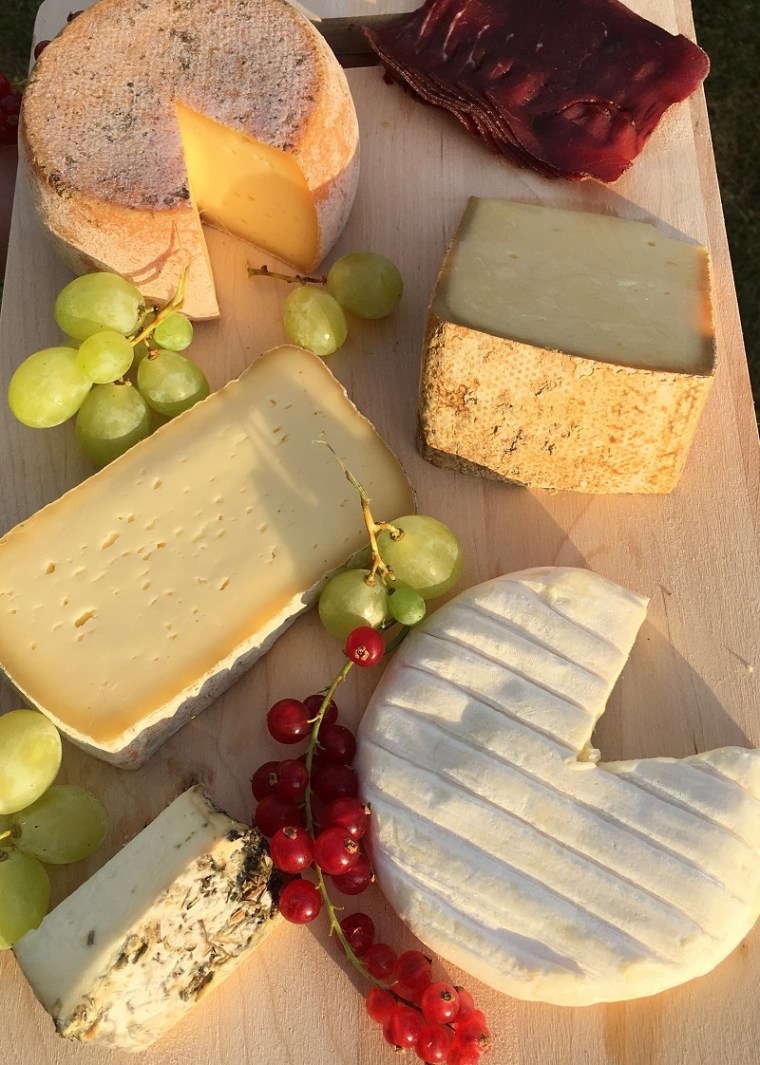
It is a big fat mouthful, especially when eaten as intended: put the torta on the table, slice of its top (the rind is quite hard as does not get eaten) and start spooning. The milk for the torta comes from Merino and Entrefina sheep and because both are not prodigious producers, it takes the milk of a small herd of sheep to make a single cheese. In turn, that makes Torta del Casar one of the most expensive cheeses in Spain. Cured for a minimum of two months, it is worth getting a cheese that is a little older to get the full benefit of the full-flavored runniness that makes this such an excellent experience. In 1999 the Torta received its DPO protection. There are at least another 3 tortas in Spain (Torta de Barros, Torta del Canarejal, and Torta la Serena) that are eaten in a similar fashion and have similar flavors. Collect them all! This one was eaten with colleagues as the sun was setting over the Douro Valley in Portugal, together with some other splendid cheeses from Salamanca, a dinner where cheese was the main course.
Ah, Salamanca. What a delight, what a delight. And what better place to soak up this delight but the Plaza Major. As a visitor, it is your job to see as much of a city as you can, but in this case, one could easily be forgiven if all available time is spent here, where the heart of the city beats. It gets brutally hot here during the day, so in the morning or after sunset is clearly the best time to hang out here, drink coffee or a glass of wine, depending on the time of day, and observe the going-ons on what is easily one of the most beautiful squares in Europe. The Plaza Major was started under King Philip V, who had successfully waged a war of succession (“I am the king” “No, I am the king” “No you’re not!” and so on, and so forth) with some important backing from the city of Salamanca. The grateful new king paid for the plaza, which was designed by one of the younger Churriguera brothers, Alberto, his nephew Manuel and Andrés Garcia de Quiñones.
Salamanca’c City Hall
In the Iberian Peninsula, they know a thing or two about architectural decoration – in most styles, there is a lot of it (probably a link to the Moorish past): in Portugal, the Manueline style is Gothic on steroids, the Plateresque is over-the-top Renaissance and the crazy bombastic baroque is named Churrigueresque after the aforementioned family. The brothers new a thing or two about making a building look positively spectacular. They actually went easy on the Plaza Major – the better Churrigueresque is seen in many churches of the period, and the style actually had somewhat of a revival in southern California with San Diego’s 1915 Panama-California exposition. A number of those buildings can still be found in Balboa Park. But back to Salamanca, drinks, cool night air and idle musings while blowing smoke from a Cuban cigar….
Where was I in those idle musings? OK, back to my contemplation on the job of the visitor, because beyond the square there are a host of other things to see here. The university has a number of splendid buildings (it is one of the oldest universities in Europe, founded in 1134), and then there is the cathedral, no wait, two cathedrals for the price of one. And that’s quite literally: you pay an entrance fee in the Gothic new cathedral and after you are done there, you can move on to the Romanesque church, which is right next door.
Vaulting in Salamanca’s New Cathedral
Usually when the church builders of yore created the great Gothic buildings, they plonked them right on top of the Romanesque church that was already there, taking it apart bit by bit to make room for the new and improved. Here, they decided to build the new building right next to the old one. I am a great fan of church art and architecture and the two cathedrals of Salamanca along with the cloisters are sort of a church-orgasm (no offense intended).
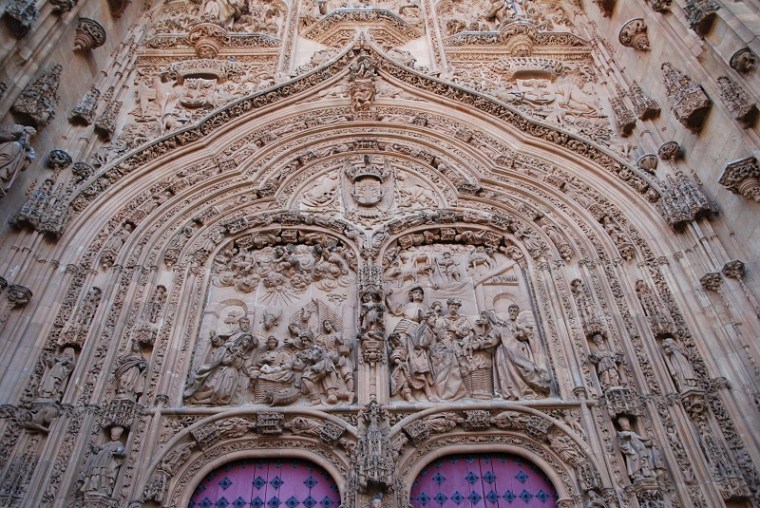
Nativity Portal of Salamanca’s New Cathedral
From Romanesque to Gothic, Renaissance and Baroque, the four major styles of the 600 years it took to build this complex are all splendidly represented in what is in essence one big labyrinth of a building. Both the outside and the inside are worth a great many oohs and ahs, so take your time here. The University buildings are in the same area, in fact most of Salamanca’s must sees are in a relatively small area. The oldest university building in particular has a facade that is a textbook example of the Plateresque style: Renaissance with a very high ‘look-at-all-that-stuff!’ factor.
The Catholic Kings on the Facade of the University of Salamanca
Another building worth a mention is the Casa de las Conchas, the House of Shells. It was built by one Rodrigo Arias de Maldonado, a knight in the order of St. James and the scallop shell (coquille Saint-Jaques, as the French would say) is a symbol not only of the Saint himself, but of the pilgrims who visit Santiago de Compostela in Galicia in northern Spain. Even today, as the road to Santiago is experiencing a revival, people carry a shell on their backpack. If you don’t believe me, rent the movie The Way, starring Martin Sheen and somehow featuring a big burly Dutch character named Joost (weird). This building has hundreds of these shells on the facade. Today it is the city’s public library and it is another must see (so much for hanging out in the plaza, I realize I am starting to harangue now).
Casa de las Conchas in Salamanca
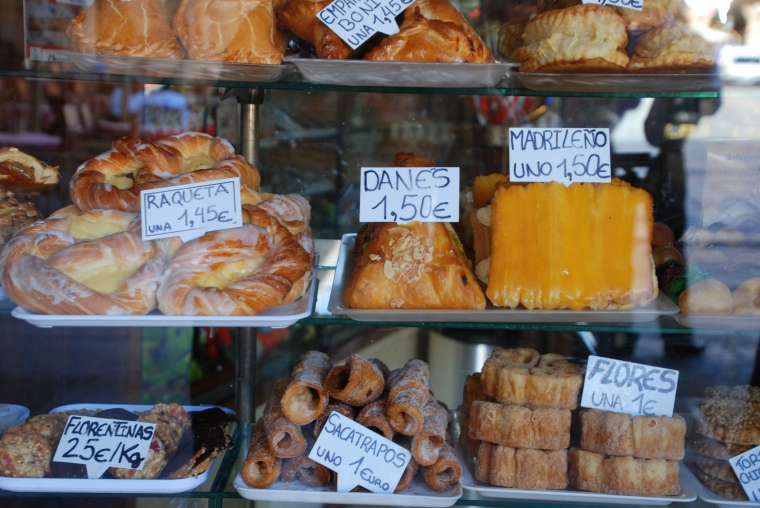
In the streets between the Plaza Major and the Cathedral there are lots of restaurants, small shops and bakeries with windows too good to pass by without stopping. None of it seems very good for the waistline and yet I did not see many residents with particularly inflated physiques. That reassured me into trying various tasty treats – I recommend the Madrileño for its stunning crumbing qualities (center right in the picture).
Bakery in Salamanca
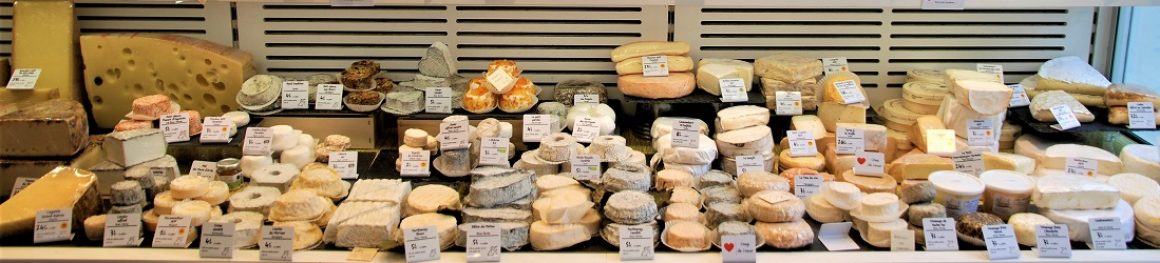
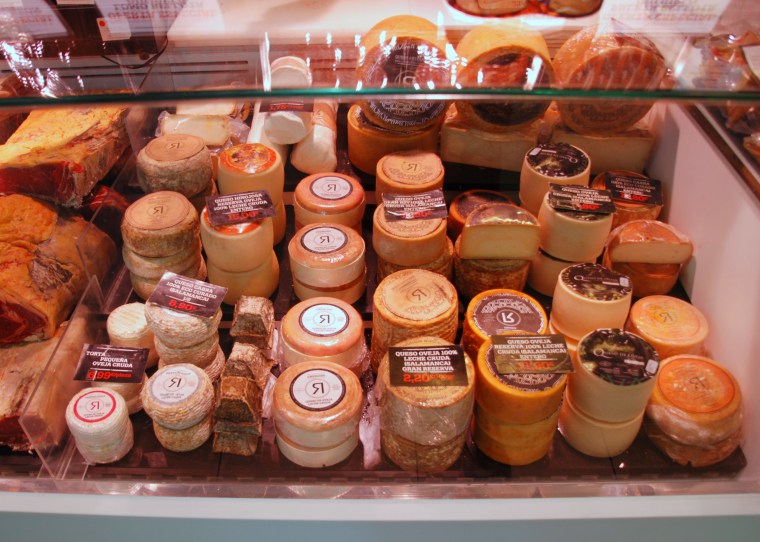
Finally, just off the Plaza Major is the covered market from the early 20th century, a temple of delicacies offered in clean, well-organized stalls. My runaway favorite here was the Rivas business, 4th generation merchants that offer all kinds of meats and a fine selection of raw milk cheese.
Rivas’ Queso Counter in Salamanca’s Covered Market
The three cheeses I bought here (a hard goat’s milk cheese, a hard sheep’s milk cheese and a torta, a runny sheep’s milk delicacy) were part of the cheesy dinner in the Douro Valley.
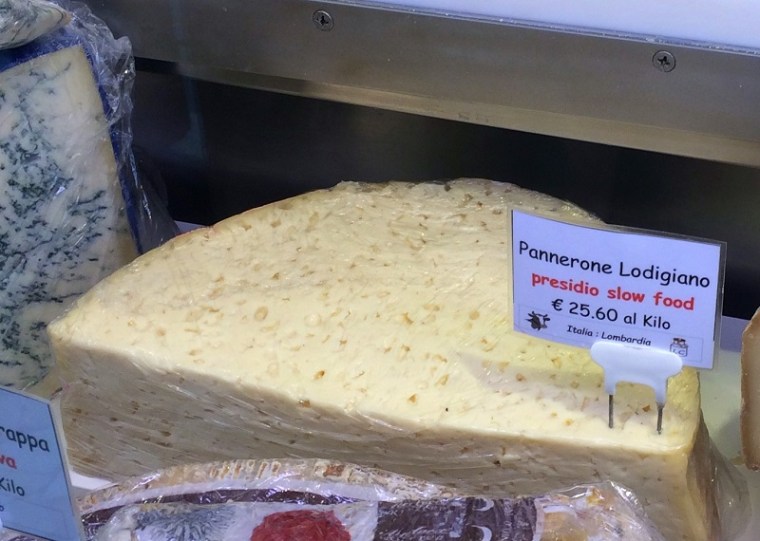
Just about 20 miles from Milan is a small town called Caselle Lurani and in that town is an easy to miss creamery that turns out this cheese, among others, that is actually on an endangered species list of sorts. Pannerone, a cheese made from afternoon cow’s milk (2% more milkfat, apparently, than the morning take) has a few things that make it unique, and give it an acquired taste which may be why it is not nearly as widespread as it once was. In fact, the creamery run by the Carena family is the only producer left. Pannerone’s (comes from panéra, which means cream) unique qualities come from an unusual production process; the whey is allowed to run off naturally, there is no pressing involved at all and that makes for a soft cheese. Then, it sits for four or five days at 28-32 degrees until all the whey has drained. No salt is added to the cheese, so the bacteria that are at work here are solely responsible for the flavor. The cheeses look impressive in the cheese counter, which is how I happened upon it: a cylinder is about 8 inches high and a foot in diameter. It has lots of little holes and a nice pale ivory color.
My next challenge was to get a piece, after I identified what I wanted. That went through the point-and-use-exaggerated-facial-expressions method, because even if Venice is inundated with visitors from abroad, a lot of merchants do not speak anything but Italian, and my Italian is non-existent. It was clear what the message directly aimed at me was to convey: ‘no, this is not what you want.’
‘But it most certainly is!’ said my English words and my facial expressions and my body language. The gentleman I spoke to decided to bring in the big guns, the owner of the shop, who reiterated: ‘bee-ter!’. I was certainly not going to like it. After this final attempt to dissuade me, I just had to have it, and the experience of finally sinking my teeth into it was rewarding: not that it would make it to the top of my list, but my buying the cheese over some local objection and then reading up on it made the tasting feel like the end of a journey.
A cheese of many holes
It is creamy and a bit sweetish at first, but it does develop an unusual, mildly bitter flavor in the mouth soon afterwards. It could do with some fruit, to counterbalance the bitter taste, and that is a popular combination in many recommendations. Pannerone has a D.O.P designation and the Slow Food organization recognize it’s uniqueness as well – they are in fact the people talking about it as if it is an endangered species worthy of preservation. Things look good though, at the Carena Creamery: the descendants of Angelo Carena who passed on to that great dairy in the sky two years ago seem to have fun doing what they are doing, judging by the images on their website, adn a determination to carry on the good work, all the way down to the youngest members of the family. Great-grandpa would be proud!

















 52 Cheeses