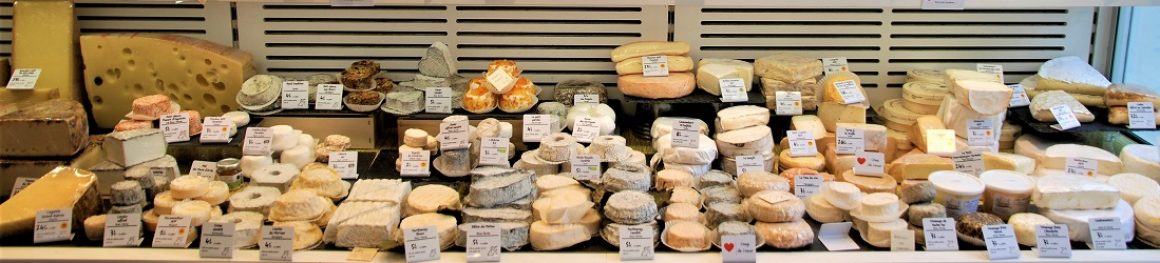
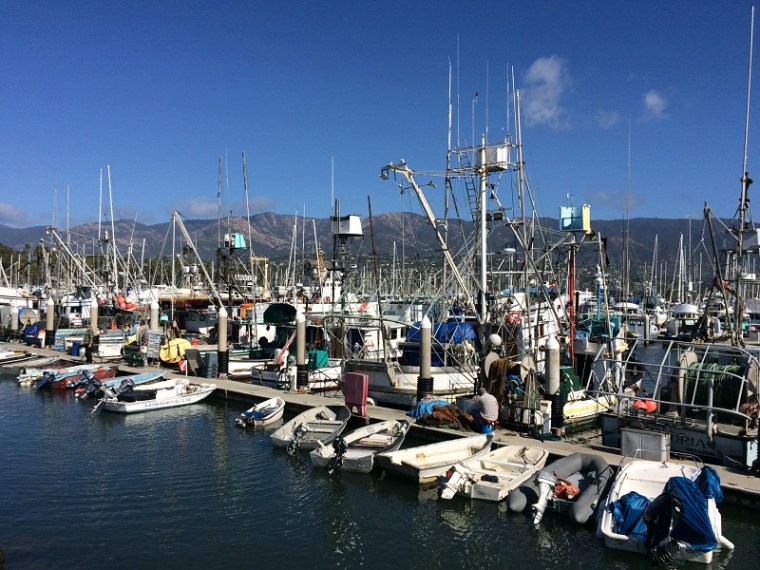
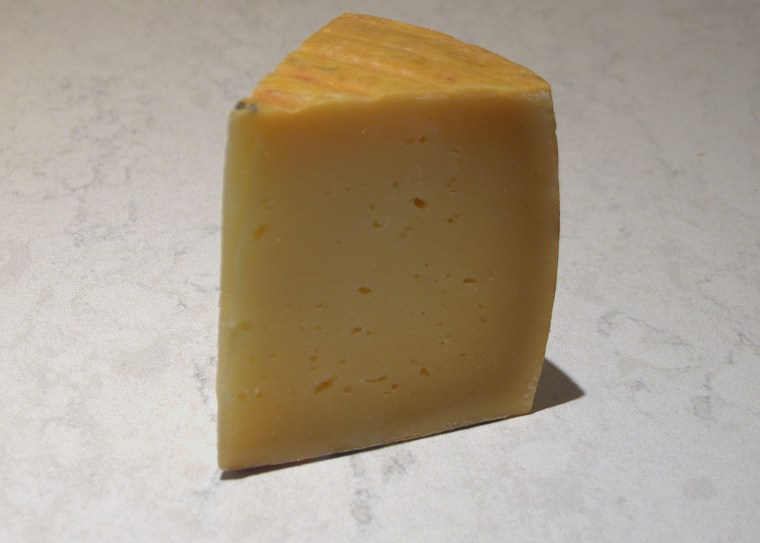
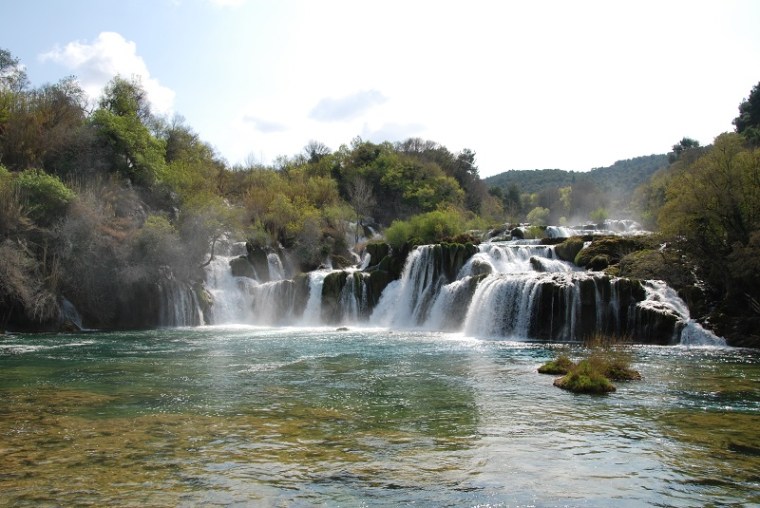
To us, Santa Barbara is always a treat. We have lots of fond memories (including a splendid little wedding and some heady college years) and we always come away as proud wannabes: one day, we say, we will be able to afford the overpriced real estate here, and the Californian Riviera will be our oyster. Until that day, we are happy to make the trek on a regular basis, and in the cheese year, we obviously had to visit C’est Cheese, the wonderful cheese store and café with an admittedly cheesy name (Eurosnob trivia: c’est, in French, is NOT pronounced ‘say’).
Breakfast at C’est Cheese
After a glorious breakfast, with great coffee, excellent breakfast potatoes, some of the best eggs Benedict I have ever enjoyed and friendly I-live-in-Santa-Barbara-so-I-really-have-no-reason-to-ever-be-crabby style service, a fine female cheese monger helped me pick not one, but two very nice, creamy cheeses, and we were off wandering the streets. It rained – not so strange in March – but that hardly mattered.
At the Santa Barbara farmer’s market
We were reminded of the days before our wedding when rainshowers severely cut into the supply of fresh flowers at the farmer’s market. So in a way, through that memory, the rain drove us to the farmer’s market, where we procured an on-demand poem, written by a young woman with a typewriter who offered her services for a modest fee, and a jar of out-of-this-world raw avocado honey, too good to eat in any other way but by the spoonful. We also got some tangerines and then walked on. We stopped in at the Lost Horizon Bookstore, an excellent used bookstore that really requires a lot more time than we had, drove back to our hotel for a short while and went for another walk in the Douglas Family Preserve which affords views over the pacific and the Arroyo Burro Beach, with the restaurant that used to be the Brown Pelican.
At the Douglas Family Preserve
For dinner, we enjoyed the seafood at the Hungry Cat twice in a row. Yes, sometimes it is as simple as that: when the food is that good, why bother going elsewhere? The first night, there was plenty on the menu to choose from and we decided on the encore before we had finished our meal. Of course we ventured out to the waterfront at the harbor and at Stearns Wharf also – it is part of the tradition in Santa Barbara. All in all, we didn’t do an awful lot, but drove home along the Pacific Coast Highway very content and refreshed: Santa Barbara is good for our souls, we find.
So here is a picture of Pag, an island just off the coast of Croatia. There are less than 10,000 people who call the island home, but there are some 40,000 sheep. They’re a little smaller than average, these Paška Ovca, and they are indigenous to the island. From the coastal Velebit Mountains of Dalmatia, the Bora wind barrels down, picks up a lot of salt from the air over the water and drops some of that salty moisture on the pasture where the sheep run around, mostly freely. The herbs and grasses on the island the sheep feast on are pre-salted, if you will, like the grass in coastal Normandy around Issigny, where the best butter in the world comes from. These roaming sheep produce about half a liter of milk a day, so half a quart of milk. That is little, even by sheep standards (half a gallon is sort of average, compared to three quarters of a gallon from a goat and 8 gallons from a cow). Add to that the fact that the sheep are still often milked by hand in the fields where they graze and you have one labor intensive dairy operation going. But at the end of that long laborious process, there is Paški Sir, the cheese from Pag, which wins medals all over the world and makes Croatians proud. Depending on who you believe, the farmers on Pag have been making cheese for hundreds of years (some writers believe since the days of the old Romans) and of course there is the popular suggestion that at one point it was used as currency, which seems a little farfetched. I am sure it may have been a barter unit in some sense, but it is hard to see that someone would buy a cow and say: “I’ll pay you 34 cheeses for that nice animal there”. One way or another, the cheese from Pag has very, very deep roots. Alberto Fortis, an Italian who traveled around Dalmatia in the 18th century wrote about the salt, the sage honey, the wool and the cheese from Pag in his Viaggio in Dalmazia, but by that time, it had already been around for a good long while. The Gligora family has been at it since 1916 and towards the end of the previous century father Ivan and son Šie have begun to take, as they say, the cheese to the next level. Among other things, they send their products all over the world provided you’re happy to pay the rather splendid shipping fees. You may find that is it more prudent to just wait until you travel to Croatia to get some. A competitor, Paška Sirana has an excellent video. Great images, and with English subtitles.
Vino, Kruh i Sir. The cheeses from left to right: Kozlar, Dinarski and Paski Sir
Paški Sir is a cheese that needs a bit of time to unfold in your mouth, don’t eat it hastily. At first, it is what you’d expect from a sheep cheese: it is hard, crumbly and drier than most cow’s milk cheeses. And then, as it melts in your mouth, your tastebuds tell you: “wait, wait, there is more”. I will leave it to experts to give the complex flavors names; I will simply say that there is a lot to savor in an innocent looking piece of Paški Sir, and only if you take your time, will you discover why it gets those accolades the Croatians like to tout. I am sure it tastes great in a variety of dishes, but it is expensive enough that you want to carefully cut it up and eat it with a glass of Croatian red rather than in the mac and cheese from the crockpot. It has a nice crunch – most if it hits the market after aging for about a year so there are the little white protein crystals that lend the cheese even more texture. Shave it on your salad like you would Parmigiano, or eat it with figs – if you can get them, from Dalmatia. Aside from the Paški Sir, I also had a taste of Gligora’s Dinarski Sir, a crumbly, salty cow’s milk cheese from the Dinaric Alps and their Kozlar, a semi-hard goat cheese, also quite salty but very creamy and if fact, I ended up liking it at least as much as the cheese of the week. But I waited until we had left Croatian territorial waters before admitting that aloud. I am sure the Croatians would seriously frown on my preference and I wanted to stay out of trouble.
Of course, if I would title this post Croatia, it would just be a bit too easy. Dalmatia is much cooler, because it is a little less used and has a faint echo of dog to it. Yes, those spotty white dogs do come from this part of the world, originally. The bit with the 101 of them originates in England: a playwright by the name of Dodie Smith wrote the book, Disney turned it into a movie 5 years later. But back to Dalmatia. This week, the cruise ship I was on stopped there twice, first in Zadar, then in Dubrovnik. Zadar is a city as old as dirt, at least 2,900 years or so. They have ample old stuff to prove it too: there is a roman forum, the church of St. Donatus that is a cool 1,100+ years old and massive fortifications because a lot of people over the centuries have had their eye on Zadar. Alas, I did not see any of it, because I traveled by bus to the nearby Krka National Park which is know for some pretty impressive waterfalls. They are near the town of Skradin and the locals call them Skradinski buk. There, now you know that ‘buk’ is Croatian for waterfalls and the number of situations in which this knowledge will come in handy are legion. Water here flows over a series of travertine terraces and some very easy walking trails take you by a handful of historical structures, meticulously restored, and over, und and past myriad waterfalls. Best really to look at the pictures, they do the place much more justice that words can. Back in Zadar, there was just enough time to have a listen of the Morske Orgulie, a water organ designed by Croatian genius Nikola Bašić. He put 35 big pipes under a terrace at the waterfront and as the water moves in and out of the tubes, it creates some very random low whistles. Time was tight, but I could easily imagine sitting there for quite a while just letting the seas sing to you. It was beautiful. Bašić also created the roundish array of solar panels, which collect the light of the sun and gives it back during the evening and night in constantly changing colors. Two intrepid fellow travelers did stay behind in Zadar and we so kind to get me some bread, a bottle of Dalmatian red wine and three pieces of cheese from the Gligora cheese shop. And that can only mean one thing (wait for it….): week 15’s cheese had to be Paški Sir, the sheep cheese from the island of Paks, just off the Dalmatian coast.
Easter In Dubrovnik
Further down along that very same coast is Dubrovnik, probably the most visited city in Croatia by a wide margin. This is not just because it is such a popular cruise stop: Dubrovnik, with its massive medieval walls, its bright, wide and clean streets and its friendly people is a three dimensional postcard in many ways. Like other living and breathing cities, it has flaws and imperfections, but there are moments, such as on Easter Sunday when there was a stage with costumed dancers and musicians in front of the 16th century Sponza Palace, where you could be forgiven for thinking that you are actually in a really well done version of the EPCOT center – Dubrovnik is almost too perfect.
St. Blaise atop his very own church
Across from the modest palace is the church of Sveti Vlaho, St. Blaise, the patron saint of the city, a very elegant baroque church and between them stands Orlando’s column, with a bigger-than-life-size statue of a medieval knight who, according to legend, defended the city against the Saracens. Of course he did no such thing, but that’s too long of a story for here. Orlando and France’s Roland are one and the same person and in the Middle Ages, Roland/ Orlando became sort of a generic brand name for heroes of all shapes and sizes. The column, along with the surrounding buildings and the bell tower at the end of Stradun, the main street in Dubrovnik is the heart of the city. Not far from here is Rozario, tucked away a little behind St. Nicholas’ church. It’s a small friendly restaurant that serves splendidly simple fresh food at prices that are more than reasonable. Must…eat…their…marinated anchovies…
Dubrovnik’s Rooftops from the City Walls
A few blocks further away in a street that runs parallel to Stradun is the place where you can get all the souvenirs you could ever want to bring home from Dalmatia, including ties with Glagolitic letters (yes, I have one of these and I will surely wear it one day. I will. I really will….). The shop is called Medusa and they’ll take all the money you want to spend on the local economy – they really do a good job in marketing Croatia. Not to miss is the Franciscan monastery from 1317, which houses one of the oldest pharmacies in the world that still functions as one – it goes back to that same year. Once you’re here, near the Pile Gate, the huge fountain is a curious landmark, and you are also close to a set of stairs that afford access to the massive walls, which you can walk all the way around town. They charge an entrance fee, and it is somewhat of a workout, but not doing it once you have made it this far is like – well – think about things where you are almost there and then, you retreat. You will leave Dubrovnik and always wonder how much more exciting your visit would have been with a walk along the walls.
Dubrovnik Port
The harbor area, finally, is the best hangout in town. There is water everywhere, some teenagers jump into the azure waters from the rocks below the walls and there is a coming and going of small vessels, among them the tender boats of the large cruise ships. It is also the place to practice the most important word of the local language: sladoled. Ask for it, and ye shall miraculously receive ice cream. And the Croatians make some mean ice cream, just like their sheep cheese – more about that in another post.
Ha! Johannes Gutenberg from Mainz was probably happy when he was able to finally leave Strasbourg behind after having spent some 14 years there between about 1434 and 1448. No one knows exactly how long he lived in the Alsatian city on the Rhine, but he was there: court documents show he was sued a number of times, most spectacularly by a woman who claimed he had promised to marry her, but then reneged on the promise. Back in Mainz, about 130 miles downstream, he continued work on his invention that would earn him worldwide fame: the printing press with movable type. So as time wore on the city of Strasbourg decided to honor the man who had left behind debts and at least one broken heart with a square and a statue, very close to the gorgeous red sandstone cathedral, one of the most beautiful Gothic Cathedrals in France – make that the world. Just off Place Gutenberg in the Rue des Tonneliers is la Cloche à Fromage. In fact, there is really two of them, one cheese shop, the other a cheese restaurant – same company, different experience. I decided to have my choucroute (sauerkraut with sausage and other assorted meats) at Aux Armes de Strasbourg right next to the statue of my pal Johannes, but I did pick up some cheese before I sat down there.
Choucroute, Sauerkraut with all kinds of meat, Alsatian style
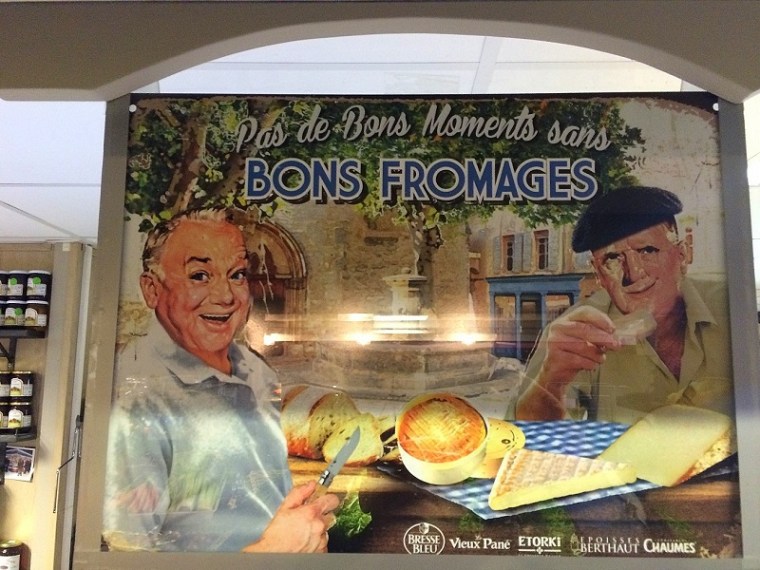
And that’s where the praise starts. La Cloche auf Fromage is not an enormous place: the cheese counter at a decent-sized Whole Foods may be just as big, but that’s where the comparison ends. Here are the five reasons why I just love a French cheese shop:
The French are fearless and know when to ignore food safety warnings: most of the cheese is made with raw milk. My wife in fact had an aunt who used to rail against EU regulations: “one day, they will take away our lait cru, and it’s all going to be over!” It hasn’t happened yet, aunt Collette, wherever you are…
The French value geography. Geography is terroir, and terroir is where the food meets the landscape. Terroir is the combination of soil, water, sun, wind, slope and so on that creates the particular environment which determines the qualities of the particular food. So neat little cards will not only tell you what kind of cheese you’re looking at, but also, where your cheese is from, and soon you can begin to build an image of the life and work of the people who produced the cheese. The better cheese shops in the US have adopted this level of care, but in France, this has always been par for the course.
The French are open when it comes to food. In a land so full of culinary traditions, there is still a lot of room for experimentation and so a cheese shop worth its salt will always carry some interesting new cheeses alongside the national and regional favorites.
The staff in these shops: they know what they are talking about; they respect the cheese and they know how to wrap it properly.
Finally: coming from the US, the prices will ensure that you walk out with a slightly bemused grin on your face: a cheese plate that would set you back the price of 20 lattes in the US can be put together for 15 euros here.
There are of course thousands of them all over the country, and it’d be far from me to even pretend that I could pass as an authority, but here are some of my favorite cheese mongers in France: there is Hisada in Paris, close to the Palais Royal. Of course it is jarring at first to walk into a cheese shop in Paris where the staff is Japanese, but once you see that they approach fromage with the same sensibility, flair and understanding of quality, it all makes perfect sense.
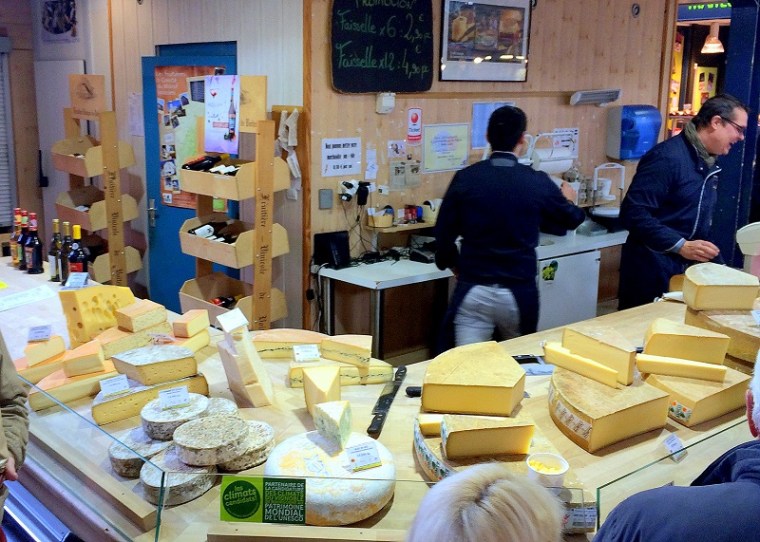
In Les Halles de Dijon
Benoit’s stand at Les Halles de Dijon specializes in the large cheeses from the Jura. They carry cheese from all over France though, and they have an very visible division of labor: the muscular guys are handling the Comtés, the Emmental and the Morbiers, while the daintier sellers wrap the Chèvres and other assorted small cheeses.
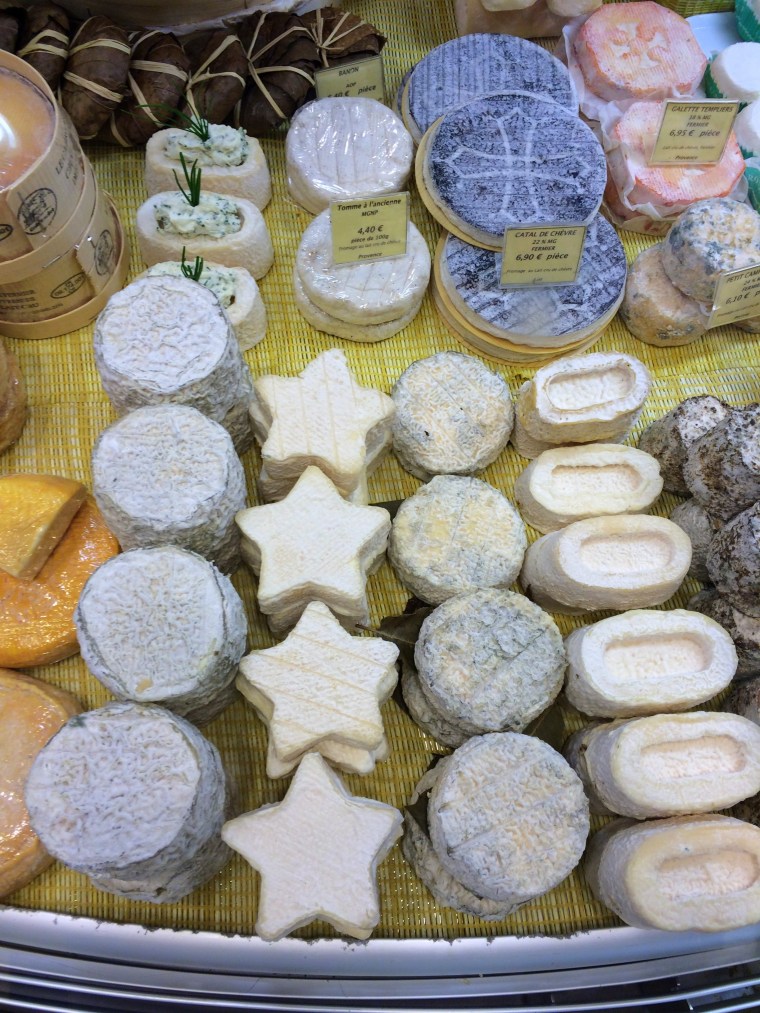
Maison du Fromage, Avignon
In Avignon, it’s the Maison du Fromage in Les Halles, and in Lyon the Halles de Lyon – Paul Bocuse are a food temple of sorts, where I would not dare to prefer one exquisite cheese monger over another.
In Les Halles de Bocuse, Lyon
Oh – and of course, if you are in Strasbourg, make sure to check out the magnificent cathedral. One cannot live of cheese alone.
Yes, you guessed it, that’s a Greek cheese I am taking about. I picked it up during a brief stop on a cruise, in the town of Thira on the idyllic Island of Santorini, which more or less lives off tourism and agriculture. I found my cheese in a small, non-descript store that sold local products, and this one looked quite interesting. Little did I know that the island has its very own cheese, Chloro. For various reasons, I had not been able to do any homework on Greek cheese. I did find out later that the particular cheese I picked up comes from an island that was only about 40 miles away from a tiny beach in Yeniköy, in Turkey, where I would dip into the Aegean Sea a few days later. But back for a moment to Santorini.
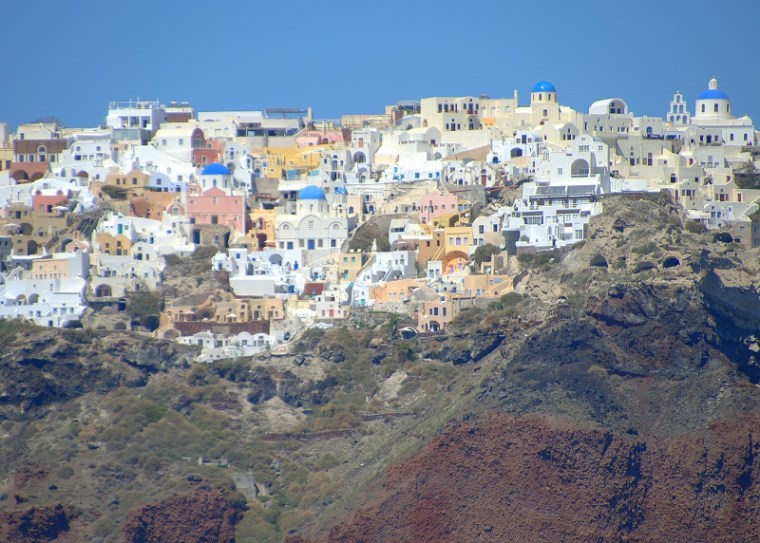
Santorini Island, Village of Oia
3,500 years ago, the people here were none too happy. That was because they got caught up in the Minoan eruption, a spectacular volcanic event that did extensive damage to the old Minoans and their civilization and created the Santorini we know today, a semicircle of sorts surrounding a lagoon with a small island in the middle. Volcanologists see a giant water-filled caldera, where the rest of us just see a string of pretty villages with white walls perched atop some very steep cliffs like icing on a gigantic cake. Thera, where I landed, is the least attractive of the little towns on the island so next time I am there I will have a double mission: see the tiny little towns with the blue-domed churches and get a piece of the Chloro cheese, even if the name does not sound inviting at all.
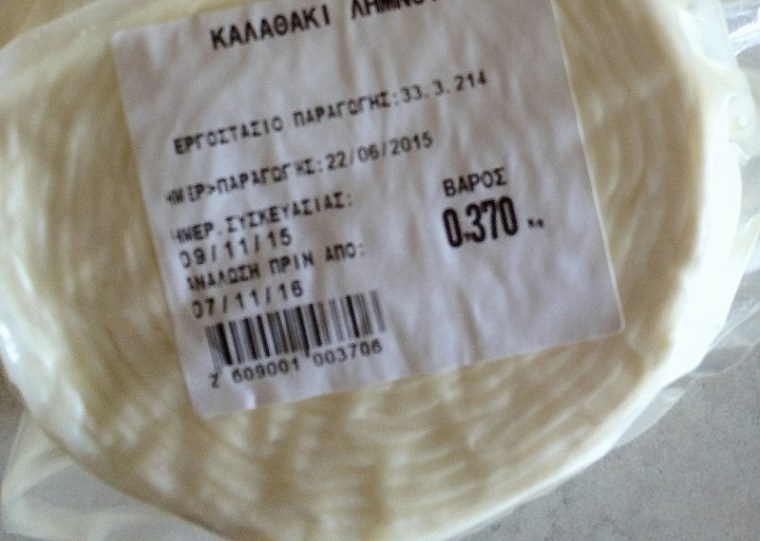
The cheese I did end up with was still interesting and, since I did not have high expectations, a very pleasant surprise. The Kalathaki was fresh and salty (it spends 3 weeks in a brine bath), with a bit of tang and since goat’s milk and sheep’s milk are mixed together to create it, you do get two flavors for the price of one, and they strike a nice balance, I found. I haven’t been a big fan of feta, perhaps because of the omnipresence of the factory produced stuff that is called upon every time olives and greens meet in a salad.
Imprint of the wicker basket that gives the cheese its name
This cheese matures for about 60 days in a small wicker basket and the imprint the basket leaves behind gives the cheese its name: Kalathaki means basket. It is one of more than 20 cheeses in Greece that has a Protected Designation of Origin (PDO, OR DOP, or AOP, depending on which EU language you are using). The sheep and the goats who deliver the milk for this cheese are largely allowed to roam around so what you get in the cheese is the flora and the climate of the island in a relatively straightforward way. Dedicated promotors of the cheese claim that is was around in Homer’s days – but the great poet didn’t really write about it, so it is not that easy to verify.
Santorini, Cathedral of Saint John the Baptist in ThiraSantorini, cruise ships docked in the caldera
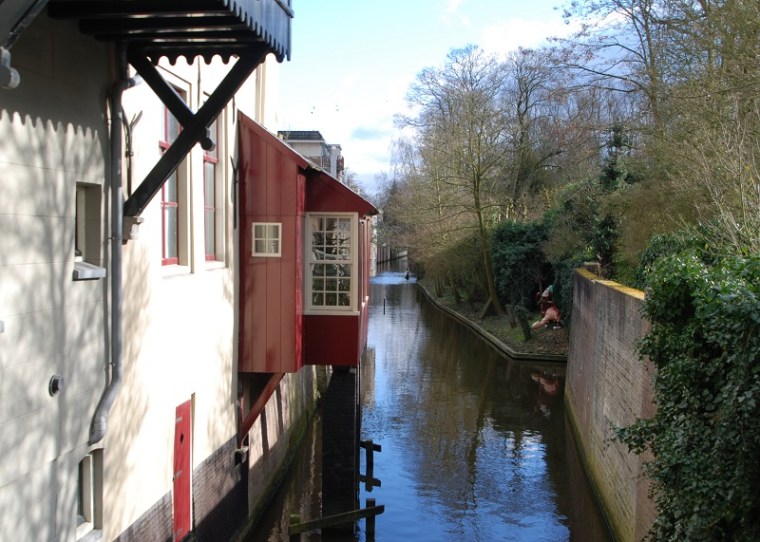
The Dieze River, running through and under the city of ‘s Hertogenbosch
The reason I was in the Netherlands for a quick visit in week 12 of this year was an exhibit in the city of ‘s Hertogenbosch. That’s a mouthful of Dutch, but all it really means is “Duke’s Forest”. In the late Middle Ages, the city was one of the largest in the Duchy of Brabant, along with Louvain, Brussels and Antwerp. The Belgian fight for independence, which officially ended with the treaty of Maastricht in 1843, cut the duchy in half, and north of the border, Noord-Brabant became a Dutch province and Den Bosch (for short) its rather quiet capital. Today, the city is overshadowed in the province by Eindhoven of Philips fame, but from its heyday date both a very large (for the Netherlands) Gothic cathedral as well as its other big claim to forever-after fame. Around the middle of the 15th century, a certain Joen or Jeroen van Aken was born here, and he was to become the most famous Dutch painter of his time as Jheronimus Bosch (usually spelled Hieronymus in English). As was the case with other painters of his time, many of his works eventually ended up far away from Den Bosch, because the Netherlands were variously owned and operated by Burgundy, France, Austria or Spain, and their kings, dukes and princes took away a lot of art, sometimes paying for it, too.
Giraffe from the Garden of Earthly Delights
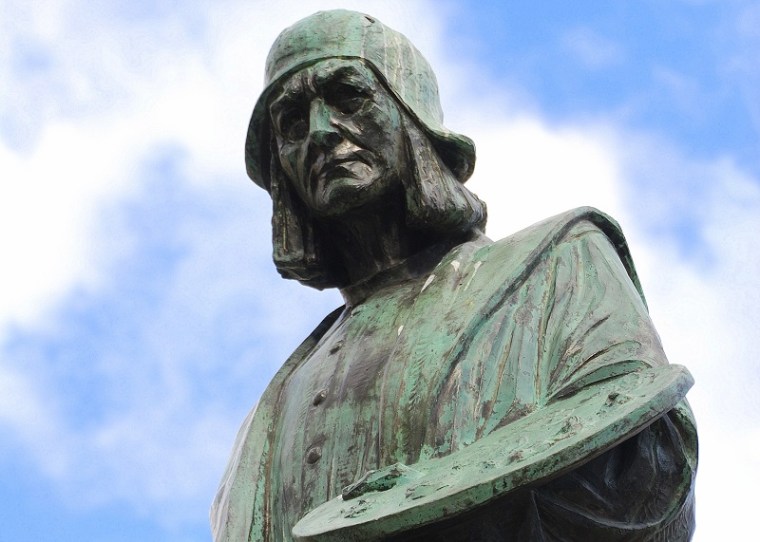
Sadly, the city couldn’t show a single painting of its famous son in its museum, and something had to be done for the celebration of the 500th anniversary of Bosch’ death in 1516. Enter a team of art experts assembled to conduct the most comprehensive study of Bosch work ever, with an intriguing proposal to any museum or gallery willing to participate in a trade: we provide research and restoration services for free, and in return, we get to have your Bosch paintings or drawings for our exhibit. The idea worked like a charm, and this spring, the spectacular exhibit brought close to half a million visitors to Den Bosch. In city parks, unsettling three-dimensional monstrous sculptures, lifted out of Bosch’ paintings created a strange cityscape, many local merchants got into the act and for a few months, den Bosch was all about its famous son, who is honored with a statue in the main market.
Jheronimus Bosch, statue on the main market square
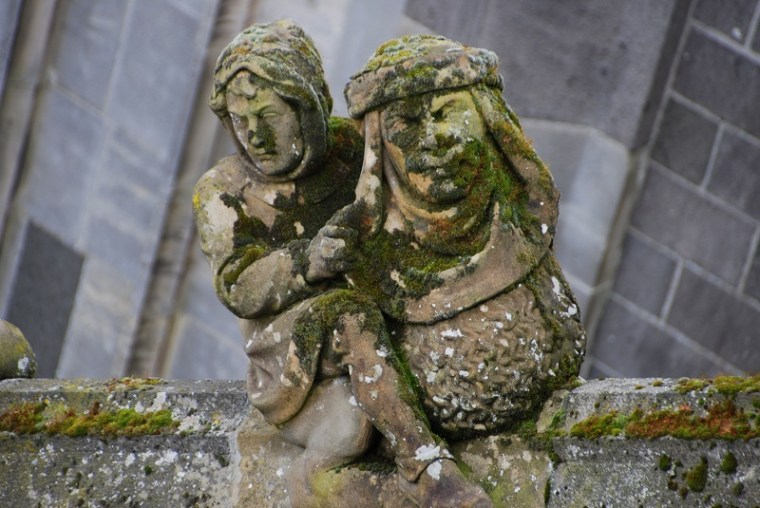
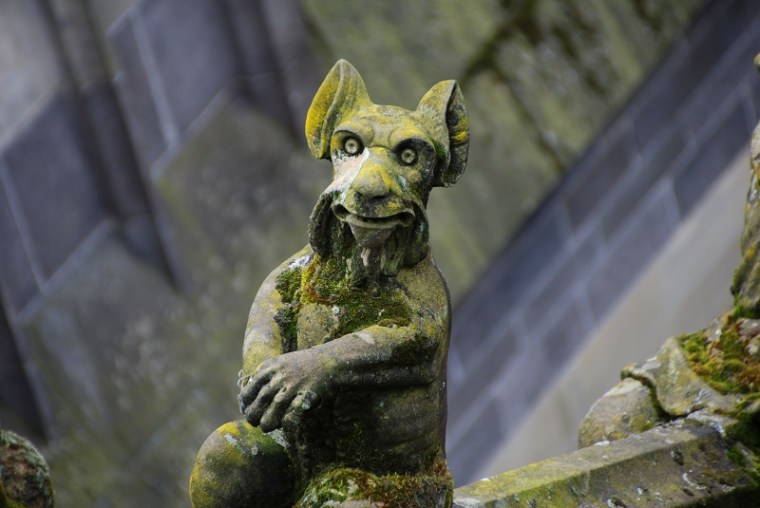
I stayed in the Duke hotel, a modern, friendly place that has top-floor rooms with views all over the city. Many little details, such as a fun collection of snacks, an XXL shower and the integration of bits and pieces of the old building in the decidedly modern aesthetic made my room a lot of fun to be in. Aside from the exhibit, visitor had a chance to climb to the roof of the cathedral, to see the sculptures on the flying buttresses that support the walls up close. 82 feet over the city is a wondrous world of medieval craftsmen, strange gargoyles and human-animal hybrids straight out of a Bosch painting.
Rider on a man-beast, sculpture on a flying buttress of the cathedral
The church’s interior is certainly worth a visit, but it pales in comparison to the thrilling roof exploration. All sculptures have been replaced in the late 19th century and some have been replicated more faithfully than others, but overall, the sense of being in a world Hieronymus Bosch would have felt right at home with added tremendously to my visit.
Monster, more than 80 feet over the city
In the meantime, the Bosch circus has moved on to Madrid. The royal Spanish thieves of yore ensured that the Prado today has the largest single museum’s collection of Bosch’ works, and it was easy to get other museums to pitch in: the Prado has plenty of bargaining power: “I’ll give you a fistful of Goya for your El Bosco triptych”. Den Bosch is recovering from the visitors (the museum was open around the clock in the last days of the exhibit) and things are returning to normal. If you happen to be in the neighborhood, the inside of the church is certainly worth a peek, the cafes are very inviting, Bosch statue is still there, and a little boat tour on the Dieze, the little stream that runs under and through the old city is a great way to get a perspective that is a little different.
Marc Mulders, the Last Judgement, stained-glass window in the cathedral
Boyle Heights is a working class neighborhood just east of downtown LA. Until the 1950s it was a diverse place called home by Jews, Latinos, immigrants from Eastern European and Portugal and people from Japanese descent. But a practice called redlining (in essence, financial institutions drawing a red line around an area on a map and deciding not to provide loans, insurance etc. to the people living within that red line) eventually forced all but the poorest people out and today Boyle Heights is almost completely Latino. If it is a working class neighborhood, it is also a neighborhood of people who know how to live: while it is quite shabby in some places, you don’t ever get the sense of desolation that you encounter in some of the urban wasteland in the poorer parts of LA. Boyle Heights is alive with people who go grocery shopping, take the family out for breakfast, sip a cup of coffee in a café, wave at a neighbor walking by. And that is the way the people like it here: the city is resisting attempts by developers to gentrify the neighborhood, and right now, it looks like they are winning: good for them, because Boyle Heights doesn’t need any ‘improvement’ beyond the normal maintenance people themselves can do.
Mole, mole, mole
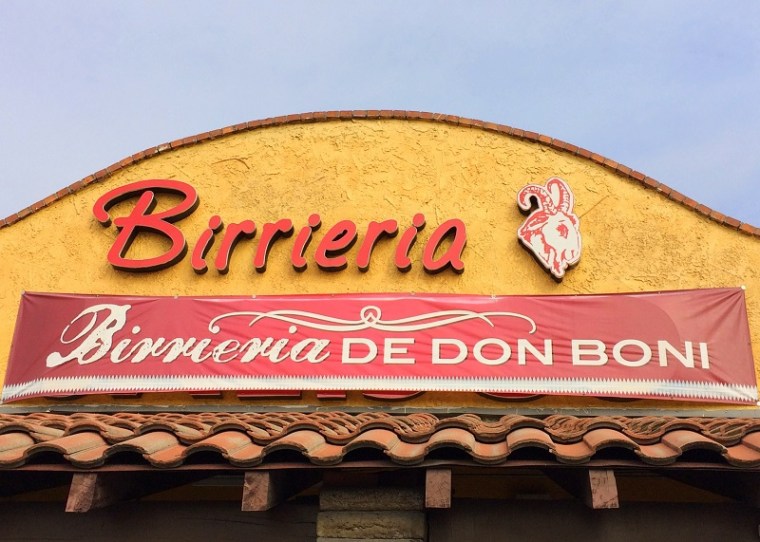
The three of us were there on a Melting Pot food tour, but some of the highlights of our visit had little to do with food. There was plenty of that too: a marketplace with a bewildering variety of foods, colors and flavors, a place where a gringo like myself would get completely lost without a little bit of help, which we had in the guise of our guide, Andrew. I tried spicy cucumber ice cream (interesting, but next time I am getting a different flavor), Christine got all kinds of mole and I found a place that sold cheese. We also visited a tortilla factory and we sampled the goat stew at Birrieria de Don Boni. Yup, I said goat stew. That’s why their call the restaurant a birrieria – a goatery, if you will. It is pretty much all they serve there, and many people bring their entire families here for a simple but tasty meal on the weekend. And that means everyone, not just mom, dad and a kid or two: a family order in this otherwise inexpensive restaurant sets you back $195 – they know you’re bringing the lot of them.
They got your goat
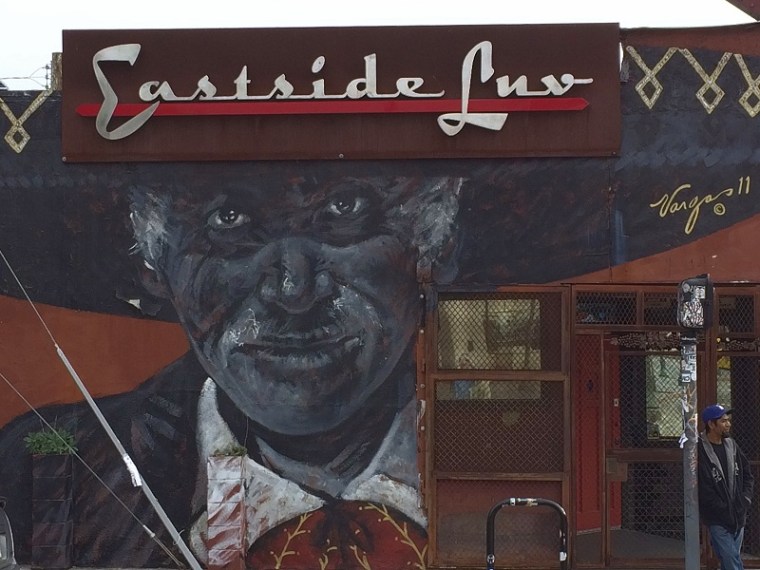
As for the non-food highlights: certainly the heart of Boyle Heights, Mariachi Plaza, would be one of those. The west side of the triangle is occupied by a beautiful Queen Anne building, the former Cummings Block and Hotel (named after the man who paid for it back in 1889), now the Boyle Hotel or the Hotel Mariachi. It is a residential hotel, and several dozens of musicians live here. And then, throughout the day, it is a coming and going in the plaza of colorfully dressed Mariachis, all looking for gigs. There is something very ‘artisanal’ about these men in their charro suits, getting ready to go to work like any other working man – except their work is the business of making music. On the Plaza there are two stores, one for charro suits and all manners of accessories, and the other for instruments. On the eastern edge of the square is a beautiful mural of a musician and there is even a music school in the neighborhood, the Mariachi Conservatory, where children learn how to play this music of frustration, heartbreak and longing, the Mexican Blues. Historically musicians have mostly been male, but the school also has girls, and I recently found an all-woman band called Mariachi Flor de Toloache on NPR.
Robert Vargas mural
Not far from Mariachi Plaza is Primera Taza, a coffee shop in a small, narrow building, and this is where I met the Blue Girl. She was in a painting by local artist Ray Vargas who also made a very large piece that sits in the back of a makeshift patio behind the café. We bought the Blue Girl home, where she represents a gritty urban LA in our decidedly suburban home. At the café, I also picked up a postcard from a local realtor. It showed a house that was maybe 15 feet wide at most but looked cheerful and well kept. It told the story of an entrepreneur who knew her area and her potential customers, who was there to provide a service (and make a living in the process) rather than transform the neighborhood. I took the postcard with me, as a reminder that a place like Boyle Heights can do quite well for itself and thrive without masterplans, mixed-use projects and development corridors, thank you very much. I plan to come back occasionally to see how the neighborhood changes – hoping that I will be pleasantly disappointed when it comes to any large-scale gentrification developments.
Ray Vargas’ Blue Girl at Primera Taza
Shameless Plug #1: This was the third time we did something like this with the Melting Pot; if you are out here (or if you live here, of course) and you are looking for something fun to do, try one of their tours. Christine, Charlie and I thoroughly enjoy them.
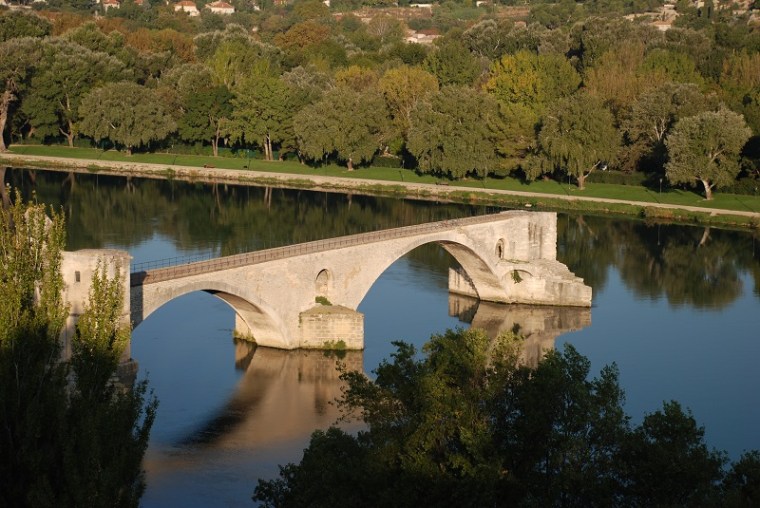
In Avignon, no one really dances on the bridge, and as a matter of fact, no one ever did, in all probability.
Sur le pont d’Avignon
on y danse, on y danse
sur le Pont d’Avignon
on y danse tour en rond.
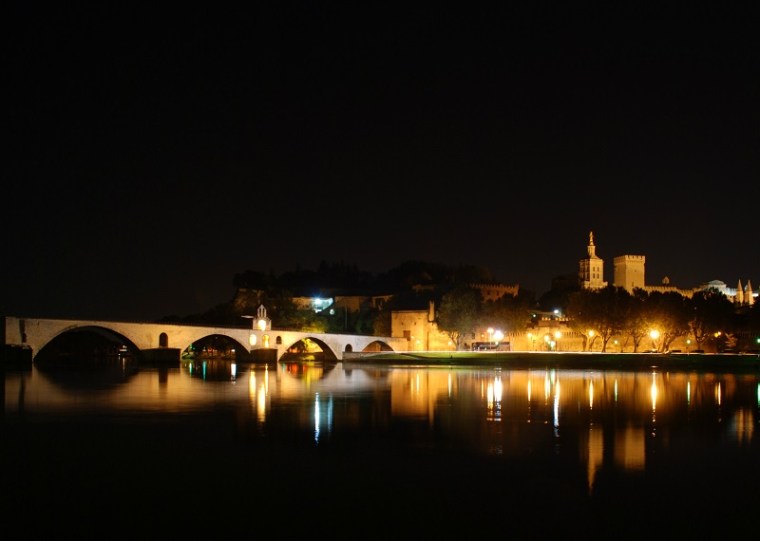
A French ditty that is simple enough for foreign students of la plus belle langue to learn, and therefore has made it in the heads of thousands, nay hundreds of thousands of middle schoolers all over Europe. Of course there are all kinds of things wrong with this song. First off, the original more accurately places the dancers under the bridge: sous le pont. The bridge itself is rather narrow, and traffic would have been seriously impeded by bunches of people who had nothing better to do than to disrupt commerce with their frivolous pastime. Today, it’s a moot point because the Pont Saint-Bénézet has only four arches of its original 22 left. Forty years after it was first completed in 1185 Louis VIII destroyed it, and when it was rebuilt, the Rhône River so often took out a few arches during high water that the people of Avignon grew tired of having to rebuild it. Today it is probably the most famous bridge to nowhere in all of Europe.
All of this is not to say that a visit to Avignon is disappointing, au contraire. But much of the city’s charm is found beyond those sites to which it owes its fame. Under the relentless Provencal sun, Avignon gets very hot, but the winding streets are narrow enough to find a little shade in them – you simply have to cross the street here and there. And as soon as the sun is up, there is nothing to stop you from getting a head start. The city’s biggest attraction by far is the palace of the Avignon popes, but before it opens, you can walk around it, always keeping it on your left, until you reach the Rue des Escaliers Sainte-Anne, the steps of St. Anne, which lead to the top of the Rocher des Doms, the promontory where the very first inhabitants of the area sought to defend themselves from intruders into their land. From here you have gorgeous views over Villeneuve-lès-Avignon and the Tour Philippe-le-Bel across the Rhône. That tower is how far the bridge once reached. The short stump that is left can also be admired from this viewpoint.
Pont Saint-Benezet from the Rocher des Doms
From here it is all downhill to the Cathedral Notre Dame des Doms d’Avignon and beyond it the 14th century Popes’ Palace. It’s a bit of misnomer, because despite some beautifully decorated rooms, it may be more appropriate to call it the Popes’ Fortress; there is nothing particularly inviting about its façade and the looming hulk of the building casts massive shadows on the surrounding area.
Palais des Papes; the belltower on the left belongs to Notre Dames des Doms
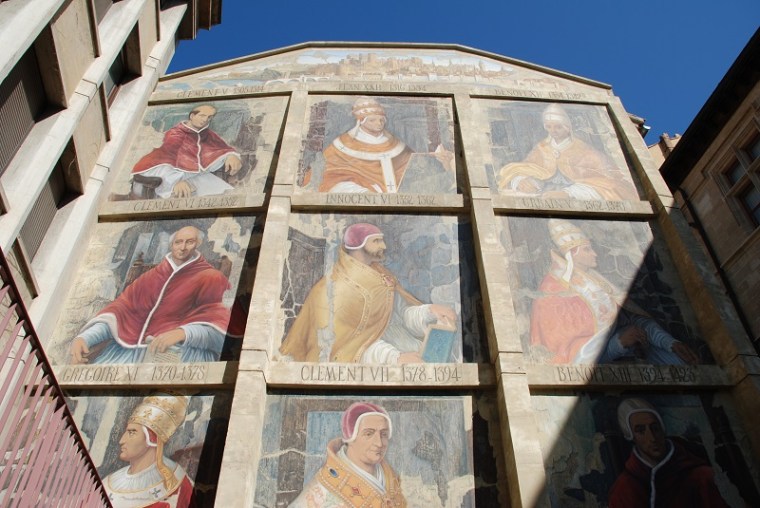
Having the popes live in Avignon from 1309 to 1375 initially completely overwhelmed the town’s infrastructure: cardinals brought hundreds of people in their entourage and an extraordinary building boom ensued. Pope Benedict XII built what is now known as the Old Palace. He must have been a humorless, dour fellow, because this part of the complex looks solid, boring and unfriendly, both inside and out. Benedict pinched pennies, only to have his successor splurge on the New Palace. Clement VI was responsible for anything colorful, intricate or luxurious that is left in the building today.
All nine Avignon Popes. In the middle on the left is Clement VI, the big spender
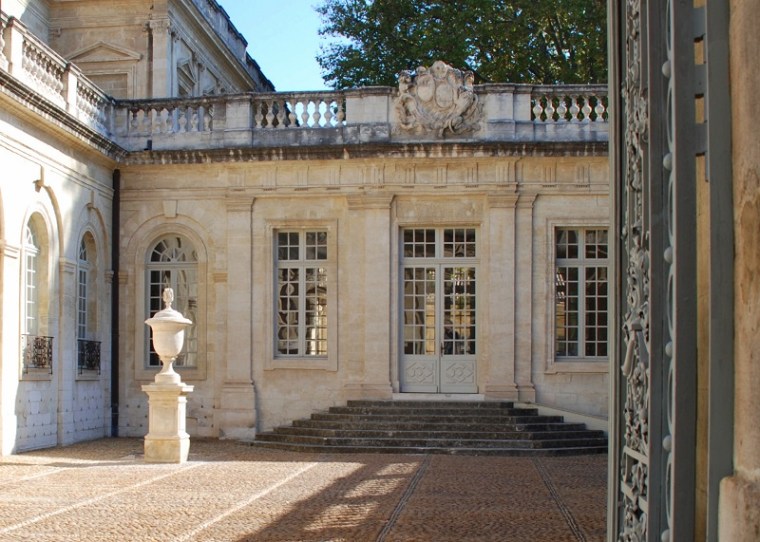
The best way to visit is with the self-guiding devices – pick a time early or late in the day, when tour groups have largely left or haven’t quite gotten there yet. From the palace it is not far to the Place d’ Horloge with its carrousel and its many cafés. A bit tucked away in the southwestern corner of the square is a short alley that leads to the Palais du Roure, a building with an inner courtyard that displays a collection of bells and houses a small museum of sorts about Provençal culture. There are a handful of these small museums where visitors can enjoy history, natural history and art in bit size chunks: the Musée Lapidaire in a former Jesuit church has ancient sculptures, among them one depicting the fearsome Tarasque, the local water monster. The Musée Calvet houses an eclectic art collection with some works by Manet, Corot and Sisley.
Courtyard of the Musee Calvet
The Musée Anglodon has a van Gogh, and works by Cézanne, Modigliani, Picasso and others in a beautifully furnished 18th century house; of course, there is also the Musée du Petit Palais, next to the Palace of the Popes, which showcases Italian and Provençal art from the 13th to the 16th century, among other things.
Two other places of note: the Place Crillion, a little away from the center just inside the city walls, with the beautiful 18th century building of the Comédie, now a very chic store, has some quiet and I daresay romantic outdoor terraces. The place is beautifully lit at night. And of course there are the Halles, the covered market with the spectacular vertical garden by Patrick Blanc (the André le Nôtre of our days) on its façade.
Les Halles, the covered market with Andre Blanc’s vertical garden
In there is the splendid Maison du Fromage, the cheese temple where I got my Banon and the other cheeses for week 5. You see, even if you forget about the whole bit about dancing on the bridge, Avignon has an awful lot to offer.